
Pacing . . . Prompt #447

  • Pacing . . . Prompt #447

    When you read the next ditty, read “d-o-e-s” as in female deer.

    Mairzy Doats

    Mares eat oats and does eat oats

    and little lambs eat ivy

    a kid will eat ivy, too

    wouldn’t you?

    Say it fast and it becomes:

    Mairzy doats and dozy doats and liddle lamzy divey
    A kiddley divey too, wouldn’t you?


    Link to what this sounds like.

    I think of this rhyme when I think of pacing – paying attention to the cadence and rhythm of writing.

    How and when to increase the pace when writing.

    Paraphrased from Make A Scene by Jordan Rosenfeld:

    By pacing your scenes well and choosing the proper length for each scene, you can control the kinds of emotional effects your scenes have, leaving the reader with the feeling of having taken a satisfying journey.

    Pace should match the emotional content of your scene. First scenes should get going with an emotional bang—start big or dramatic, ratchet up the suspense or lay in the fear, since you’re capturing the reader here.

    Your first scene is like a cold pool—the reader needs to dive in and get moving fast, or he’ll be too cold to stay in the water for very long. In other scene types, you’ll have more leeway with pacing. In the first scene, however, a quick pace—with more action and less reflection or exposition—will be a better sell.

    Dramatic scenes – Start slow, speed up pace to match emotional intensity, slow down for reflection.

    Speed up pace: Strip away exposition, use dialogue, quick action, and hot emotional content to build intensity.

    When and how to slow the pace

    After a lot of action or intense dialogue give the reader time to digest what happened.

    Use description, narration, details and interior monologues to slow the pace.

    When a character is contemplative, time slows down.

    During these contemplative scenes you can weave in details. Be specific and descriptive. Give your character something to observe or something to do, more than hair twirling.

    Your turn:  Do a freewrite about pacing.

    Here’s mine, thinking about Mairzy Doats. This was a quickly written spontaneous type of writing, just for fun.

    Go too fast and we get frantic and hear garble versus calm, steady breaths and an even, gentle flow.

    Calm is water caressing rocks, dark green moss going with the flow.

    No rough and tumble white water rapids. No gurgling over brooks, no water cascading over boulders.

    Rather, when we slow our writing, we achieve a calm, quiet, graceful feeling.

    Pace yourself. Eat watermelon slowly. Savor the juices.

    Pace yourself.

    Write fast let you lose that thought.

    To slow down, think about the poppy scene in Wizard of Oz. Slower, slower, snail’s pace slow.

    Meditate. Ommmmmmm.

    To pick up the pace, think caffeine and the energy of a toddler/child, always on the go. Child knows no pacing. Always running, talking, doing.

    Challenge self:  No such thing as Writer’s Block. Just keep writing.

    More on pacing:  Find the right pace by Adair Lara: Prompt #70
  • How many povs can be in one scene?

    The question often pops up: How many points of view can be in one scene?

    The easy answer: One point of view per paragraph.

    The expanded answer: “If you have more than one character within a scene whose points of view are relevant, then you’ll need to use the omniscient pov.” Jordan E. Rosenfeld, Make A Scene.

    The omniscient narrator is all-knowing, able to move in and out of the thoughts of all the characters and to comment on events before and after the scene has happened.

    Jordan, an authority on writing,  expands upon the idea of changing pov within a scene: “. . . you must make omniscient clear right away from the first paragraph in the scene. If the readers believes that he has only been able to see inside character A’s head, and then you suddenly leap into character B’s head, the reader will feel confused and possibly irritated.”

    For a reminder about what a scene is, Jordan says, “A scene should largely take place in one location.”

    When you use omniscient pov and hop from one character’s head into another character’s head, you are able to describe the scene (action, thoughts, feelings) from different characters points of view. This can be tricky. Just make sure the reader knows which character is observing the scene.

    First: Just Write. Then, during the revising/editing stage, check that points of view are clear and consistent.

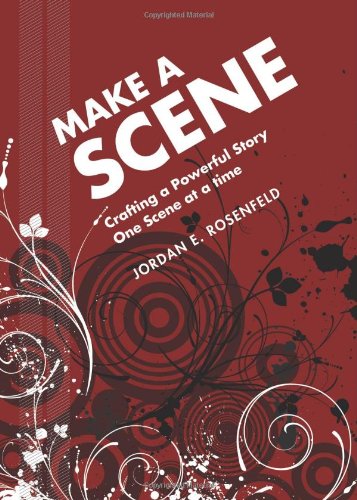
    Make A Scene.RosenfeldFor more details about scene, points of view and examples, check out Make a Scene: Crafting a Powerful Story One Scene at a Time, by Jordan E. Rosenfeld.

  • Find the truth of the scene — Actor Will Forte

    In an interview with The Costco Connection, Will Forte – an eight-year vet of Saturday Night Live – talks about his experience working with Bruce Dern in the movie “Nebraska.”  When asked what he learned from Bruce Dern, Will answered, “Bruce would always give me this advice: ‘Be in the moment. Just find the truth of the scene.’ I’m not a trained actor, so that just seemed like drama school hogwash, but the further we got into the  movie, it really made a lot of sense to me, and then I started thinking, maybe that’s what I’m supposed to do in comedy too. The truths might be very different, the levels of reality might be different, but you have to commit 100 percent either way.”

    Note from Marlene: I think this is true with writing also.  When “the truth of the scene” is conveyed, writing is strong and readers feel a visceral reaction.

    Excellent resource book for writing good scenes:  Make A Scene by Jordan Rosenfeld.

    Make A Scene.Rosenfeld


  • Write the Scene. Prompt #51

    Prompt #48 was about how to “Grow Your Character.”  Prompt #49 was about setting the mood. Prompt #50 was “The Problem.”

    Let’s put them all together and write the scene.  If you have freewrites on character, mood and a problem. . . use these elements to write a scene. Or, write a scene, using all new material.

    If writing memoir, write what actually happened, as best as remembered. Be sure to include details. Be specific. Not “car,” rather “1966 blue Dodge van.”

    “Scenes are capsules in which compelling characters undertake significant actions in a vivid and memorable way that allows the events to feel as though they are happening in real time. When strung together, individual scenes add up to build plots and storylines.  — Make A Scene, Crafting a powerful Story One Scene at a Time,  by Jordan E. Rosenfeld

    In Make A Scene, Jordan includes a recipe for basic ingredients for compelling scenes. If you are looking for an excellent book on how to write, this is it! Click here for my review of Make A Scene.

    Make A Scene.Rosenfeld

  • Guest Blogger Jordan E. Rosenfeld – How to Stay on the Writing Path

    “The seeker embarks on a journey to find what he wants and discovers, along the way, what he needs.”  —Wally Lamb, The Hour I First Believed

    “Not all who wander are lost.” J.R.R. Tolkien, The Fellowship of the Ring

    How to Stay on the Writing Path by Jordan E. Rosenfeld

    I believe that most writers are also seekers. While we may have a larger-reaching goal to find an audience and be published, ultimately, the writers who stick out the hard times do so because there is gold to be found along the journey. Sometimes it’s the kind of gold that requires mining and panning and sweat and agony. Other times it comes silently, a gift in the night from a willing muse. But one thing is for sure: writing gives as much as it takes—and it takes a lot.

    So how do you stay on the path of writing without falling off? How do you overcome the critical voices (internal and external) without giving up? Every writer soothes themselves differently, but sometimes soothing is in short supply, and it’s then you have to turn to other resources beyond yourself to find that boosting. And if you’re letting despair or discouragement drag you down, remember you don’t have to. You’re not alone! There are as many allies on the path as there are villains. It’s my goal to be one of your allies.

    For this month, remind yourself that a writer’s life is a worthy endeavor, a high calling, an important purpose. For this month I ask you to put in place one new support for yourself, be it a quote of kind words over your desk, or a buddy who will hold you accountable.

    Starting in the New Year I will be blogging the topics of my book in the works: A Writer’s Guide to Surrender. I chose the word surrender not to imply giving up, but instead, a settling in to what matters most. It’s also a concept I find immensely helpful when things are not going as we hope; when rejections roll in, when the writing isn’t flowing, when criticism stings. Surrender is, at root, a state of accepting your vulnerability and not letting anything harden you.

    Let’s stay flexible and gentle with ourselves. But don’t get off the path. It’s your right to walk it!

    Jordan E.  Rosenfeld is author of the novel Forged in Grace, the writing guides Make a Scene: Crafting a Powerful Story One Scene at a Time, Write Free: Attracting the Creative Life (with Rebecca Lawton) and the forthcoming: A Writer’s Guide to Surrender: A Tool-kit to Build and Bolster a Lasting Writing Practice. Jordan’s essays and articles have appeared in such publications as AlterNet.org, Marin Magazine, Publisher’s Weekly,  San Francisco Chronicle, The St. Petersburg Times, Whole Life Times, The Writer and Writer’s Digest magazine. Her book commentaries have appeared on The California Report, a news-magazine produced by NPR-affiliate KQED radio.
    Learn more about Jordan and her writing wisdom at: www.jordanrosenfeld.net