An Exercise in Barbecuing

  • An Exercise in Barbecuing

    Memorable writing that sparks imagination. Lean in. Hear the writer’s voice on the page.

    This Sparks page on my website, The Write Spot, is, hopefully, a place for entertaining, fun, and enlightening reading.

    “An Exercise in Barbecuing” by DS Briggs is one of the funnier stories in Discoveries.

    The Write Spot to Jumpstart Your Writing Discoveries is for sale for a limited time for $6.99

    An Exercise in Barbecuing

    DS Briggs

    Very recently I leapt into the world of backyard barbecuing. For years I have secretly wanted to learn to barbecue. In my family it was always my Dad’s domain. However, I love grilled foods and got tired of waiting for Mr. WeberRight to BBQ for me. I proudly acquired a very big, shiny new Weber BBQ. It came with a grown-up sized grill width of twenty-two and a half inches. I dubbed my new friend “Big Boy.”

    Unfortunately, for me, Big Boy came in a big box with far too many pieces. It was with a definite leap of faith to undertake putting Big Boy together. He did not have written directions, nor a you-tube video and I have no degree in advanced “IKEA.”

    Instead, Big Boy came with an inscrutable line drawing and lots of lines leading to alphabet letters. Still, I have my own Phillips’s head screwdriver. I used to call it the star-thingie until an old boyfriend corrected me. But I digress. Suffice to say, after trials and even more errors, I constructed Big Boy.

    Okay, so it took me three hours instead of twenty minutes, but Big Boy was upright and proud. I just wanted to admire my handiwork by this time and Big Boy was clean, so very clean. In fact, he was too clean to use. I postponed the baptismal fire and nuked my dinner that night. In a couple of days, after repeated trips to the store for important and essential tools of the trade: A cover to keep Big Boy dry and clean, real mesquite wood to feed him, and long-handled tongs. For my own protection I bought massive mittens. I was almost ready to launch Big Boy. 

    A few forays into the garage for additional must haves—my landlord’s trusty but rusty charcoal chimney fire starter can with a grate on the bottom and handle on the side and a dusty, spidery partial bag of charcoal in case my mesquite wood failed to turn into coals. I was finally ready to light up the barbecue. I chose to inaugurate Big Boy on a humid, somewhat breezy day. No gale force winds were predicted. As a precaution, I hosed down the backyard weeds. I found matches from the previous century and a full Sunday paper for starter fuel. The directions to stuff the bottom of the charcoal chimney can with crumpled newspaper and then load up the top part with either charcoal or wood sounded easy enough.

    I chose to use the mesquite wood based on advice from Barbecue Bob, a friend of mine. I lit the chimney and soon had enough white smoke to elect the Pope. I waited the prerequisite twenty minutes for coals to appear. Nada. Nope. No coals in sight. The wood had not caught fire, although the paper left a nice white ash. Hungry, but not deterred, I re-stuffed the bottom of the charcoal chimney with more newspaper and set the whole chimney on top of a mini-Mount St. Helens pile of newspaper. I found smaller bits of wood since the lumber did not ignite. I lit the new batch of newspapers again. After a second dose of copious white smoke, miracle of miracles, the splinters of wood caught fire. Finally, it produced enough smoke for the oleanders to start talking.

    “You do know it is a red flag day.” I know bushes don’t really talk, so I assumed the warning came from the owner of the fish-belly-white legs and flip-flops standing behind the tall, overgrown oleanders.

    Having no clue what Flip-Flops meant, I explained that I was trying to learn how to BBQ. I asked what she meant by red flag day and she said that it was extreme fire danger in the hills. Aside from the fact that there was not a hill in sight, I told her that I had the hose at ready. I also asked Flip if BBQing was banned on red flag days. She didn’t know, however, I think I heard the word fire bug. Perhaps she just wanted to let me know that she knew who was playing with matches on a red flag day in case the fire department asked.

    Reassuring Neighbor Fire Watch, I carefully emptied the chimney’s coals onto Big Boy’s smaller, lower but still sparkling clean grill. Using my mitts, I gently crowned Big Boy with the very clean, shiny huge upper grill. The sacrificial chicken had, at last, a final resting place. Whoosh! The previously white Pope smoke was now black and voluminous. Turns out olive oil makes lots of good smoke and less-than-helpful flare ups of flame. With my hands still ensconced in bright red mittens and using a very long tong, I turned the chicken. Only slightly blackened. I kept turning the chicken every five or ten minutes. More black, but not at the briquet stage—yet. I figured I had better recheck my BBQ Bible, the thick one with pictures so you can compare your results with theirs. Their advice was to cook the chicken until it had an internal temperature of 189 degrees Fahrenheit. I hoped Fire Watch was not watching because I dangerously left my BBQ unattended to go rummage through my kitchen drawers in search of an instant read thermometer. I knew that I would need it someday when I bought it a decade earlier. I inserted it and watched it slowly rise to 145 degrees. Only 44 more degrees to go but I was starving and the coals were cooling! I knew this because according to said Bible you hold your hand above the coals and count three Mississippi’s for good heat.

    By the time I had counted “One Mississippi, two Mississippi, three Mississippi . . . fifteen Mississippi,” even I could tell the coals were dead. I pulled the chicken off the grill. The skin was definitely done. Delicious? No. Blackened? Yes. Delectable? No. Vaguely resemble the BBQ Bible’s picture? Not at all.

    So for the lesson summary: Two hours of perseverance resulting in one hardly edible, even when finished-in-the oven chicken. Adding insult to injury I had a very dirty, sticky, greasy, too-large-for-my-sink grill to scrub.

    Lesson learned: find a home for Big Boy and call take-out.

    DS Briggs resides in Northern California with Moose, her very large, loving, and loud hound/lab mix. She has been privileged to contribute to Marlene Cullen’s Write Spot books: Discoveries, Possibilities, and Writing as a Path to Healing.

    Share your barbecue story on my Writers Forum Facebook Page.

  • California Winter

    California Winter

    By Patricia Morris

    (with thanks to Ted Kooser)

    The wind turns the pages of rain

    As drops splatter on the skylights,

        beating a rhythm punctuated by

        the cracks of unmoored oak limbs

         hitting the roof.


     The rain chain dances,

        brass acorns jingling,

        water swooshing through its cups.


     The creek rushes over rocks,

          gushes into the culvert and out again,

          making its overground / underground way to the river.


    The thirsty earth soaks it in,

       filters it down into empty aquifers.

    One chapter ending, another beginning.


    Freewrite inspired by the poem, A Rainy Morning, by Ted Kooser


    Patricia Morris misses the summer thunderstorms of her rural Midwestern upbringing, but enjoys observing and writing about the California rains from her home in Petaluma.

    After careers as diverse as trial lawyer and organization and leadership development consultant and coach, she is exploring life beyond the workaday world.

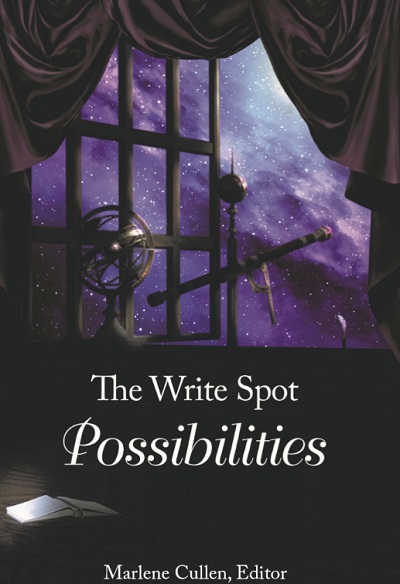
    Every Monday night she writes with friends at Marlene Cullen’s and Susan Bono’s Jumpstart Writing Workshops. Her writing has appeared in Rand McNally’s Vacation America, the Ultimate Road Atlas and The Write Spot:  Possibilities edited by Marlene Cullen. Available on Amazon, print $15 and ereader $2.99.

  • Choices

    Guest Blogger Nancy Julien Kopp wrote about choosing a path and exploring your choice. It seems like a perfect writing prompt for the start of a new year.

    Nancy wrote on her blog:

    Life is full of choices. I think often of Robert Frost’s poem that tells us of two roads diverging in a yellow wood, and the poet said he took the one less traveled by. But don’t we always wonder if this choice would be better than that choice or another one?  

    For a writing exercise today, look at the four photos. Each of them is somewhere you can walk. Two have water while the others are filled with green trees. What is your choice? Where would you prefer to walk? A, B, C or D? 

    Choose one and write a paragraph or several paragraphs about the photo you liked best. Study the photo and ask yourself a few questions. What sounds are there? What is the weather like; air temp? Are you going to meet someone? Does a person appear coming toward you? Does the weather make a distinct change? Can you smell anything? Are you happy on this walk? Or are you despondent? Do you have a destination in mind? Or are you walking aimlessly? Are you hungry? Thirsty? Barefoot or wearing shoes? 

    Think about all those questions before you begin to write. Hopefully, you’ll end up with the beginning of a story, or even a piece of flash fiction. Or a bit of memoir. There is no limit to where you can go with this exercise. 

    If you enjoyed one, try another with the same questions and see what happens. Remember that writing exercises allow you to flex your writing muscles in any way you like. Let your creativity flow.

    Original post on Writer Granny’s World by Nancy Julien Kopp.

    Nancy Julien Kopp lives in Manhattan, KS where she writes creative non-fiction, fiction for children, personal essays, articles on the craft of writing, and poetry. She has been published in 22 Chicken Soup for the Soul books, newspapers, magazines, and ezines, and several anthologies including The Write Spot: Possibilities and The Write Spot: Writing as a Path to Healing (available in both print and as an ebook at Amazon).

    Nancy was the Kansas Authors Club Prose Writer of the Year in 2013.

  • Fiction. Nonfiction. Creative nonfiction.

    What are you writing these days? Some people find it difficult to concentrate. Others are filling pages with poetry, fiction, nonfiction, and creative nonfiction.

    It might be a perfect time to chronicle what is going on in your life . . . if you write this as a journalist would . . . just the facts, that’s nonfiction.

    If you add vignettes and personalize your story, that’s creative nonfiction.

    Here’s what guest blogger Nancy Julien Kopp says about fiction, creative nonfiction, and fictional narrative.

    Most people are aware of the difference between fiction and nonfiction. Fiction is made up, nonfiction is true.

    There is, however, a differentiation between nonfiction and creative nonfiction. Nonfiction is generally expository in that it describes, explains or is informative. If you wrote about leaves in a forest in Montana, your readers would probably learn a great deal about the topic. You would write it as straightforward as possible after doing some research and using your own knowledge of leaves in this part of our country.

    Creative nonfiction is true, can be informative, and written in story form using fiction techniques. It would probably include some dialogue, description of the place and people and relate a story—a true story.

    Memoir writers are writing creative nonfiction. So are those who write Family Stories. Inspirational writers might use this form, too.

    I was reading an article about writing for children recently. They used a different term for true stories told with fiction techniques. They called it ‘Narrative Fiction.’ It is a way of teaching children factual material by telling stories. For instance, if a children’s author wanted to write about the Chicago Fire of 1871, incorporating stories of real people who had experienced that tragic event, it would bring the facts to life for any child reading it. Writing nothing but the facts would make the piece strictly nonfiction, but telling about a boy who helped someone during the fire brings it into narrative form and heightens interest.

    I’ve written countless family stories, and many of you have, too. They are far more than just reporting the facts of what happened. We want to show the people, the place, and what occurred. By adding dialogue, we bring the people to life, and we add feelings which helps the reader relate. We’re writing creative nonfiction.

    I like to think of Creative Nonfiction as telling a true tale with the human element first and foremost.

    Nancy Julian Kopp lives in Manhattan, KS where she writes creative non-fiction, fiction for children, personal essays, articles on the craft of writing, and poetry. She has been published in 22 Chicken Soup for the Soul books, newspapers, magazines, and ezines, and several anthologies including The Write Spot: Possibilities (available in both print and as an ebook at Amazon).

    Nancy was Prose Writer of the Year in 2013 by the Kansas Authors Club.

    She blogs at Writer Granny’s World With Nancy Julien Kopp with tips and encouragement for writers.

  • On Top Of Your Game

    My dear friend, Nancy Julien Kopp blogs at Writer Granny’s World by Nancy Julien Kopp.

    Last year, Nancy posted:

    In mid-November, I posted a review of The Write Spot: Possibilities.  The anthology consists of stories, essays, and poems by several writers. At the end of each offering is a prompt that might have inspired what they wrote and also a paragraph or two of advice for writers.

    Ahhh, advice. It can be given, but is it always accepted? Not by a longshot. Sometimes, we read the advice of other writers with a shield in front of us. The attitude can be Go ahead, teach me something I don’t already know. At other times, we’re wide open to any advice given. We want to soak it up like water in a sponge. 

    I’ve been skimming through the book again looking at the advice the writers offered. I consider it a gift to us, the writer-readers. I’m not going to quote from the book but have chosen bits and pieces of the advice that was given to share with you. Many of the writers repeated similar advice. I find that, when multiple people advise the same thing, I’d better pay attention.

    Advice from other writers:

    Don’t be afraid to share your work

    Join a writing group

    Write!

    Try different mediums of writing

    Never stop growing as a writer

    Find a special place to write that is your own

    Learn from your failures

    Nearly every one of those pieces of advice has appeared on my blog at some time, and often more than once. The suggestions for writers to heed is important enough to bear repetition. 

    One of the reasons I especially liked this anthology for writer-readers is that it offers more than the stories, poems, and essays. The prompts are excellent help for writing exercises, and the advice is worth a great deal. These writers put in a nutshell what some need an entire book to explain. An additional plus is the short bio of each writer. 

    The pieces of advice in The Write Spot: Possibilities and on my blog are simple things. Nothing so technical or intricate that others scratch their heads when they read them. Do all those little things, and you’ll be on top of your game. 

  • Listen To Your Heart

    Today’s guest blogger, Nancy Julien Kopp, has been published in Chicken Soup for the Soul books 22 times! Her story:

    A good many years ago, I submitted to a Chicken Soup for the Soul  book for the first time. The story was a simple one, a childhood memory, that I thought might work for the Fathers and Daughters book. Maybe.

    I hesitated to send it. Why? My pride told me it was impossible because rejection hurts a lot.

    Experience added that I hadn’t been writing very long, and the Chicken Soup editors received hundreds, maybe even a thousand or more, submissions for each book. My chances were pretty slim. 

    Reason stepped in and sneered at me as it said it was pointless to submit this story. What would it matter to the rest of the world? Then they laughed and I whimpered.

    All three had ganged up on me, and then a funny thing happened. My heart whispered softly in my ear. Your story is something others can relate to. Go ahead and give it a try. You have nothing to lose and everything to gain. I pushed pride, experience, and reason out the door. I liked what my heart told me.

    I sent the story. Many months later, I received a notice that the story had made it to the finals. My heart did a happy dance. I waited a few weeks longer before learning that the story had made it into the book. What a thrill to hold the published book in my hand a few months later.

    That story was “Love In A Box,” about a Valentine box my dad made for me when I was in the second grade. At age seven, I suddenly realized that my hardworking father truly loved me. That fact came as a startling discovery, one that left a life-long impression on me.

    Apparently, readers related to it and responded positively, so much so that the story has been published multiple times in English and some foreign languages.

    What if I hadn’t listened to my heart? What if I’d let those three bullies push me into a corner?

    Have you ever had a project that you wanted to submit somewhere but held back for one or more of the reasons above? What kept you from sending it? Were those three bullies-pride, experience and reason-invading your space, too?

    Don’t let them push you around. Remind yourself that you wrote a good story or poem or essay and that it deserves a chance.

    Get the submission ready, hit the Submit button and laugh at the three bullies.

    Listen to your heart. Your heart knows you better than those three twerps who try to place blocks in your way.

    Remember this:  If you don’t submit, you cannot be published.

    Nancy Julien Kopp has been published in several anthologies including The Write Spot: Possibilities, newspapers, magazines and ezines. Her writing includes award-winning fiction for children, creative nonfiction, poetry, travel and personal essays. She was named Prose Writer of the Year in 2013 by the Kansas Authors Club.

    Check out what Chicken Soup for the Soul is currently working on.

    Study the Guidelines.

    Submit!