I Don’t Know . . .

  • I Don’t Know . . .

    Note from Marlene: I am very excited to share Jennifer’s post with you. Since my passion is how to write about difficult subjects without adding trauma, I am especially grateful to Jennifer for addressing this topic.

    Jennifer’s eloquent writing on what she doesn’t know about her father is outstanding and an example of how you can write about “what you don’t know.”

    Guest Blogger Jennifer Leigh Selig:

    When I lead memoir writing retreats, I like to kickstart the mornings with writing prompts. One of the tricks of my trade is a manilla envelope stuffed with images I’ve printed out of vintage and iconic toys and games from across the decades. It’s a ritual I cherish—spreading these images out on the long conference room tables, imagining my students’ delight as they light upon a special toy or game that brings back fond memories, and then watching them begin to furiously write.

    This last retreat was different. I found myself tearing up as I laid out the pictures of the Kewpie doll and the troll. I found those tears falling as I laid out the pictures of Clue and Yahtzee. So many of the toys and games took me back to my beloved grandmother’s house. This was the first retreat I led since her death at 102 years old. I was blessed with 60 years of my life with her. And now no more.

    I wiped my tears away before anyone entered the room. Sitting alone in the circle, I wondered if there was any writing prompt I could give that wouldn’t trigger someone. Even asking: “Write a happy memory about your mother” is fraught with danger. What if someone has no happy memories of their mother? What if someone’s mother has just been diagnosed with a terminal disease? What if someone has no mother?

    Then I remembered a writing prompt a teacher gave me that triggered a torrent of furious writing. I shared that piece with my students, to acknowledge that any prompt, no matter how seemingly innocuous, can stir something deep within.

    For fifteen minutes, write about your father’s eating habits. Remember the journalistic imperative to include what, how, where, when, and why, all aiming to flesh out a deeper sense of who your father is. Follow the writer’s adage to write what you know.

    I don’t know a thing about what my father eats. I don’t know if he peppers everything he eats with tons of salt or if sugar is his road to ruin. I don’t know if he frequents farmers’ markets for the freshest produce or if he stockpiles boxes of frozen food in his grocery store cart. I don’t know if he goes to the grocery store or if that’s the province of his wife. (I don’t know if my father even has a wife.)

    I don’t know a thing about how my father eats. I don’t know if he’s a gentleman who savors each bite or a feral animal who wolfs down his plate. I don’t know if he smacks his food with relish, if he rests his elbows on the table, if he licks his fingers or knows to use a napkin. I don’t know whether he dives straight into a meal, or if he stops to thank God first. (I don’t know if my father even believes in God.)

    I don’t know a thing about where my father eats. I don’t know if he eats standing up in the kitchen or if he takes a plate to the sofa where he can watch sports on TV. I don’t know if his taste skews toward fine dining establishments or all-you-can-eat buffets or if he prefers eating at home. (I don’t know where my father’s home even is.)

    I don’t know a thing about when my father eats. I don’t know if he’s a creature of habit or if he eats when he’s hungry, regardless of the hour. I don’t know if he eats after smoking or smokes after eating, or if a happy-hour cocktail always precedes dinner. I don’t know if his children nag him for skipping a meal, or scold him for snacking all day. (I don’t know if my father even has other children.)

    I don’t know a thing about why my father eats. I don’t know if he’s trying to gain or lose weight, to lower his cholesterol, to control his diabetes, or to stave off cancer. I don’t know if he eats when he’s stressed or he eats when he’s bored. I don’t know if he eats for pure pleasure or whether he eats to stay alive. (I don’t know if my father is even alive.)

    If my father is no longer alive, I don’t know where he died, when he died, or why he died. I don’t know how he died, or what he was doing when he died. I don’t know whether he is interred in a tomb where coffin flies feast on his corpse or if he was buried at sea where fish nibble on his flesh or if they bled him out before they burned him to ashes and scattered him.

    I cannot flesh out my father, Teacher. I cannot write what I know, because I do not know the flesh and the blood of my father.

    ___

    As a writer, I was seething. Not seething at my teacher, though the prompt did seem presumptuous. But in the end, I’m glad I wrote to it. It was good to see how bad I still feel that half of who I came from is a ghost. This is the raw power of writing prompts crafted by others—when we open our memory bank, we have no idea if the coins will fall out heads or tails, or which is best for us.

    So I tell my students—I’m going to give you writing prompts this week. Even if I don’t mean it to, any prompt may trigger distressful or traumatic memories. If you go there, it may hurt. If you go there, it may help.

    It’s a coin toss, really.

    Consider this your warning.

    Originally published as “Should All Writing Prompts Come With a Trigger Warning?” By Jennifer Leigh Selig on the September 2 Brevity Blog.

    Jennifer Leigh Selig is an LBGTQ+ teacher, book publisher, and author whose writing career spans nearly four decades. Her most recent book is Deep Memoir: An Archetypal Approach to Deepen Your Story and Broaden Its Appeal, a companion to her co-written Nautilus Gold award-winning book, Deep Creativity: Seven Ways to Spark Your Creative Spirit. Learn more about Jennifer and her writing classes and her publishing companies.

    Your turn: I don’t know . . .

    Choose a prompt from The Write Spot Blog and Just Write!

    If the topic is difficult, please take care while writing.

    Write What You Know: What Does That Mean, Exactly?

    The Write Spot: Healing as a Path to Healing

  • Sleep

    So, you had trouble falling asleep. Again.

    Or, you woke up and couldn’t get back to sleep.

    Or both.

    Why does this happen and what to do about it?

    The following is excepted from “Up at 4 A.M.?” by Amy Spencer, in the magazine, Dr. Oz The Good Life, Jan-Feb 2015 (an oldie, and hopefully a goodie).

    What happens

    If we’re not sure how something will play out, our primitive mind prepares us for the worst possible outcome.

    Survival

    Back in our cave days, our ancestors needed to be prepared to fight or flee to survive.

    Key

    The primitive part of the brain—the amygdala—thinks our idle ruminations are urgent matters that need to be dealt with right away, as if they are real emergencies.

    Wide Awake

    And there we are, wide awake, ready and alert, to battle the catastrophe that we have imagined.

    What To Do

    Take some deep, relaxing breaths.

    Get out of bed, walk around a little, look out a window, read something light.

    Write down what is bothering you, or make a to-do list. Get it out and onto paper.

    Take a mental vacation. Visualize a relaxing place, recreate a fun memory, take a trip down Happy Memory Lane.

    Soothe and Calm

    Listen to soothing and calming music, white noise, or a sleep app.

    Get Checked

    If sleep continues to elude you, seek professional help to rule out medical conditions to get to the cause of your sleeplessness

    And, of course . . . .

    Count sheep!

    ACTIVITIES TO CALM MIND AND BODY

    Qi Gong To Calm the Mind by Lee Holden

    The mind’s natural tendency is to ruminate on thoughts that produce stress or anxiety.

    Qi Gong provides powerful tools for calming the mind and returning to peace.

    Why is it that humans tend to think about things that cause stress and anxiety? Why can’t we naturally gravitate toward thoughts that bring us to a place of joy?

    Back when humans faced life-threatening situations on a regular basis, it was helpful to have a mind that could quickly identify unwelcome circumstances. The mind evolved to constantly look for signs of danger and plan for the worst. 

    The Mind Can’t Tell the Difference by Brad Yates

    In spite of all the encouragement to live in the present or focus on the future, most of us are likely to still spend a fair amount of time reviewing the past. And, more often than not, the moments we dwell on are not necessarily the highlights.

    It’s normal … but it isn’t without cost. Because the mind can’t tell the difference between something that is real and something that is imagined, just thinking about past troubles triggers the same chemical reactions and the same uncomfortable feelings.

    How to Write About Difficult Topics

     And so, we lose sleep over troubling events and difficult people. We can’t change people and we can’t change what has already happened. We can only change our own thinking. We can write about them to “give them air,” and release these thoughts onto paper (or computer monitor).

    But how to write about these difficulties without adding trauma?

    Perhaps one of these writing prompts will help:

    How to Write Without Adding Trauma

    Write What is Hard to Admit

    Does Your Heart Hurt?

    More ideas to write without adding trauma are in “The Write Spot: Writing as a Path to Healing.” Available from your local bookseller and as both a print and ebook from Amazon.

    Just Write!

  • An Exercise in Barbecuing

    Memorable writing that sparks imagination. Lean in. Hear the writer’s voice on the page.

    This Sparks page on my website, The Write Spot, is, hopefully, a place for entertaining, fun, and enlightening reading.

    “An Exercise in Barbecuing” by DS Briggs is one of the funnier stories in Discoveries.

    The Write Spot to Jumpstart Your Writing Discoveries is for sale for a limited time for $6.99

    An Exercise in Barbecuing

    DS Briggs

    Very recently I leapt into the world of backyard barbecuing. For years I have secretly wanted to learn to barbecue. In my family it was always my Dad’s domain. However, I love grilled foods and got tired of waiting for Mr. WeberRight to BBQ for me. I proudly acquired a very big, shiny new Weber BBQ. It came with a grown-up sized grill width of twenty-two and a half inches. I dubbed my new friend “Big Boy.”

    Unfortunately, for me, Big Boy came in a big box with far too many pieces. It was with a definite leap of faith to undertake putting Big Boy together. He did not have written directions, nor a you-tube video and I have no degree in advanced “IKEA.”

    Instead, Big Boy came with an inscrutable line drawing and lots of lines leading to alphabet letters. Still, I have my own Phillips’s head screwdriver. I used to call it the star-thingie until an old boyfriend corrected me. But I digress. Suffice to say, after trials and even more errors, I constructed Big Boy.

    Okay, so it took me three hours instead of twenty minutes, but Big Boy was upright and proud. I just wanted to admire my handiwork by this time and Big Boy was clean, so very clean. In fact, he was too clean to use. I postponed the baptismal fire and nuked my dinner that night. In a couple of days, after repeated trips to the store for important and essential tools of the trade: A cover to keep Big Boy dry and clean, real mesquite wood to feed him, and long-handled tongs. For my own protection I bought massive mittens. I was almost ready to launch Big Boy. 

    A few forays into the garage for additional must haves—my landlord’s trusty but rusty charcoal chimney fire starter can with a grate on the bottom and handle on the side and a dusty, spidery partial bag of charcoal in case my mesquite wood failed to turn into coals. I was finally ready to light up the barbecue. I chose to inaugurate Big Boy on a humid, somewhat breezy day. No gale force winds were predicted. As a precaution, I hosed down the backyard weeds. I found matches from the previous century and a full Sunday paper for starter fuel. The directions to stuff the bottom of the charcoal chimney can with crumpled newspaper and then load up the top part with either charcoal or wood sounded easy enough.

    I chose to use the mesquite wood based on advice from Barbecue Bob, a friend of mine. I lit the chimney and soon had enough white smoke to elect the Pope. I waited the prerequisite twenty minutes for coals to appear. Nada. Nope. No coals in sight. The wood had not caught fire, although the paper left a nice white ash. Hungry, but not deterred, I re-stuffed the bottom of the charcoal chimney with more newspaper and set the whole chimney on top of a mini-Mount St. Helens pile of newspaper. I found smaller bits of wood since the lumber did not ignite. I lit the new batch of newspapers again. After a second dose of copious white smoke, miracle of miracles, the splinters of wood caught fire. Finally, it produced enough smoke for the oleanders to start talking.

    “You do know it is a red flag day.” I know bushes don’t really talk, so I assumed the warning came from the owner of the fish-belly-white legs and flip-flops standing behind the tall, overgrown oleanders.

    Having no clue what Flip-Flops meant, I explained that I was trying to learn how to BBQ. I asked what she meant by red flag day and she said that it was extreme fire danger in the hills. Aside from the fact that there was not a hill in sight, I told her that I had the hose at ready. I also asked Flip if BBQing was banned on red flag days. She didn’t know, however, I think I heard the word fire bug. Perhaps she just wanted to let me know that she knew who was playing with matches on a red flag day in case the fire department asked.

    Reassuring Neighbor Fire Watch, I carefully emptied the chimney’s coals onto Big Boy’s smaller, lower but still sparkling clean grill. Using my mitts, I gently crowned Big Boy with the very clean, shiny huge upper grill. The sacrificial chicken had, at last, a final resting place. Whoosh! The previously white Pope smoke was now black and voluminous. Turns out olive oil makes lots of good smoke and less-than-helpful flare ups of flame. With my hands still ensconced in bright red mittens and using a very long tong, I turned the chicken. Only slightly blackened. I kept turning the chicken every five or ten minutes. More black, but not at the briquet stage—yet. I figured I had better recheck my BBQ Bible, the thick one with pictures so you can compare your results with theirs. Their advice was to cook the chicken until it had an internal temperature of 189 degrees Fahrenheit. I hoped Fire Watch was not watching because I dangerously left my BBQ unattended to go rummage through my kitchen drawers in search of an instant read thermometer. I knew that I would need it someday when I bought it a decade earlier. I inserted it and watched it slowly rise to 145 degrees. Only 44 more degrees to go but I was starving and the coals were cooling! I knew this because according to said Bible you hold your hand above the coals and count three Mississippi’s for good heat.

    By the time I had counted “One Mississippi, two Mississippi, three Mississippi . . . fifteen Mississippi,” even I could tell the coals were dead. I pulled the chicken off the grill. The skin was definitely done. Delicious? No. Blackened? Yes. Delectable? No. Vaguely resemble the BBQ Bible’s picture? Not at all.

    So for the lesson summary: Two hours of perseverance resulting in one hardly edible, even when finished-in-the oven chicken. Adding insult to injury I had a very dirty, sticky, greasy, too-large-for-my-sink grill to scrub.

    Lesson learned: find a home for Big Boy and call take-out.

    DS Briggs resides in Northern California with Moose, her very large, loving, and loud hound/lab mix. She has been privileged to contribute to Marlene Cullen’s Write Spot books: Discoveries, Possibilities, and Writing as a Path to Healing.

    Share your barbecue story on my Writers Forum Facebook Page.

  • Choices

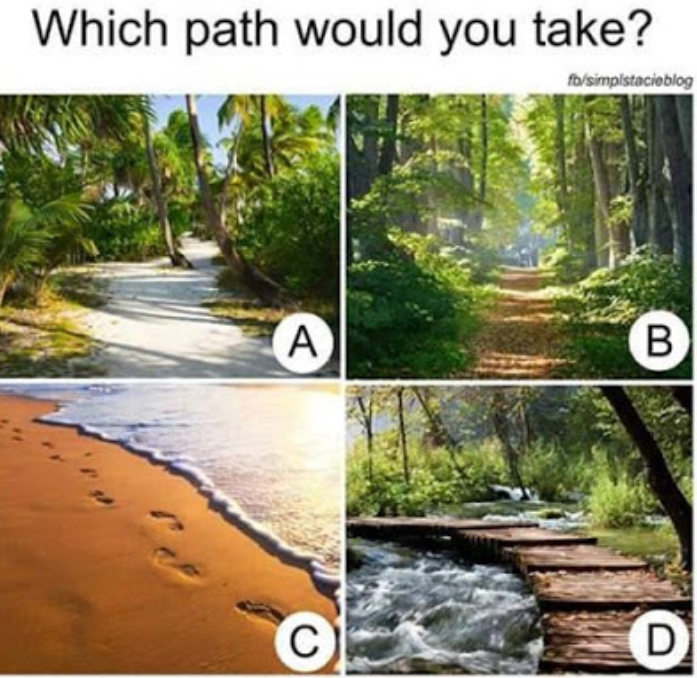
    Guest Blogger Nancy Julien Kopp wrote about choosing a path and exploring your choice. It seems like a perfect writing prompt for the start of a new year.

    Nancy wrote on her blog:

    Life is full of choices. I think often of Robert Frost’s poem that tells us of two roads diverging in a yellow wood, and the poet said he took the one less traveled by. But don’t we always wonder if this choice would be better than that choice or another one?  

    For a writing exercise today, look at the four photos. Each of them is somewhere you can walk. Two have water while the others are filled with green trees. What is your choice? Where would you prefer to walk? A, B, C or D? 

    Choose one and write a paragraph or several paragraphs about the photo you liked best. Study the photo and ask yourself a few questions. What sounds are there? What is the weather like; air temp? Are you going to meet someone? Does a person appear coming toward you? Does the weather make a distinct change? Can you smell anything? Are you happy on this walk? Or are you despondent? Do you have a destination in mind? Or are you walking aimlessly? Are you hungry? Thirsty? Barefoot or wearing shoes? 

    Think about all those questions before you begin to write. Hopefully, you’ll end up with the beginning of a story, or even a piece of flash fiction. Or a bit of memoir. There is no limit to where you can go with this exercise. 

    If you enjoyed one, try another with the same questions and see what happens. Remember that writing exercises allow you to flex your writing muscles in any way you like. Let your creativity flow.

    Original post on Writer Granny’s World by Nancy Julien Kopp.

    Nancy Julien Kopp lives in Manhattan, KS where she writes creative non-fiction, fiction for children, personal essays, articles on the craft of writing, and poetry. She has been published in 22 Chicken Soup for the Soul books, newspapers, magazines, and ezines, and several anthologies including The Write Spot: Possibilities and The Write Spot: Writing as a Path to Healing (available in both print and as an ebook at Amazon).

    Nancy was the Kansas Authors Club Prose Writer of the Year in 2013.

  • Collage in Poetry . . . Prompt #529

    I would like to share collage in writing with you, some things I learned from the poet Dave Seter.

    His poem, “Fargo Airport, Waiting in a Bar” in The Write Spot: Writing as a Path to Healing is an example of using collage in poetry. The lines in italics in his poem are from signs on the wall and on the label on a bottle. He seamlessly incorporates “lines from others” into his poetry.

    Look around you . . . what writing do you see that you can use in your writing?

    Perhaps: A book title, a greeting card, writing on décor, writing on a tissue box, or a piece of mail.

    Or: A note you have written, writing on a coffee mug, a sign on a wall.

    A label on a jar, a can, or a bottle.

    You can also use song lyrics as a jumping off point for your writing.

    Writing Prompt: Today . . . or . . . Yesterday

    Incorporate written words that you see into your writing.

    A stanza from “Fargo Airport, Waiting in a Bar” by Dave Seter:

    Waiting for a funeral, it seems the years collapse

    into one moment. I want to find

    the right thing to say to firemen and farmers,

    who are kind, as they offer from

    A Bucket of Beer Nine Dollars.

    Dave Seter is the author of  Night Duty,  and Don’t Sing to Me of Electric Fences, a poetry collection due out from Cherry Grove Collections in 2021. A civil engineer and poet, he writes about social and environmental issues, including the intersection of the built world and the natural world.

    Born in Chicago, he now lives in Sonoma County, California. He earned his undergraduate degree in civil engineering from Princeton University and his graduate degree in humanities from Dominican University of California, where he studied ecopoetics.

    Dave wrote his master’s thesis, “Introducing Godzilla to Marianne Moore’s Octopus of Ice at the Intersection of Global Warming, Environmental Philosophy, and Poetry,” based on Marianne Moore’s collage poem, “An Octopus (of ice).”

     “This paper explores the question: How can a poet write an ecologically aware poem about global warming?”

  • The Three Questions

    Guest Blogger Shawn Langwell shares smart writing tips, focusing on three important questions.

    Octavia E. Butler said, “You don’t start out writing good stuff. You start out writing crap and thinking it’s good stuff, and then gradually you get better at it. That’s why I say one of the most valuable traits is persistence.”

    Writing and leadership have a lot in common. Both require creativity, passion, and persistence. Both are conversations. And every good author as well as effective leaders know their audience. Each requires a level of confidence and humility to listen. To listen to the suggestions of an editor. To listen to the inner voice that says you need to sit your butt down on a regular basis and write. Or, upon awakening to listen and follow the conviction of a dream so vivid and powerful that the story just unfolds and becomes a book and a short memoir entitled: “Cathartic Writing: The Healing Power of a Story Now Told,” included in The Write Spot: Writing as a Path to Healing, by editor Marlene Cullen.

    I am still very much a rookie when it comes to writing and, like many people, tend to overthink the entire process before I even write the first word. For me, focus is a key to establishing a successful plan for any endeavor. Sure, there’s a lot more to writing than focus but I have found that lack of focus tends to lead to overthinking, which is a result of fear about not knowing where you want to go or believing enough in your abilities that one becomes consumed with analysis paralysis.

    Not everyone wakes up from a dream with a crystal-clear vision of what they want to write. Sometimes you need to kick that doubt to the curb and sit your butt down in front of your computer and write. Don’t worry about the results, yet. And certainly, don’t try and edit as you go. Some may be able to do this, but I find it messes with my flow and I get back onto the perfectionism merry go round and lose any emotion or momentum I may have finally gained.

    Writing is messy and not many like being messy. Writing also means you must become vulnerable. You are putting your thoughts and ideas out there for the world to see and some people may not like them.

    “Almost all good writing begins with terrible first efforts. You need to start somewhere. Start by getting something—anything—down on paper. What I’ve learned to do when I sit down to work on a shitty first draft is to quiet the voices in my head.” ― Anne Lamott

    I’ve been in sales and marketing for over twenty-eight years and, like authors, occasionally feel stuck. A few years ago, I went to a colleague to get input on a big proposal I was working on. He stopped me before I even got started and asked me if I had done a needs assessment.

    “What do you mean? Yes, I know they need to increase their business.” I said.

    “No. Have you asked them the three questions?”

    “The three questions?”

    “Before you can give a business presentation or any type of communication you need to ask these three questions:

    One: Who do you want to reach?

    Two: What do you want to say to them?

    Three: What do you want them to do?”

    Before they write or submit for publication these same three questions need to be decided by every author or speaker.  In other words, who is your audience or what genre do you want to write?

    Are you writing fiction or non-fiction? Each of these will dictate the voice, narrative and theme of your work.

    Lastly, What’s the purpose of your writing? Is it to entertain (Fiction)?

    Or, is it to inform? Persuade?  Or share a unique experience? (Non-fiction).

    Taking time to focus on these three questions has dramatically helped me increase my success rate in sales and made it easier to get started with writing. I have learned that answering these questions up front and not worrying about writing crap at first takes the pressure off. My persistence in practicing these steps has enabled me to finish three years of creative writing at the junior college, write and submit to three additional anthologies, give six speeches for Toast masters, and be asked to share a few words about the process with other writers like you.

    I look forward to meeting you on August 5th when we explore this a little more in depth at a Writers Forum Zoom Event.

    Be well, Shawn Langwell

    Note from Marlene: Shawn leads the parade in a series of Zoom talks based on the anthology, The Write Spot: Writing as a Path to Healing. Please join us for these free Writers Forum events.

    Shawn Langwell is a graduate of San Francisco State University with a Bachelor of Science Degree in Marketing and Advertising. He earned certificates from Dominican University, Barowsky School of Business Executive Education Leadership Program, and the San Rafael Chamber of Commerce Leadership Institute.

    He is President of Redwood Writers, a branch of the California Writers Club, and immediate past President of Toast of Petaluma.

    Shawn’s personal mission is to add value to people and businesses everywhere. He is a sought-after speaker for recovery and has over 33 years of continuous sobriety. He lives in Petaluma, CA with his wife, three adult children, and a Maine Coon cat, Cleo.

    Shawn is the author of the memoir, Beyond Recovery: A Journey of Grace, Love, and Forgiveness.