-
Three Top Pointers About Writing Personal Essays by Kelly Caldwell
From December 2013 issue of The Writer magazine. “In the Classroom” with Kelly Caldwell.
1. Don’t worry about What is My Larger Subject? in your first draft. Just get out of your own way, write the story and let the universal themes of the essay reveal themselves.
2. When you’ve got that first draft, ask yourself, “So what?” and write down the answer.
3. When you reach a point in the essay where you want to make things up because they would be more interesting or more satisfying or just prettier, don’t. This is creative NONfiction, after all, and yes, that matters. Also, those are usually places where you need to dig deeper, because that’s where the richer, more meaningful material usually lies.
-
Writers @ Work Annual Fellowship Competition
Writers @ Work Annual Fellowship Competition is pleased to announce its annual Fellowship Competition for emerging writers in fiction, nonfiction, and poetry — a great opportunity for emerging writers to have their work vetted by a talented panel of judges, well-known in their respective fields.
http://www.writersatwork.org/wp/?page_id=1171
First Prize: $1,000; Publication in Quarterly West; tuition for the 2014 conference; featured reading at the conference.
Two Honorable Mentions: $250.
Any writer who has not yet published a book-length volume of original work in the genre in which they submit a manuscript.
Unpublished work only. Work appearing in online journals is considered published. Work on personal websites or blogs is considered unpublished.
-
Her Story Anthology: Write to Heal Abuse
Gabrielle Pullen, founder of Your L.I.F.E Matters, Inc, is seeking submissions for Her Story Anthology: Write to Heal Abuse.
Writing is one way to make sense of our experience and turn pain into art. Your insight matters, to you and to other women who don’t yet believe they can get out. Pick one moment when you knew something had to give, and for once, it wouldn’t be you. This anthology will contain short stories, either non-fiction or creative fictionalized accounts, of your experience which demonstrate creativity and clarity.
Your L.I.F.E. Matters, Inc. began as a desire to support women with codependency issues who tended to play the victim. Gabrielle hoped to speak indirectly to her grown daughter through her work. But two days before the launch, in September of 2011, her daughter was found dead in her room in Eugene, Oregon where she was about to finish her last semester before graduation from the University of Oregon.
HERSTORY Insight Journaling is just one of the methodologies available for honing your experience into gems of insight to keep you centered in yourself. Rather than living in reaction to the conditioning of disrespect, learn to live from your own authority. Acting in congruence with your own values, gain access to the original confidence and power you were born with.
Hurry!
Deadline: December 15, 2013
-
Writing about place
Kevin Nance’s interview of August Kleinzahler in the Nov/Dec 2013 issue of Poets & Writers shows how to describe character and setting.
“One bright afternoon in San Francisco, Kleinzahler joins me for a spot of lunch at his favorite Chinese restaurant in the Haight-Ashbury neighborhood, once a hippie haven and now well into the process of gentrification, full of trendy shops and high-end hipsters. He cuts a fine figure in sunglasses, a banded hat, and a jaunty scarf tied haphazardly around his neck.
He is, in some ways, a Californian now, a San Franciscan. ‘It agreed with me instantly,’ he says of the city he first encountered more than three decades ago. ‘The look of it, the feel of it, the bookstores, the bars, the Chinese food—all good for me.’ On the other hand, ‘It’s not home,’ he says, ‘The people don’t talk right here, they don’t walk right, their body language is wrong.’”
-
Debbie Macomber had so many rejections . . .
I enjoy books that take me away, where I can escape into other worlds, like Cedar Cove, the fictional town Debbie Macomber created for her cast of characters. A Costco Connection article about Macomber invites readers into her real world.
“When I first started out, the rejections came so fast they hit me in the back of the head.” November 2013, The Costco Connection.
The article continues, “Macomber describes her desire to write as a ‘dream that pounded inside of me.’” She overcame dyslexia and taught herself the art of writing by dissecting Kathleen Woodiwiss’ The Wolf and the Dove. “Whatever was inside that story that made me want to go back and read them again and again, I wanted in my own story.”
From Debbie Macomber’s website:
“. . . I wanted to become a writer because I had stories to tell. And I was always interested in people—in what happens to them and what they choose to do or not do and why—which is the basis of story. I knew from the time I was in grade school that I wanted to write books, but it was a dream I kept close to my heart for fear someone would laugh or tell me I’d never be published.”
How about you? Let’s nurture your dream. . . start writing. Use any of the prompts on this blog to spark your flame to write. Write now! Just write!
-
Elizabeth Berg demystifies how to describe characters
I love it when writers describe characters in a way that I can really see them, beyond eye and hair color. The trick is how to describe a character that gets into the essential details of the person.
Elizabeth Berg demystifies how to describe characters, using interesting details, in “Escaping into the Open,” The Art of Writing True, page 91:
Whether you’re writing fiction or nonfiction, you can greatly help define a character by sharing not only what he says and does, but also how he looks. Again, details matter. don’t tell the reader that someone is old; show it by describing the dime-size age spots, the sag of the cheeks, the see-through hair, the spiderlike spread of veins at the back of the knees. Are nylons falling down? Are belts too big? Are there greasy thumbprints on the lenses of bifocals? Is the posture stopped or stubbornly erect? Is there a periodic squeal from a hearing aid? What does he eat for breakfast? How does she speak on the phone? Do medication bottles rattle in his front pocket? Does she keep nitro-glycerin in a silver monogrammed case?
Your Turn: Write a character sketch. Write so that readers can hear, see, smell, feel your character.
-
“Pass on the dream and tell its truth” — Natalie Goldberg
In her book, “The True Secret of Writing” Natalie Goldberg writes:
Writing is for everyone, like eating and sleeping. Buddha said sleep is the greatest pleasure. We don’t often think of sleep like that. It seems so ordinary. But those who have sleepless nights know the deep satisfaction of sleep. The same is true of writing. We think of it as no big deal, we who are lucky to be literate. Slaves were forbidden to learn to read or write. Slave Owners were afraid to think of these people as human. To read and to write is to be empowered. No shackle can ultimately hold you.
To write is to continue the human lineage. For my grandfather, coming from Russia at seventeen, it was enough to learn the language. Today, it’s our responsibility to further the immigrant dream. To write, to pass on the dream and tell its truth. Get to work. Nothing fancy. Begin with the ordinary. Buddha probably knew, but forgot to mention, that along with sleep, writing can be the greatest pleasure.
-
Get started – how to use writing prompts
 Get out some paper and a fast moving pen or set up your computer.
Set the timer for ten minutes.
Look at something in your room, anything, it doesn’t matter. Now write. Just write whatever enters your head.
Or, open your dictionary to a random page, run your finger down a column. Stop on a word and freewrite, using that word as your prompt.
Or, use one of the prompts in this blog.
Think of this as practice writing, just as a badminton player practices before an actual meet.
Follow Natalie Goldberg’s six rules of writing listed in a previous post.
Try it right now. Paper and pen or computer ready? Glance at your clock. Note the time. Or set your timer for ten minutes. Write for ten minutes about “trees.” After that, write for ten minutes, using “I remember” as your prompt. Now go with, “What I really want to say.”
Those first thoughts as you start thinking about the prompt is where the energy is. And that’s where you will find the good stuff. The nitty-gritty that means something. As Natalie Goldberg says, “The aim is to burn through first thoughts. Say what you want to say. Don’t worry if it’s correct, polite or appropriate. First thoughts have tremendous energy. First thoughts are the way the mind flashes on something.”
Keeping your hand moving is essential. If you stop to think, your inner critic enters the scene. Write quickly so there is no time to censor yourself. If you get stuck, just write the prompt again and go from there. New thoughts might come up. Or write “What I really want to say . . .” Or write, “the trouble started when. . . ” Keep going, trust the process, your mind will give you something to write about.
If you cross out, you are letting your editor take charge. There is time for the editor to work later, when you are revising. For now, invite the editor to sit this one out.
Do not worry about spelling, punctuation and grammar. You are the only one who will see this writing, unless you choose to share it. Don’t lose the thoughts that are propelling your writing energy by worrying about grammar.
Just write.
-
Natalie Goldberg’s Six Rules of Writing Practice
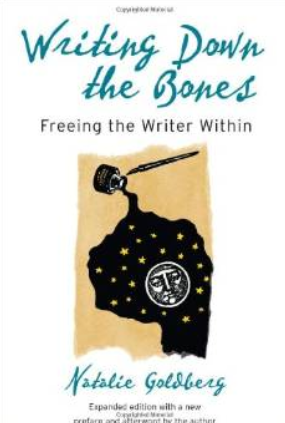
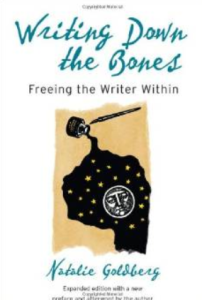 Natalie Goldberg’s Six Rules of Writing Practice from her books: Writing Down the Bones and Wild Mind
- Keep your hand moving.
- Don’t cross out.
- Don’t worry about spelling, punctuation, or grammar.
- Lose control.
- Don’t think.
- Go for the jugular