
“High white clouds skittered, their color matching the sheep that ambled below.”
From: “How to Knit a Love Song,” by Rachael Herron
Your turn: What beautiful phrasing can you conjure?
“High white clouds skittered, their color matching the sheep that ambled below.”
From: “How to Knit a Love Song,” by Rachael Herron
Your turn: What beautiful phrasing can you conjure?
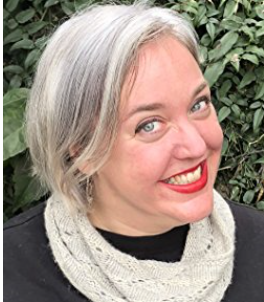
Guest Blogger Rachael Herron writes about one of my favorite topics: Revision:
I’m in the middle of revision of a book, and I’m swimming in the water I love.
What I adore about revision is this: I know the world. I invented it, after all! When I open the document, I’m right in the middle of something I understand. It’s much easier, for me, to drop in for hours and rest on the page. It’s also easier to come out of, to shake off.
First drafts remain torture for me. Many writers love first drafts, and I can admit that sometimes, the writing of new words is glorious.
You surprise yourself with a turn of phrase that you’re pretty sure is genius and has probably never been said before. The plot bends and a tree you wrote about comes to life and points a branched finger in a direction you never saw coming. Inspiration flows, hot and heavy.
But maybe I’m just more of a down-to-earth gal. I love falling in love, but I love remaining in love more. Give me a passionate kiss before you take the trash out—that’s happiness to me. I like the comfort of What I Know. I like to tuck my feet under the thighs of my manuscript as we cuddle on the couch. I love knowing my manuscript likes the lights on till sleep-time, even though I prefer to read in the dark.
Revision is both comfortable and exciting, like a sturdy marriage. Oh, I love the word sturdy. It’s prosaic, but it’s so me. My legs are sturdy. My emotions are, too. I love my books to be sturdy enough to lean on.
And lean on them, I fall into them, really. Revisions are getting in the bed you made out of words and pulling up the covers. Then you roll around, making those words better, cleaner, more focused.
Revision is when the REALLY big ideas show up. Then you have to move parts around, like those flat puzzle toys you slid pieces around on to make a picture, to make those new ideas fit. You might have to pry out some pieces and manufacture new ones. But then you click one piece left, and another one right, and suddenly, you’re looking at it. The whole picture. Your book.
Ahhh. I’m reveling.
Note from Marlene: I love Rachael’s enthusiasm about revision. If you dread revising, here’s a positive way to look at it: It’s an opportunity to look at your writing with new eyes; a prospect to improve your writing; to be sure your writing is clear, concise; to make sure you are saying what you really want to say.
Best wishes with your revision projects.
Rachael Herron is the internationally bestselling author of more than two dozen books, including thriller (under R.H. Herron), mainstream fiction, feminist romance, memoir, and nonfiction about writing. She received her MFA in writing from Mills College, Oakland, and she teaches writing extension workshops at both UC Berkeley and Stanford. She is a proud member of the NaNoWriMo Writer’s Board.
Links to other guest posts on The Write Spot Blog by Rachael Herron:
Reviews for Rachael Herron’s books on The Write Spot Blog. Type “Rachael Herron” search box for reviews about her books.
 Guest Blogger, Author Rachael Herron has this to say:
Hi readers and writers,
You’re an artist in some way.
Yes, you. I see you there, hiding there in the back shaking your head. I just like to read books. I’m not creative.
What do you do that brings you joy? What do you make? Cookies? Scarves? Do you sing in the car? Do you have a great eye for color?
Yes, keep reading. You’re creative, and I’m so glad to talk to you.
I’m back from my month off (oh, joy), and I’m so relieved to be back at work (I don’t relax well). I’m currently revising a thriller. It’s a departure for me, and it’s what I’ve wanted to write for years. The 911 dispatcher picks up the phone to find her daughter on the other end of the line, and it’s bad, y’all.
I was a dispatcher for many years, and I always knew that when I didn’t work for the department anymore, I’d write about the long, tedious hours, and the pure adrenaline that pounds through your system when lives truly hang in the balance. I’d make it exciting and realistic.
I wrote the thriller. It’s got a mother/daughter team that I just love. I adore the book.
And man, is it kicking my ass.
My incredible, intelligent, and very market-savvy agent is having me revise it again, to get it into the best shape possible before she tries to sell it. She’s right about everything that I need to fix, even though the last time I sent it to her, I was pretty sure it was just about perfect.
It wasn’t.
And every single day, I don’t want to work on it. It feels like doing the same thing over and over. What’s the point?
Sometimes?
It’s just hard to keep going, no matter what we’re in the middle of doing. The political climate is beating us down. Loss happens. Grief arises.
Just getting through the day can be rough.
So that begs the question:
How do we keep going?
I had a chat with my friend Marrije this morning. I asked how her writing is going, and she held up a small blank book. She told me that every day, no matter what, she writes one page in it from the point of view of one of her characters. Often that work makes it into the novel she’s working on, and sometimes it’s background work to better understand her characters.
But it’s her baseline.
It’s the least she allows herself to do.
It keeps her creative writing spark alive.
I picture Marrije leaning down and blowing gently over the paper, once a day. Even if she has no time for anything else, the fact that she touched the work, that she blew until the ember glowed, keeps her going.
And because she does that, the world speaks to her. She finds synchronicity in the happenings around her—she sees an article that inspires a new plot point, or she hears a conversation that illuminates a character trait.
What’s your baseline?
What’s the bare minimum you can decide to do daily to keep your spark alive?
Marrije also pointed me to an AMAZING (truly) talk by the wondrous Austin Kleon with 10 Tips to Keep Going. You should watch this. You won’t regret the time spent. The end, especially, moved me.
So, my friend, find your baseline. Name it. Know it.
Then blow on that spark gently. Grow the ember to a flame and then to a blaze. Feel that warmth. You’re worth it.
Note from Marlene: I watched the 26 minute Austin Kleon video. Totally worth the time. 🙂
Today’s Guest Blogger is Rachael Herron, one of my favorite writers. Read one of her books and you’ll know why. More on that later.
For now, you get to sneak a peek into how she gives priority to the problem, rather than to the answer.
Hi Writers,
I spent yesterday morning in the tub, thinking about writing. It wasn’t procrastination, I promise. It was actually the most delicious thing ever.
Usually, I get up and have coffee and do yoga and write in my journal, and then I jump into work. I work all morning on writing and revision, and I use my afternoons to answer email, record my podcasts, teach, and coach.
Yesterday, my “writing” took the form of thinking.
And I was cold.
So I got in the tub at ten in the morning.
I lit a candle to help me think, for something to stare at. I brought in with me a notepad and a pencil (I love the Aquanotes waterproof writing pad) but I turned to my phone instead, making voice memos in Evernote. I didn’t look at Twitter or Facebook, I just thought. I allowed myself to go down deep internet rabbit holes (when was the last orphanage in Venice closed? What’s a debilitating disease that requires care but doesn’t immediately kill?).
I paddled. I splashed.
It was, pretty much, heaven.
And it was part of the job.
I want right now to remind you of that. If you’re stuck in the middle of something, PLAY.
Write out all the frustrating questions you can’t figure out answers to and get in the bath with them. No bath? Go (alone!) to a hot tub place, bonus points if it’s outside and you can see the sky. Or go to the beach or lake, bundling up if it’s cold. Get your favorite splurge-y coffee drink and drive to the best view you can find. Tilt the seat back and just think.
Meander in your mind. Wander around. If the answer stumps you, go in a different direction.
Give priority to the problem, and not to the answer. I felt that yesterday — I kept trying to latch on to the “right” answer until I realized there wasn’t one, not really. I can write a book about anything. Poking around and trying to grab the “correct” book idea wasn’t going to work, but letting myself play with the problem did work.
What you’re doing when you do this is priming your mind to keep working on it in the background, while you go to work or feed the kids or sleep at night. Your brain will keep working on this, the more you play with the ideas, and then one afternoon while you’re searching for the Tom’s of Maine that doesn’t suck (spearmint), the answer will drop into your mind. A flash of inspiration, yes, but it’s a flash that you set yourself up for.
Remember to play. Writing is hard work, yes. I spend a lot of time acknowledging that it’s often a painful thing to push yourself to do. So if it’s been awfully hard lately, or if you just haven’t been getting anything done, give yourself permission to play.
See what happens.
Onward! Rachael
Rachael’s Bio includes my favorites of her books.
Rachael Herron is the bestselling author of the novels The Ones Who Matter Most (named a 2016 Editor’s Pick by Library Journal), Splinters of Light and Pack Up the Moon (all from Penguin), the Darling Bay and the Cypress Hollow series, and the memoir, A Life in Stitches (Chronicle).
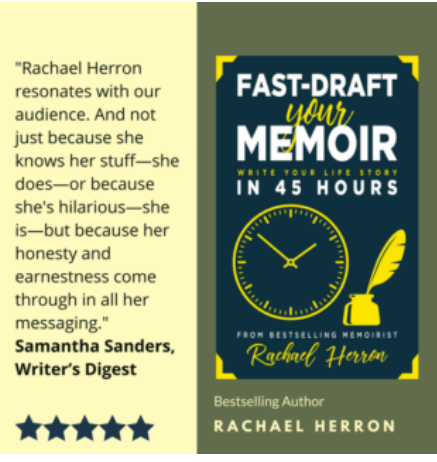 Rachael’s latest book, Fast-Draft Your Memoir: Write Your Life Story in 45 Hours, is about writing quickly while still creating a compelling narrative arc out of the story only YOU can tell.
She received her MFA in writing from Mills College, Oakland and she teaches writing in the extension programs at both UC Berkeley and Stanford. She’s proud to be a New Zealander as well as a US citizen, though her Kiwi accent only comes out when she’s very tired. She’s honored to be a member of the NaNoWriMo Writers Board. She is currently a Writer in Residence at Mills College.
 Today’s Guest Blogger Rachael Herron has this to say about revision.
I’m back in the middle of revision of a book, and I’m finally swimming in the water I love.
What I adore about revision is this: I know the world. I invented it, after all! When I open the document, I’m right in the middle of something I understand. It’s much easier, for me, to drop in for hours and rest on the page. It’s also easier to come out of, to shake off.
First drafts remain torture for me. So many of you love the first drafts, and I can admit that sometimes, the writing of new words is glorious. You surprise yourself with a turn of phrase that you’re pretty sure is genius and has probably never been said before. The plot bends and a tree you wrote about comes to life and points a branched finger in a direction you never saw coming. Inspiration flows, hot and heavy.
But maybe I’m just more of a down-to-earth gal. I love falling in love, but I love remaining in love more. Give me a passionate kiss before you take the trash out—that’s happiness to me. I like the comfort of What I Know. I like to tuck my feet under the thighs of my manuscript as we cuddle on the couch. I love knowing my manuscript likes the lights on till sleep-time, even though I prefer to read in the dark.
Revision is both comfortable and exciting, like a sturdy marriage. Oh, I love the word sturdy. It’s prosaic, but it’s so me. My legs are sturdy. My emotions are, too. I love my books to be sturdy enough to lean on.
And lean on them, I do. I fall into them, really. Revisions are getting in the bed you made of out words and pulling up the covers. Then you roll around, making those words better, cleaner, more focused.
Revision is when the REALLY big ideas show up. Then you have to move parts around, like those flat puzzle toys you slid pieces around on to make a picture, to make those new ideas fit. You might have to pry out some pieces and manufacture new ones. But then you click one piece left, and another one right, and suddenly, you’re looking at it. The whole picture. Your book.
Ahhh. I’m reveling.
Note from Marlene: Yes! I also love revising. Moving parts around, like a puzzle = Exactly! And the euphoria when the pieces fit = Joy!
Rachael Herron is the bestselling author of the novels The Ones Who Matter Most (named a 2016 Editor’s Pick by Library Journal), Splinters of Light and Pack Up the Moon (all from Penguin), the Darling Bay and the Cypress Hollow series, and the memoir, A Life in Stitches (Chronicle). She received her MFA in writing from Mills College, Oakland and she teaches writing in the extension programs at both UC Berkeley and Stanford. She’s proud to be a New Zealander as well as a US citizen, though her Kiwi accent only comes out when she’s very tired. She’s honored to be a member of the NaNoWriMo Writers Board. She is currently a Writer in Residence at Mills College.
 Today’s Guest Blogger post is from one of my favorite authors, Rachael Herron.
Rachael writes:
A comment by David Sedaris on a podcast gave me an a-ha moment recently, and I wanted to share it with you.
I’d always wondered how he got his essays so brilliantly specific—filled with the kind of particulars that put you right into the spot where he stands.
From Me Talk Pretty One Day, “For the first twenty years of my life, I rocked myself to sleep. It was a harmless enough hobby, but eventually, I had to give it up. Throughout the next twenty-two years I lay still and discovered that after a few minutes I could drop off with no problem. Follow seven beers with a couple of scotches and a thimble of good marijuana, and it’s funny how sleep just sort of comes on its own. Often I never even made it to the bed. I’d squat down to pet the cat and wake up on the floor eight hours later, having lost a perfectly good excuse to change my clothes. I’m now told that this is not called “going to sleep” but rather “passing out,” a phrase that carries a distinct hint of judgment.”
His humor comes from the details.
But how did he remember those details? When you’re reading his work, you’re right there, exactly with him.
I have a legendarily bad memory. This is why I blog and journal.
But I’ve been stumped in the past as to how to catch the things that flit by, the words I want to remember, the colors of the sunset I’m in front of, the smell from the Korean barbecue on the corner.
I’m not willing to drag out my big ole journal and plop down on the sidewalk to catch my ideas and put them into beautiful sentences. Therefore, I lose a lot of them. I want to live in the moment, not next to it.
The tip David Sedaris gave me? He jots down snippets, and then later transcribes and expands them in his diary.
I’ve often jotted snippets into a tiny Moleskine (because those can seriously go through the washer and come out with your words intact — ask me how I know). And I journal.
But combining the two — grabbing the few words and expanding them later — this is a really powerful combination that’s netted me some great stuff recently.
So I’ve taken to carrying a purse, even though I hate to do so. I find that tapping ideas into my phone doesn’t have the same feel as grabbing a notebook and pen and scribbling the words that lead to other ideas.
Of course, I don’t stop the party. I don’t announce that I need quiet for my creative inspiration. My goal is that no one notices what I’m doing. It’s the bank robbery of journaling — get in and get out before anyone sees your face.
Rachael Herron wrote an article, soon to be published in Vogue magazine. Not about “fashion, beauty, culture, living, runway, met gala.”
Rachael’s article is about clearing out craft supplies.
Imagine that.
What a brilliant idea! I imagine most crafters would benefit from an article about how to organize material and/or encouragement to let go of scraps of fabric, wisps of ribbon, etc.
Do you have a special skill, a hobby, a special interest? Write about it. Think about a magazine that might seem an unusual fit. Tweak your essay to fit the magazine’s demographics. Research the magazine’s mission statement, purpose, intent, masthead.
Do you have a pet peeve, an obsession, a unique collection? Turn your thoughts into an article, then research and submit!
Browse magazines at the library. Search online for potential magazines.
Find the right magazine for your piece:
Wikipedia List of American Magazines
How a Freelance Writer Should Submit an Article to a Magazine by David Kirk
Magazines that accept freelance articles.
The Write Life’s list of where to publish personal essays.
Share your ideas and your publishing success stories here, on The Write Spot Blog.
Not only does Rachael Herron write, she knits. And she writes about knitting.
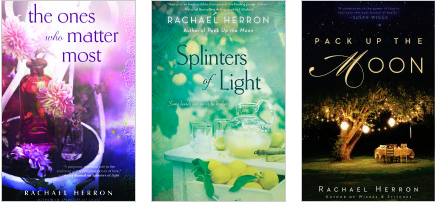
 This has been Rachael Herron Week on The Write Spot Blog. It’s been fun highlighting her and her work.
Today’s writing prompt is inspired by her latest book, The Ones Who Matter Most.
“What begins as one woman’s search for truth becomes a deep bond forged between the unlikeliest of people. Their surprising journey reveals how strangers can quickly find themselves to be family, and how kindness can bridge even the widest of gaps.”
Choose something from this synopsis, or elevator pitch, to write about. Perhaps:
Write about a kindness offered to you, or something kind you did for someone.
Or, write about a surprising journey.
Or, write about a stranger.
Write about what a search revealed.
Write about family.
Note: An “elevator pitch” is a short summary of a book or project that can be explained in the time it takes an elevator to go from ground floor to the 30th floor.
A conversation with Rachael Herron, author of 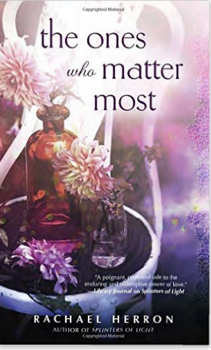 The Ones Who Matter Most.
“How did you get the idea for this book?”
“The original idea for any of my novels usually gets buried so deep that by the time I’ve finished writing, I can barely remember what the first ideas was. This book, though, was different. The first scene was my original idea.”
“Do you always know the endings of your novels when you start them?”
“I wish! I know writers who know their endings and aim for them like marksmen. Rather than apples to be hit with arrows, though, my endings are always asymptotes. I write toward them forever, getting closer and closer but never quite getting there. Usually I have to revise the whole book (minus the ending) a few times until I figure out what should really happen.”
Excerpted from the Conversation Guide at the end of Rachael Herron‘s book, The Ones Who Matter Most.
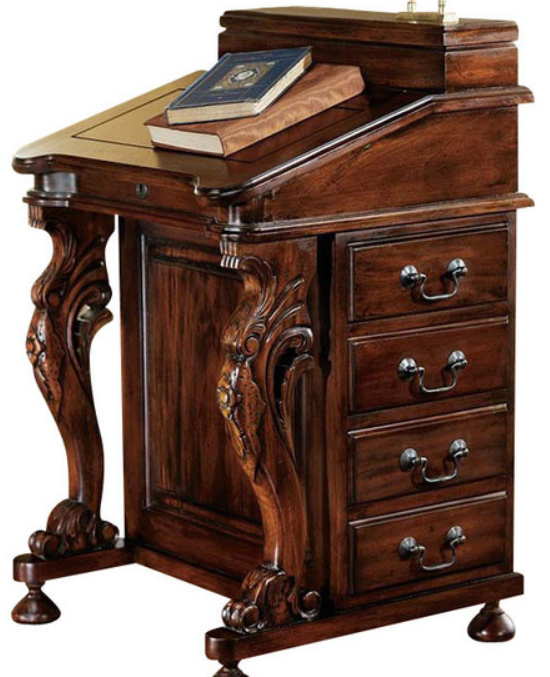 Write about something surprising found in a desk drawer.
Today’s writing prompt is inspired by the catalyst for Rachael Herron‘s latest book, The Ones Who Matter Most. A secret in a rolltop desk drawer leads a woman on a search that changes her life and the lives of another family.
“What begins as one woman’s search for truth becomes a deep bond forged between the unlikeliest of people, and the discovery that there are many ways to make a family—as long as you take care. . . ”
— quote from the back cover of The Ones Who Matter Most.