Life . . . Prompt #770

  • Life . . . Prompt #770

    More than one friend recently told me their difficulties, about how things seem impossible, how hard everything is.

    Sometimes I wonder why these things happen.

    And then I remember: Life. 

    Life happens.

    There are ups and downs.

    Situations that seem hopeless.

    And then time goes by.

    We find solutions. Or the situation remedies somehow.

    Write about a time that seemed hopeless. What happened?

    Or, if you are in a situation now that seems hopeless, write as if the problem has been resolved.

    What would your life look like if this situation was remedied?

    Writing About Difficult Times In Your Life by Guest Blogger Nancy Julien Kopp

    #justwrite #amwriting #iamawriter

  • Writing Family Stories

    Guest Blogger Nancy Julien Kopp encourages writing family stories as a gift to family members.

    When stories are only told around the holiday dinner table, they eventually get lost. Writing the stories ensures that they will live on, that those stories will be a continuing gift to other family members.

    Many people want to write their family stories, but don’t know how to begin. There is no set place or time to begin. It’s not necessary to start with the first ancestor you remember. The starting spot is anywhere, about anyone, or anyplace.

    Begin with the most vivid memory you have. Type your family stories, put them in a binder, and assemble them any way you like: By the person, by the era, by the ones you like best. It does not matter how you put your book of family stories together. What is important is that you do it.

    Writing family stories is a big undertaking and once started, people get enthused and want to keep going. 

    Below is a list of prompts to help you get started. You’ll note they are questions, and it’s you who have the answers.

    What part of the world did you live in?

    Did you live near close relatives?

    Did you see relatives only on holidays?

    Were grandparents part of your everyday life?

    Were your closest relatives born in America or somewhere else?

    What kind of storms did you have where you lived?

    Were your parents and grandparents strict?

    Did you have siblings?

    Were you close to siblings?

    Was there jealousy among siblings?

    Were any of your relatives mean?

    Who was the kindest relative you had?

    Do you know stories about your siblings at school?

    Did you have cousins who were close to you?

    Was your family large or small?

    What were holiday gatherings like in your family?

    How did you decorate for holidays?

    What special foods did your family make for holidays?

    Did you wear new clothes or hand-me-downs?

    Did you have chores to do every day?

    Who was the biggest eater in the family?

    Who made you happy?

    Who made you sad? 

    Who taught you to drive?

    Do you know any weather-related family stories?

    Was there anyone in your extended family that scared you?

    Who had a special hobby?

    Who was the best cook?

    What were family vacations like? Or were there any?

    Did your family attend church?

    What leisurely activities did your family pursue?

    Did you have radios, TVs, record players?

    Who was your favorite relative? Why? 

    Did your father and mother each have a best friend?

    How did your parents or grandparents meet?

    What kind of wedding did they have?

    These are not meant to receive one-word answers but to trigger some memories so that you can begin to write your family stories. Pick any one of them and get started. Starting is the hardest part of the project. Once you begin, you’ll probably want to continue. 

    There will be parts missing as you delve into your family history.

    For instance, I know that my maternal grandparents lived in different states. My grandmother grew up on a Minnesota farm, daughter of Irish immigrant parents. My maternal grandfather came to America from England with parents who settled in Iowa and were coal miners. How, I have often wondered, how did they meet and decide to marry? As a very young person, I never thought to ask my mother. Did she even know? So, it remains a mystery. That story about my grandfather coming to America with his parents? Turned out the man his mother married was not his father. Grandpa was not English but 100% Irish like his mother and the man who fathered him before his mother fled to England in shame. It’s the stuff that we read in novels. A great-uncle went to England and Ireland and researched the people involved. It was a true revelation in our family. A family story to be told over and over, but I still don’t know how my grandparents met! Or where.

    Ask questions of your older relatives. Find out the answers to questions you have before it’s too late. Don’t worry about where or how to begin writing your family stories. Just start!

    Nancy Julien Kopp lives and writes in the Flint Hills of Kansas. She has been published in various anthologies, including 23 times in Chicken Soup for the Soul books, websites, newspapers, and magazines and The Write Spot: Writing as a Path to Healing (available on Amazon both in paperback and as an e-reader)

    She writes creative nonfiction, poetry, fiction for middle grade kids, and short memoir.

    Nancy shares writing knowledge through her blog with tips and encouragement for writers. www.writergrannysworld.blogspot.com 
  • Crystallize A Moment

    Today’s guest blogger Nancy Julien Kopp muses about capturing and crystalizing a moment.

    The Wall Street Journal had an article profiling Maggie Smith, a contemporary poet. One of her quotes was simple but said a lot.

    “A poem doesn’t have to tell a story; it can just crystallize a moment.”

    I read it two or three times, then copied it on a notepad. 

    If you’ve ever been stopped by a beautiful sight or sound and wanted to write a poem, you’ll understand her thought to crystallize a moment.

    There’s no set number of verses to do that, no rhyming pattern, or anything else . . . just crystallize a moment.

    Maybe you’ve watched your children interacting, and there was a moment that you wanted to keep forever. It’s then that you should get that little notepad you keep nearby and jot down the thoughts you had. If you don’t do it right away, you’ll probably lose the intensity of the moment. 

    Early one morning, I went outside to pick up the newspaper, and I saw something that made me stop and watch and think. I wrote a poem about that one moment and what I saw in that tiny sliver of time, that took me to do a daily chore. It was a moment I wanted to remember, and the poem helped me do so.

    Message by Nancy Julien Kopp

    The cacophony of geese  

    caught my ear immediately  

    this cold, early morn, 

    as I claimed my newspaper

    on the still frosty driveway.

    I scanned the cloud-dense sky,

    paper clutched in hand,                                                              

    none sighted, but raucous honking

    pierced the dawn as they flew

    north from warmer climes.

    Yet, their message arrived with

    clarity, joy, and triumph.

    I smiled, knowing another spring

    will grace us one day soon. 

    Many nature poems are something we see for a moment, perhaps a quick glance at a colorful butterfly on a flowering bush. If that glimpse of something beautiful spoke to you, that’s when a poem might ‘crystallize’ the experience. It might be as simple as a haiku, or it could be a poem of several verses. 

    As you go about your day, use your writer’s eye to look for that exceptional moment or special sight, and pen a poem. You can ‘crystallize’ whatever it happens to be. 

    Nancy Julien Kopp lives and writes in the Flint Hills of Kansas. She has been published in various anthologies, including 23 times in Chicken Soup for the Soul books, websites, newspapers, and magazines and The Write Spot: Writing as a Path to Healing (available on Amazon both in paperback and as an e-reader)

    She writes creative nonfiction, poetry, fiction for middle grade kids, and short memoir.

    Nancy shares writing knowledge through her blog, Writer Grannys World by Nancy Julien Kopp with tips and encouragement for writers.

    Today’s photo is from the Queen Wilhelmina’s Tulip Garden, near the windmill in San Francisco. My crystalline moment.

  • Choices

    Guest Blogger Nancy Julien Kopp wrote about choosing a path and exploring your choice. It seems like a perfect writing prompt for the start of a new year.

    Nancy wrote on her blog:

    Life is full of choices. I think often of Robert Frost’s poem that tells us of two roads diverging in a yellow wood, and the poet said he took the one less traveled by. But don’t we always wonder if this choice would be better than that choice or another one?  

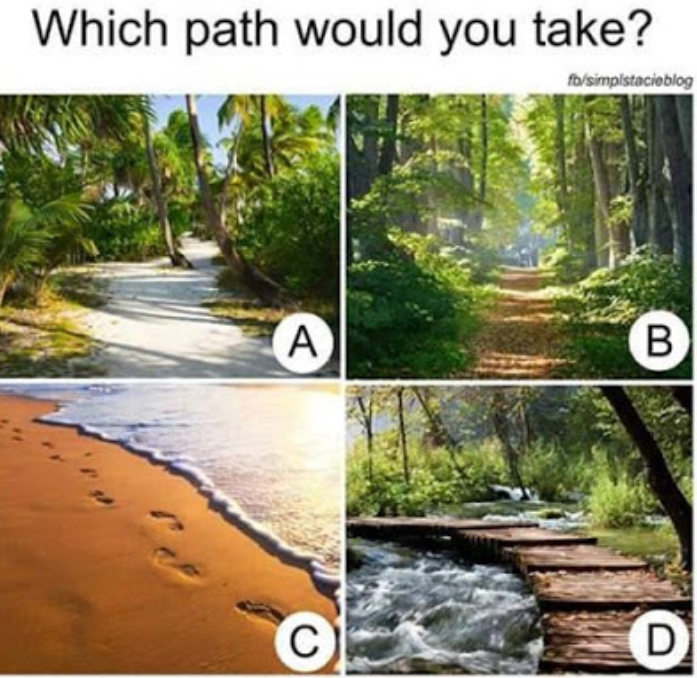
    For a writing exercise today, look at the four photos. Each of them is somewhere you can walk. Two have water while the others are filled with green trees. What is your choice? Where would you prefer to walk? A, B, C or D? 

    Choose one and write a paragraph or several paragraphs about the photo you liked best. Study the photo and ask yourself a few questions. What sounds are there? What is the weather like; air temp? Are you going to meet someone? Does a person appear coming toward you? Does the weather make a distinct change? Can you smell anything? Are you happy on this walk? Or are you despondent? Do you have a destination in mind? Or are you walking aimlessly? Are you hungry? Thirsty? Barefoot or wearing shoes? 

    Think about all those questions before you begin to write. Hopefully, you’ll end up with the beginning of a story, or even a piece of flash fiction. Or a bit of memoir. There is no limit to where you can go with this exercise. 

    If you enjoyed one, try another with the same questions and see what happens. Remember that writing exercises allow you to flex your writing muscles in any way you like. Let your creativity flow.

    Original post on Writer Granny’s World by Nancy Julien Kopp.

    Nancy Julien Kopp lives in Manhattan, KS where she writes creative non-fiction, fiction for children, personal essays, articles on the craft of writing, and poetry. She has been published in 22 Chicken Soup for the Soul books, newspapers, magazines, and ezines, and several anthologies including The Write Spot: Possibilities and The Write Spot: Writing as a Path to Healing (available in both print and as an ebook at Amazon).

    Nancy was the Kansas Authors Club Prose Writer of the Year in 2013.

  • Chug, Chuff, Hiss, Squeal, Off We Go

    Today’s post is inspired by Nancy Julien Kopp’s blog post about using sound in writing.

    Nancy wrote:

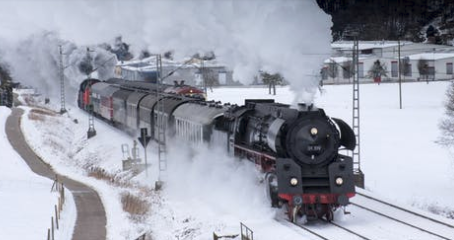
    This morning, I was catching up on email when I heard the whine of a train whistle, blown several times. I wondered if it was the historic Union Pacific train, known as Big Boy, making its way across Kansas this week in celebration of 150 years of the Transcontinental Railroad. It was due to stop here in our town at 9:30 a.m. 

    The sound of that whistle made me stop and listen. I always liked to hear train whistles when I was a child. We lived across the street from the railroad tracks, so we were treated to that arresting sound on a frequent basis. I can remember being in bed on a summer night, windows open, hoping for the train to come by and announce its presence. When I did hear it, I wondered where it was going. My own world in those days was quite small, but I knew a train went to many places.

    What do you think of when you hear a train’s whistle? Does it trigger any memories for you? Do you think of it as mournful or cheerful? Is it different at nighttime when the train moves through the darkness than it is on a sunny day? 

    Readers knows what a train whistle sounds like, so you don’t need to write “The train blew its whistle.” You can enlarge that thought to make it more interesting: The train’s whistle whined loudly as it passed by the crossing gates, growing dimmer and dimmer as it sped down the track. 

    Write a sentence or two for each of the items below, using sensory detail.

    jet plane

    waves on the shore

    ball hitting a baseball bat

    washing machine

    school bell

    air brakes on a bus

    popcorn popping

    crying child

    church bells

    piano

    cow mooing

    birdsong

    Note from Marlene: Adding sensory details enhance the story and help readers “see” the scene and the characters.

    The Magic of Sensory Words by Enchanting Marketing.

    Write Spot Posts about sensory detail:

    The neurological impact of sensory detail.

    Imagery and sensory detail ala Adair Lara Prompt #277

    Sensory Detail – Sound

    Sensory Detail

    Using sensory detail in writing.

    See more posts about using the senses in writing by typing “sensory detail” in the Search Box on The Write Spot Blog.

  • Guest Blogger Nancy Julien Kopp and The Writing Fairies

    Guest Blogger Nancy Julien Kopp writes about her struggles and success with Good Fairy/Bad Fairy.

    2012

    I’ve had a story swirling in the recesses of my mind for several weeks. One that I think would work for a Chicken Soup for the Soul book. Last night, I opened a blank page in Word and began to write the story.

    I wrote for well over an hour. The story seemed to be coming together nicely. I was aiming for 1200 words, and by the time I was ready to call it quits for the day, I had over 700 words and still a lot to be told. I didn’t take time to read over what I’d written, knew there would be time to do that in the morning.

    I got ready for bed, feeling satisfied that more than half the first draft was complete. I settled down in bed to watch the news but while the news anchor and weatherman jabbered on about the day’s events, something began to gnaw at me. My story!

    I knew that the story wasn’t right but what, I wondered, was wrong with it. I mentally replayed what I’d written, and the answer came. The first two paragraphs were fine, but the rest of it went into background that threatened to take over the original story. It would overshadow the original premise. Maybe I’d find a solution the next day.

    Then the Bad Writing Fairy whispered that it would be a shame to lose all those words that I’d so painstakingly written. “Leave it the way it is and keep going.” The Good Writing Fairy rapped her over the head with her Writer’s Wand. but smiled sweetly at me. Then she said, “Dump all except the first two paragraphs and keep going.” I knew which one I should heed. I pushed both fairies off my pillow and decided to sleep on their advice.

    The next day there was no doubt in my mind that I had to begin the story again. The first thing I decided to was to delete more than 500 words, no matter how much it hurt. There was no reason to sabotage my own story with words that didn’t belong.

    A good many stories that are published look nothing like the first draft. It’s a practice round to help a writer know what direction to go. We begin and often begin again. Writing isn’t easy. Well, maybe the Bad Writing Fairy might tell you it’s a piece of cake, but the Good Writing Fairy is going to remind you that it’s hard work but well worth the effort.

    2020
    If you listen to that Bad Writing Fairy too often, you’ll become a lazy writer. Sometimes she talks loud enough to make you pay attention. You’ll be a lot better off paying attention to the Good Writing Fairy. She will push you in the right direction because she wants you to be the best writer ever.

    I was in that Bad Fairy/Good Fairy situation once again. I had a YA story that was finished. Well, maybe it was. It could end in two different ways. I chose one, then finished the story. But the Good Fairy kept tapping me on the shoulder with her wand. I knew she wanted me to write the second possible ending, then decide which one would work best. The Bad Fairy must have been hiding somewhere. I didn’t hear her say to use what I had and forget about writing the best ending.

    I know it pays to listen to each of those little nymphs, then make an adult decision.

    The Good Fairy is way ahead in scoring points. 

    Nancy Julien Kopp lives in Manhattan, KS where she writes creative non-fiction, fiction for children, personal essays, articles on the craft of writing, and poetry. She has been published in 22 Chicken Soup for the Soul books, newspapers, magazines, and ezines, and several anthologies including The Write Spot: Possibilities (available in both print and as an ebook at Amazon).

    Nancy was Prose Writer of the Year in 2013 by the Kansas Authors Club.

    She blogs at Writer Granny’s World With Nancy Julien Kopp with tips and encouragement for writers.

  • Fiction. Nonfiction. Creative nonfiction.

    What are you writing these days? Some people find it difficult to concentrate. Others are filling pages with poetry, fiction, nonfiction, and creative nonfiction.

    It might be a perfect time to chronicle what is going on in your life . . . if you write this as a journalist would . . . just the facts, that’s nonfiction.

    If you add vignettes and personalize your story, that’s creative nonfiction.

    Here’s what guest blogger Nancy Julien Kopp says about fiction, creative nonfiction, and fictional narrative.

    Most people are aware of the difference between fiction and nonfiction. Fiction is made up, nonfiction is true.

    There is, however, a differentiation between nonfiction and creative nonfiction. Nonfiction is generally expository in that it describes, explains or is informative. If you wrote about leaves in a forest in Montana, your readers would probably learn a great deal about the topic. You would write it as straightforward as possible after doing some research and using your own knowledge of leaves in this part of our country.

    Creative nonfiction is true, can be informative, and written in story form using fiction techniques. It would probably include some dialogue, description of the place and people and relate a story—a true story.

    Memoir writers are writing creative nonfiction. So are those who write Family Stories. Inspirational writers might use this form, too.

    I was reading an article about writing for children recently. They used a different term for true stories told with fiction techniques. They called it ‘Narrative Fiction.’ It is a way of teaching children factual material by telling stories. For instance, if a children’s author wanted to write about the Chicago Fire of 1871, incorporating stories of real people who had experienced that tragic event, it would bring the facts to life for any child reading it. Writing nothing but the facts would make the piece strictly nonfiction, but telling about a boy who helped someone during the fire brings it into narrative form and heightens interest.

    I’ve written countless family stories, and many of you have, too. They are far more than just reporting the facts of what happened. We want to show the people, the place, and what occurred. By adding dialogue, we bring the people to life, and we add feelings which helps the reader relate. We’re writing creative nonfiction.

    I like to think of Creative Nonfiction as telling a true tale with the human element first and foremost.

    Nancy Julian Kopp lives in Manhattan, KS where she writes creative non-fiction, fiction for children, personal essays, articles on the craft of writing, and poetry. She has been published in 22 Chicken Soup for the Soul books, newspapers, magazines, and ezines, and several anthologies including The Write Spot: Possibilities (available in both print and as an ebook at Amazon).

    Nancy was Prose Writer of the Year in 2013 by the Kansas Authors Club.

    She blogs at Writer Granny’s World With Nancy Julien Kopp with tips and encouragement for writers.

  • On Top Of Your Game

    My dear friend, Nancy Julien Kopp blogs at Writer Granny’s World by Nancy Julien Kopp.

    Last year, Nancy posted:

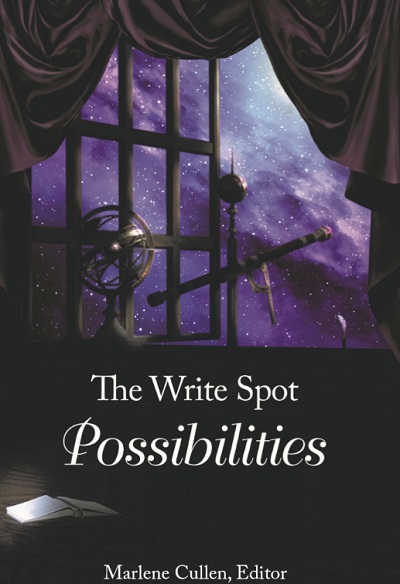
    In mid-November, I posted a review of The Write Spot: Possibilities.  The anthology consists of stories, essays, and poems by several writers. At the end of each offering is a prompt that might have inspired what they wrote and also a paragraph or two of advice for writers.

    Ahhh, advice. It can be given, but is it always accepted? Not by a longshot. Sometimes, we read the advice of other writers with a shield in front of us. The attitude can be Go ahead, teach me something I don’t already know. At other times, we’re wide open to any advice given. We want to soak it up like water in a sponge. 

    I’ve been skimming through the book again looking at the advice the writers offered. I consider it a gift to us, the writer-readers. I’m not going to quote from the book but have chosen bits and pieces of the advice that was given to share with you. Many of the writers repeated similar advice. I find that, when multiple people advise the same thing, I’d better pay attention.

    Advice from other writers:

    Don’t be afraid to share your work

    Join a writing group

    Write!

    Try different mediums of writing

    Never stop growing as a writer

    Find a special place to write that is your own

    Learn from your failures

    Nearly every one of those pieces of advice has appeared on my blog at some time, and often more than once. The suggestions for writers to heed is important enough to bear repetition. 

    One of the reasons I especially liked this anthology for writer-readers is that it offers more than the stories, poems, and essays. The prompts are excellent help for writing exercises, and the advice is worth a great deal. These writers put in a nutshell what some need an entire book to explain. An additional plus is the short bio of each writer. 

    The pieces of advice in The Write Spot: Possibilities and on my blog are simple things. Nothing so technical or intricate that others scratch their heads when they read them. Do all those little things, and you’ll be on top of your game. 

  • Listen To Your Heart

    Today’s guest blogger, Nancy Julien Kopp, has been published in Chicken Soup for the Soul books 22 times! Her story:

    A good many years ago, I submitted to a Chicken Soup for the Soul  book for the first time. The story was a simple one, a childhood memory, that I thought might work for the Fathers and Daughters book. Maybe.

    I hesitated to send it. Why? My pride told me it was impossible because rejection hurts a lot.

    Experience added that I hadn’t been writing very long, and the Chicken Soup editors received hundreds, maybe even a thousand or more, submissions for each book. My chances were pretty slim. 

    Reason stepped in and sneered at me as it said it was pointless to submit this story. What would it matter to the rest of the world? Then they laughed and I whimpered.

    All three had ganged up on me, and then a funny thing happened. My heart whispered softly in my ear. Your story is something others can relate to. Go ahead and give it a try. You have nothing to lose and everything to gain. I pushed pride, experience, and reason out the door. I liked what my heart told me.

    I sent the story. Many months later, I received a notice that the story had made it to the finals. My heart did a happy dance. I waited a few weeks longer before learning that the story had made it into the book. What a thrill to hold the published book in my hand a few months later.

    That story was “Love In A Box,” about a Valentine box my dad made for me when I was in the second grade. At age seven, I suddenly realized that my hardworking father truly loved me. That fact came as a startling discovery, one that left a life-long impression on me.

    Apparently, readers related to it and responded positively, so much so that the story has been published multiple times in English and some foreign languages.

    What if I hadn’t listened to my heart? What if I’d let those three bullies push me into a corner?

    Have you ever had a project that you wanted to submit somewhere but held back for one or more of the reasons above? What kept you from sending it? Were those three bullies-pride, experience and reason-invading your space, too?

    Don’t let them push you around. Remind yourself that you wrote a good story or poem or essay and that it deserves a chance.

    Get the submission ready, hit the Submit button and laugh at the three bullies.

    Listen to your heart. Your heart knows you better than those three twerps who try to place blocks in your way.

    Remember this:  If you don’t submit, you cannot be published.

    Nancy Julien Kopp has been published in several anthologies including The Write Spot: Possibilities, newspapers, magazines and ezines. Her writing includes award-winning fiction for children, creative nonfiction, poetry, travel and personal essays. She was named Prose Writer of the Year in 2013 by the Kansas Authors Club.

    Check out what Chicken Soup for the Soul is currently working on.

    Study the Guidelines.

    Submit!

  • Start Small

    Today’s brilliant post is by Nancy Julien Kopp:

    I’m a proponent of starting with small projects and moving on, step by step, to the bigger ones. Many writers dream of publishing a novel or a full book memoir. Some will start out their writing journey by beginning the pursuit of that dream immediately. It’s fine to have a worthy goal, but diving in the deep end before you know how to swim can bring big problems.

    Start small. Write a personal essay or memoir about an occurrence, something that happened and had some meaning for you. Later, it might become a part of the book you hope to write. Those little snippets of memoir can grow into something much larger, as can your personal experiences that taught you a lesson, as we see in personal essays.

    Novelists can practice their skill by writing short stories before attempting a full novel. Lots of short stories. Use all the tools you have as a writer to write a good short story, then submit it. If you have some success in selling your short stories, it could very well be time to begin writing the novel you’ve been thinking about for a very long time.

    Many writers want to start with the big project, to write a memoir or a novel before writing anything else. They have read many books. How hard can it be? Some will begin by reading a book or two on writing novels (or memoirs), and that’s fine. Others will not bother with reading a book about how to write a novel. They’ll start with chapter one, page one. A few might do very well with this method, but most are going to run into one roadblock after another. At some point, the whole thing could become overwhelming. 

    If that happens, step back and work on smaller projects for a while. Read some of those reference books on writing a memoir or novel. Attend a workshop about the same. Talk to other writers. Gather all the information you can before you tackle that big idea.

    One of my keywords is patience. Don’t be in such a hurry to tackle the big game plan. Take your time, learn as you go, but continue to keep the original goal in mind. Start on the big scheme when you feel ready. With some success at smaller projects, you’ll have some confidence in your ability to take on the big one. 

    Nancy Julian Kopp has been published in 22 Chicken Soup for the Soul books, several anthologies including The Write Spot: Possibilities, newspapers, magazines and ezines. Her writing includes award-winning fiction for children, creative nonfiction, poetry, travel and personal essays.  She was named Prose Writer of the Year in 2013 by the Kansas Authors Club.