
Guest Blogger Daniel Ari: Sense And Specificity . . .

  • Guest Blogger Daniel Ari: Sense And Specificity . . .

    Daniel AriGuest Blogger Daniel Ari writes about Sense And Specificity: The Soul of Great Writing

    Great art is about balance. Okay, great art is about a heck of a lot of things. But one thing that makes great writing stand out from the superfluity of all writing is that it strikes a balance between emotional abstraction and concrete specificity.

    We want to read about things like devotion, honor and transformation. But the actual words devotion, honor and transformation aren’t concrete enough to sweep a reader away. As I discussed in “How to Make Your Poems Stand Out: Advice From a Reader” for Writer’s Digest online,  abstract nouns can’t be grabbed, and they don’t grab readers. And what’s worse, they tend to come in flocks. Once a writer writes honor, then love and respect want to come in. Then deep, forever, and mutual are at the door, having chased away all the beautiful specifics like moonstone, cardamom, and foxtrot.

    But luckily, concrete nouns also come in flocks. That’s because when you tell a story or describe a moment, either remembered or imagined, the telling includes all the specific things that make the moment unique and moving. If you want to test whether your writing is too abstract, imagine illustrating it. Could you? If there aren’t enough nouns and verbs to make into a drawing or painting, then your writing may be too abstract to interest most readers.

    Allen Ginsberg put it well: “You can’t write about ‘The Stars.’ You can go out one night and see a glitter in Orion’s belt, or see a constellation hanging over Nebraska, and that’s universal. But it’s got to be over Nebraska—particular—otherwise it isn’t universal. If it’s just the stars in the abstract you don’t even see them, so it’s not a living experience. It’s not an instant in time actually observed, and only instants in time are universal.

    What’s universal is the sense of being human that we translate into language as writers and that readers translate back into thought. That’s why concrete sense imagery is so crucial. That’s how the abstract system of language is able to relate living humans to one another—though memory and imagination of sensed experience.

    Here are two poems that I think do a good job of being relatable by being specific. The first is one of my own, a draft in a series about a legendary backwoods character named Starlight. The second is by Rebecca Auerbach, and I think it’s wonderful how her imagery isn’t just visual, but also auditory, and even more interesting how the sensation she describes is often the absence of sensation and hunger for it.

    “To build a supper”

    by Daniel Ari

    Without matches, I’m sure I could build a fire.
    I may be city, but I’m not dumb. I would
    just use a lighter. No lighter either? Hm.
    Then I’d use friction between two bits of wood
    to weave threads of smoke into a baby spark
     
    then huff and puff the infant in a hoodie
    of soft, dry bark or needles. I’d be famished
    by the time the contained blaze could be called good.
    Then I’d have to start the hunting or fishing
    or just eat miner’s lettuce and blackberries.
     
    I wonder how much hungry equals finished.
    Lost in the woods, I’d be grateful for Starlight.
    She knows a thousand growing things that furnish
    sustenance and comfort. She could catch a trout
    with a thorn hook—or we could stalk the shoulder
     
    of Tyler-Foote Road for fresh (truck-)grilled meat,
    a bumper crop of headlight venison.
    

    **********************************************

     untitled

    by Rebecca Auerbach

    We used to start with eyes meeting,

    exchanging a smile,

    then voices,

    speaking, sharing names.

    Now we start with a photograph & a profile.

    If you like the way a man smiles

    when he isn’t smiling at you,

    the way he introduces himself

    when he isn’t meeting you,

    you might exchange words without voices,

    & if you like what he says when you can’t hear him,

    you might consent to speak aloud by phone,

    & if you like how he speaks to you

    when he has never seen you,

    you might

    maybe

    consent to look into his eyes.

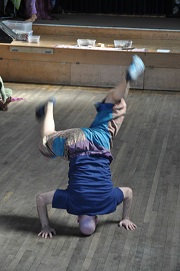
     Daniel Ari began dancing to Freeze Frame” by The J. Geils Band at an 8th grade dance in 1981. He hasn’t stopped. About five years later, he began courting poetry as a practice, and that, too has stuck. As a poet and professional writer these days, movement remains key to his creativity.  Daniel recently won Grand Prize in the Dancing Poetry Festival, and his poem about swing will be set to choreography and performed at the Legion of Honor in September. His forthcoming book One Way To Ask from Zoetic Press, pairs poems in an original form called queron, with artwork by 67 artists including Roz Chast, Tony Millionaire, Bill Griffith and R. Crumb.

    Daniel Ari will be the August 20, 2015 Writers Forum Presenter in Petaluma, CA

  • Crafting scenes a reader can see—and sense by Constance Hale

    Crafting scenes a reader can see—and sense by Constance Hale

    Place looms large in all the work I do—whether in travel writing (when I’m trying to capture the essence of another country or culture), or in narrative journalism (when I often begin with a scene to draw my reader into the story), or even in Facebook status updates (when I try to sketch a place with a few poetic images).

    When crafting scenes, many writers make the mistake of loading up adjectives. But, as always, nouns and verbs do the best detail work. Take for example this description by the Indian writer Arundhati Roy, in The God of Small Things:

    May in Ayemenem is a hot, brooding month. The days are long and humid. The river shrinks and black crows gorge on bright mangoes in still, dustgreen trees. Red bananas ripen. Jackfruits burst. Dissolute bluebottles hum vacuously in the fruity air. Then they stun themselves against clear windowpanes and die, fatly baffled in the sun. The nights are clear, but suffused with sloth and sullen expectation.”

    Roy doesn’t shy from adjectives, but she starts out by grounding us in a specific time and place (May, Ayemenem). She fills the scene with concrete things (crows, mangoes, dustgreen trees, red bananas, jack- fruits, bluebottles), and she uses nouns to give us big ideas (sloth and expectation).

    William Finnegan relies on verbs in his 1992 New Yorker opus on surfing, “The Sporting Scene: Playing Doc’s Games.” He fills his entire story with sentences that use active verbs to make inanimate things animate, like this one:

    The waves seemed to be turning themselves inside out as they broke, and when they paused they spat out clouds of mist—air that had been trapped inside the truck-size tubes.

    These passages are taken from the all-new edition of Sin and Syntax, which also contains exercises and writing prompts.

    Laconic landscapes, and not so laconic ones

    In Bad Land, a book about the settling—and abandonment—of the Great Plains, Jonathan Raban uses extended metaphor to sketch a scene in Eastern Montana as he drives along in his car:

    A warm westerly blew over the prairie, making waves, and when I wound down the window I heard it growl in the dry grass like surf. For gulls, there were killdeer plovers, crying out their name as they wheeled and skidded on the wind. Keel-dee-a! Keel-dee-a!

    Raban recasts the plains as a seascape, with the wheat making waves, the wind growling like surf, and the killdeer plovers crying out like seagulls.

    To practice your own scene-writing muscles, try two of my favorite exercises. First, describe a vast and empty landscape—or a deserted street. Can you write about the scene so that it does not seem static or dead? Can you make it bristle with energy, even if human action is long gone?

    Second, situate yourself in a place that offers a symphony of sound. (A busy street corner? A screeching subway? A quiet courtyard in which each footstep registers?) Tune in to those sounds only. (Ignore the panhandlers, the change of the traffic lights, the people looking at you askance.) Find words that are onomatopoeic in some way, that suggest the sounds themselves. Write sentences whose rhythms evoke the sounds you are hearing

    The Raban passage and these writing prompts appear in Vex, Hex, Smash, Smooch, which is now out in paperback. If you’ve given these prompts a try and like what you wrote, please post your quick scene sketch in the comments section below. [After you register, posting can be done with a quick log-in.]

    Places that inspire

    For an opportunity to find inspiration in a scenic setting, and to be guided through exercises that will develop more of these muscles, join me at the Mokule’ia Writers Retreat from May 4-9, 2014. With the Waianae Mountains of O’ahu at your back and the blue ocean before you, learn from the masters, write in the shade of ironwoods, wander along the beach, salute the sun in morning yoga, and come to understand the essence of Hawaii through evening programs led by island composers, dancers, and musicians. The program includes daily workshops, private writing time, and one-on-one meetings with faculty. The theme, nā wahi ho‘oulu, acknowledges that a sacred spot like this will inspire us to explore other places— whether in the heart, in memory, or in the moment.

    If you live in the Bay Area, I’d like to invite you to the Petaluma Writers Forum on March 20, 2014. I will be appearing with my friend and travel-writing colleague Michael Shapiro, who has written a book titled A Sense of Place: Great Travel Writers Talk About Their Craft, Lives, and Inspiration. Needless to say, we’ll be digging into the craft of scene writing in our remarks.

    Finally, if you’d like more of this kind of thing, come visit my Web site, or sign up for my mailing list. (I also post on Facebook via the Constance Hale Scribe page.) I post regularly on how to straighten out your syntax, how to make your sentences sing, and how to survive and thrive in this sometimes difficult but always enriching writing life.

    CONSTANCE HALE is a fiend about the craft of writing and covers it at sinandsyntax.com. She also writes about style and language in her books: Vex, Hex, Smash, Smooch (the most recent), Sin and Syntax, and Wired Style. She has been an editor at the Oakland Tribune, San Francisco Examiner, Wired, and Health; her journalism has appeared everywhere from The New York Times and The Los Angeles Times to The Atlantic and Honolulu. She directed the narrative journalism program at the Nieman Foundation at Harvard and edits books, turning narratives about serious subjects into serious page-turners. She also runs writing retreats in Vermont and Hawaii.
    Hale, Constance