Choices

  • Choices

    Guest Blogger Nancy Julien Kopp wrote about choosing a path and exploring your choice. It seems like a perfect writing prompt for the start of a new year.

    Nancy wrote on her blog:

    Life is full of choices. I think often of Robert Frost’s poem that tells us of two roads diverging in a yellow wood, and the poet said he took the one less traveled by. But don’t we always wonder if this choice would be better than that choice or another one?  

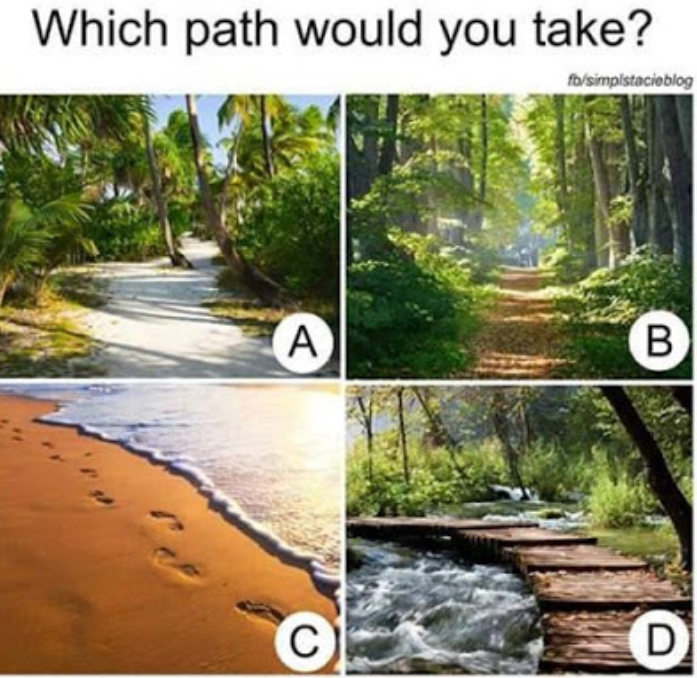
    For a writing exercise today, look at the four photos. Each of them is somewhere you can walk. Two have water while the others are filled with green trees. What is your choice? Where would you prefer to walk? A, B, C or D? 

    Choose one and write a paragraph or several paragraphs about the photo you liked best. Study the photo and ask yourself a few questions. What sounds are there? What is the weather like; air temp? Are you going to meet someone? Does a person appear coming toward you? Does the weather make a distinct change? Can you smell anything? Are you happy on this walk? Or are you despondent? Do you have a destination in mind? Or are you walking aimlessly? Are you hungry? Thirsty? Barefoot or wearing shoes? 

    Think about all those questions before you begin to write. Hopefully, you’ll end up with the beginning of a story, or even a piece of flash fiction. Or a bit of memoir. There is no limit to where you can go with this exercise. 

    If you enjoyed one, try another with the same questions and see what happens. Remember that writing exercises allow you to flex your writing muscles in any way you like. Let your creativity flow.

    Original post on Writer Granny’s World by Nancy Julien Kopp.

    Nancy Julien Kopp lives in Manhattan, KS where she writes creative non-fiction, fiction for children, personal essays, articles on the craft of writing, and poetry. She has been published in 22 Chicken Soup for the Soul books, newspapers, magazines, and ezines, and several anthologies including The Write Spot: Possibilities and The Write Spot: Writing as a Path to Healing (available in both print and as an ebook at Amazon).

    Nancy was the Kansas Authors Club Prose Writer of the Year in 2013.

  • Fiction. Nonfiction. Creative nonfiction.

    What are you writing these days? Some people find it difficult to concentrate. Others are filling pages with poetry, fiction, nonfiction, and creative nonfiction.

    It might be a perfect time to chronicle what is going on in your life . . . if you write this as a journalist would . . . just the facts, that’s nonfiction.

    If you add vignettes and personalize your story, that’s creative nonfiction.

    Here’s what guest blogger Nancy Julien Kopp says about fiction, creative nonfiction, and fictional narrative.

    Most people are aware of the difference between fiction and nonfiction. Fiction is made up, nonfiction is true.

    There is, however, a differentiation between nonfiction and creative nonfiction. Nonfiction is generally expository in that it describes, explains or is informative. If you wrote about leaves in a forest in Montana, your readers would probably learn a great deal about the topic. You would write it as straightforward as possible after doing some research and using your own knowledge of leaves in this part of our country.

    Creative nonfiction is true, can be informative, and written in story form using fiction techniques. It would probably include some dialogue, description of the place and people and relate a story—a true story.

    Memoir writers are writing creative nonfiction. So are those who write Family Stories. Inspirational writers might use this form, too.

    I was reading an article about writing for children recently. They used a different term for true stories told with fiction techniques. They called it ‘Narrative Fiction.’ It is a way of teaching children factual material by telling stories. For instance, if a children’s author wanted to write about the Chicago Fire of 1871, incorporating stories of real people who had experienced that tragic event, it would bring the facts to life for any child reading it. Writing nothing but the facts would make the piece strictly nonfiction, but telling about a boy who helped someone during the fire brings it into narrative form and heightens interest.

    I’ve written countless family stories, and many of you have, too. They are far more than just reporting the facts of what happened. We want to show the people, the place, and what occurred. By adding dialogue, we bring the people to life, and we add feelings which helps the reader relate. We’re writing creative nonfiction.

    I like to think of Creative Nonfiction as telling a true tale with the human element first and foremost.

    Nancy Julian Kopp lives in Manhattan, KS where she writes creative non-fiction, fiction for children, personal essays, articles on the craft of writing, and poetry. She has been published in 22 Chicken Soup for the Soul books, newspapers, magazines, and ezines, and several anthologies including The Write Spot: Possibilities (available in both print and as an ebook at Amazon).

    Nancy was Prose Writer of the Year in 2013 by the Kansas Authors Club.

    She blogs at Writer Granny’s World With Nancy Julien Kopp with tips and encouragement for writers.

  • Writing About Difficult Times In Your Life

    Guest Blogger Nancy Julien Kopp writes about a topic I am passionate about: Healing through writing.

    WRITING ABOUT DIFFICULT TIMES IN YOUR LIFE

    When life hands us situations that hurt, we sometimes want to push it away, hide it in a closet. It’s too hard to bring it forth and try to deal with the misfortune. There are so many events in our life that create deep wounds and leave scars—the death of a spouse, losing a child, being in a terrible accident, losing a home to fire or a tornado, a difficult romance and break-up. The list could go on and on.

    I believe that writing about whatever happened has benefits. It is cathartic for the writer and can be a help to readers who have gone through a similar situation. You’re a double winner if you aid both yourself and those readers who have been through something difficult.

    It’s definitely not easy to write about a tragedy in your life. It cannot always be done immediately after the event. For me, it took almost 30 years before I could write about the loss of two infants born three years apart. I wanted to but the time was not right for me to do that. When I finally was able to write about those two difficult times in my life, and my husband’s, it seemed that a dam opened and I wrote one story after another. Did it help me? I think it finally brought the peace I had sought and not found all those earlier years. It also made me feel good that I brought something to others who had gone through a similar tragedy. I would not advise waiting such a long time to write, however.

    Ernest Hemingway has passed on many pieces of advice for writers. His quote that fits today’s topic is “Write hard and clear about what hurts.” When you’re writing about something that has hurt you deeply, it’s best to address it head first. Some writers will tip-toe around whatever happened and perhaps infer but not really explain. That’s not fair to you or your readers. If you decide to write about that deep hurt, do it the way the quote says—write hard and clear.

    Give the facts of what occurred but also reach into your mind for your feelings, your attitude, the way you dealt with it. This kind of writing is filled with emotion and should be. For you, the writer, it can be a blessed release. Occasionally, what you write will surprise you. You’re not aware of some the buried thoughts you have.

    There are writers who can’t or won’t write about a hard time they experienced because they feel it is too personal to share with others. That’s showing the difference in people and personalities. If you can’t write about a hard time to share with others, do it for yourself. Write the story and how it affected you and put it away in a drawer or a safe deposit box or a computer file—somewhere that is just for you to see and read. There’s nothing wrong in not sharing with others. The main thing is that writing about whatever hurt you will be helpful. If nothing else, you can realize exactly how the situation did affect you or how it may have changed you.

    Whether you write about tragedies in your life for yourself only or for others, do write. It can’t hurt and it certainly might help.

    Nancy Julien Kopp lives and writes in Manhattan, KS. She writes creative nonfiction, poetry, personal essays, children’s fiction, and articles on the craft of writing. She has stories in 21 Chicken Soup for the Soul anthologies, ezines, other anthologies, newspapers and magazines.

    She posts Monday through Friday on her blog about her writing world with tips and encouragement for writers.

    Note from Marlene:  I recently discovered Nancy and her blog, Writer Granny’s World by Nancy Julien Kopp, and am loving her writing and thought process. I like the way she thinks and encourages writers.

    For suggestions about how to write about difficult things:

    Does your heart hurt? Prompt #269

    Make Sense of Your World Through Writing

    How To Write Without Adding Trauma

    Use Your Writing To Heal

    Things Falling Apart Is A Kind of Testing-Pema Chodron