Why I Love Writing Ekphrastic Poetry

  • Why I Love Writing Ekphrastic Poetry

    Why I Love Writing Ekphrastic Poetry by Guest Blogger, Robin Gabbert

    Yes, I do love writing ekphrastic poetry!  It’s poetry that never requires a prompt besides the piece of art you are viewing — be it a painting, a sculpture, a collage, digital rendering, or other artistic presentation such as dance, drama, and music (so hearing counts). You don’t have to search for writing prompts beyond your nearest museum or gallery (or their website) or a visit to WikiArt or Google Arts & Culture to search for your favorite artist or browse for something new that sparks your imagination.

    Ekphrastic poetry has been with us since at least the time of Homer and has been used by many of our best poets. An early example is John Keats “Ode on a Grecian Urn.”

    Rainer Maria Rilke was another advocate as shown in his beautifully descriptive poem “Archaic Torso of Apollo.

    Modern poets like W.H. Auden, William Carlos Williams, Anne Sexton, and Anne Carson have also written ekphrastic poetry to art as diverse as Bruegel’s “The Fall of Icarus” to “Van Gogh’s Starry Night” and Edward Hopper’s “Nighthawks.”

    My contribution to this genre is “The Clandestine Life of Paintings in Poems.”

    Do you know that paintings can tell stories? Perhaps you do. But do you also know that they can tell secrets as well – whispering unexpected confidences and tales to their friends, especially poets?

    That is how I approach ekphrastic poetry. What does this painting want to tell me? In what way can I best “enter” the art?  It might be, what did the artist want to tell me?— but not necessarily.

    It might instead be, “What is that dog curled at his master’s feet thinking?” or “What is really on the mind of that nude woman stretched across the divan?”

    What feeling does the painting evoke in the viewer, in me? Does it relate to some issue I care about? Is there an ambiguity in the art that can be explored?

    Abstracts and surreal paintings can be fun to write about because, rather than a story, they tend to bring up feelings, emotions and then challenge you to evoke in your poem both the painting, and what you discern from it, in a way that is relatable to the reader. 

    Here are a few examples of ekphrastic poems, starting with the very simple, including explanations of how I approached them, how I “entered” the art.
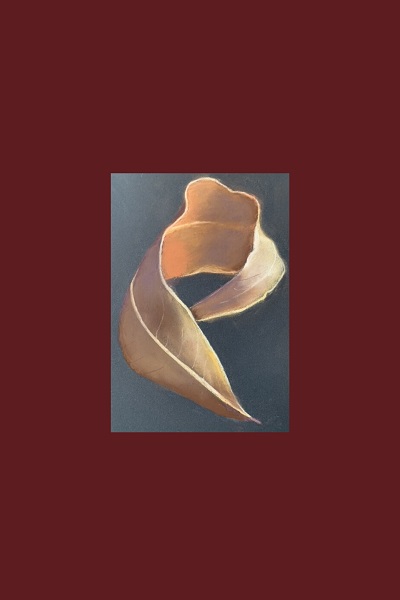
    I Know How You Feel

    Little brown leaf caught

    by the sun, in mid-flutter.

    I too, sometimes 

    just want to curl-in on myself
    and hope for a soft landing.

    This simple sweet image evoked a feeling in me, which I translated into a short, simple poem. The poem gave feelings to a small leaf so that I could express my own feelings, by empathizing with it.

    This next poem, “Yelo Moon, is different. The title character in this striking watercolor is so large and so vivid, it demands attention. It demanded that I make him (funny how it had to be a “him”) the Center of Attention. So, I did. 
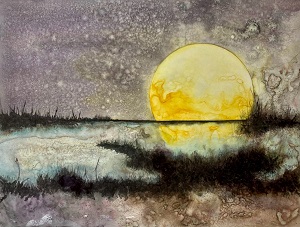
    Yelo Moon

    After a watercolor of the same name

    by Marion Stern

    The glowing saffron globe

    pulls itself into the night sky
    and seems to      float 

    in the wetland marsh,

    reflecting, observing
    its gleaming face in the salty water.

    As if to say—

    See,

    I am not made of green cheese!

    Behold me with wonder—
    I light the sky, I light the land.

    Marsh grasses, cower before me!
    I pull the tides like stretching rubber bands,

    leaving crabs to flounder and unwary boats askew.

    But the sea grasses and marsh creatures know

    that, as the braggart rises, his reflection will

    shrink along with

    his delusions of grandeur.

    After the bragging moon had his say, of course, he had to be brought back down to earth. Thus, the last stanza is written from the point of view of the surrounding plants and animals that are listening to the moon go on and on about how great he is, letting us know that they are not buying into his PR spiel.

    Another technique I use in writing ekphrastic poetry is to invent a fictional story based on a person in a painting. In “Clandestine Life of Paintings in Poems, it was a portrait of a woman by Amedeo Modigliani— an artist who does amazing portraits, portraits you could stare at all day because the people in them are so fascinating, mesmerizing. The name of the painting was simply “Amaisa.”  In my poem, she became “The Woman with the Wrist Tattoo.”
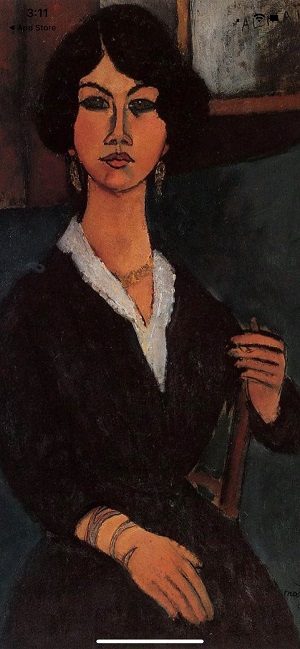
    The Woman with the Wrist Tattoo

    Based on Amaisa by Amedeo Modigliani

    The woman across the room

    seems upset, trying not to look

    at anyone, she focuses on the door.

    Eyes, two shining coals

    rimmed with sorrow

    She lights a cigarette,

    but lets the fire burn down

    until the ash is almost at her hand.

    Her lipstick slightly smeared

    on pillowed lips.

    Swallowing, she pulls herself upright,

    assumes an iron face

    and greets the man who’s just entered—

    Hello Claude,

    She puts out the cigarette.

    Don’t look so surprised,

    (this is Claude’s favorite club

    not a place she is expected).

    do you think I don’t know

    that you’re not here

    when you tell me you’re

    going for a cigar and brandy

    with Maurice?

    Do you think I don’t smell

    the stink of attar and ashes

    from your dalliance with the

    vicinal char girl?

    Well, I’ve had enough.

    I used your long absence

    to get this reminder of you—

    she says extending her arm—

    the snake who slithered up my sleeve

    and into my heart, the serpent who

    stole my fortune and dignity

    When people ask about

    the tattoo at my wrist,

    I’ll just tell them—

    Oh, that’s Claude, a snake

    I once knew

    But really, it’s just a reminder that,

    if you again try to take my hand,

    I should pull it back…

    To avoid the sting.

    These are just a few of the ways one can “enter” a piece of art to write a poem. Other ways include exploring the spiritual aspects the painting may suggest, or the purely emotional aspects. Of course, paintings and other art can suggest all manner of issues to write about including social issues, relationship issues, and all the diverse items that your brain can connect to an image! Don’t go in with a preconceived notion, just look at the art and  give your mind free reign. You may be surprised what the painting has to tell you.

    Robin Gabbert has poems in Redwood Writer Poetry anthologies, California Writers Club Literary Reviews and in “The Best Haiku” 2022 international anthology from Haiku Crush.

    Robin’s books, “Diary of a Mad Poet” and “The Clandestine Life of Paintings, in Poems”are available on Amazon.

    Several of her haiku, tankas, and haibuns appear in the anthology, “Burro in My Kitchen,”published byBlue Light Press.

    Robin lives in California wine country with her Dutch husband, Con Jager, and pup Hamish.

    available on Amazon.
  • Presence and Connection

    Guest Blogger Dr. Doreen Downing talks about public speaking, especially for writers.

    As a writer, you may be able to put words on a page, but … do you have the confident voice to access your words when you must speak in public?

    If you don’t feel confident, and if you feel anxiety, doubt yourself, hold yourself back, then what you write won’t reach as many ears or as many hearts as you’d like.

    When I ask my clients what holds them back from feeling at ease speaking about their work, the answer is always fear.

    And, bottom line, it’s the fear of being judged.

    It’s true that a judge could be sitting in the audience, listening for your mistakes, and counting your um’s, but more likely than not, the judge that criticizes you the most is perched right inside your own head.

    In fact, you could be your own worst critic.

    Ask yourself now to listen to what you say about public speaking. Note if you hear a voice telling you something like this…

    … You are going to forget what you have to say, go blank, and mess up… or

    … Your nerves are going to show, and everyone will notice.

    I know I can’t tell you to simply disregard the thoughts in your head.

    But I can suggest a way that will lead you to the amazing voice that comes from your true self, the Essence of who you are.

    And once you learn how to drop down and tap into the strength that comes from your Essence, you will be able to speak with a natural confidence.

    I’ve taken this inner journey to find my true voice, and I wrote about it in my book, “The 7 Secrets to Essential Speaking: Find Your Voice, Change Your Life.”

    As an author, I know what it takes to find my words and put them on a blank page, but I also know what it takes to find my words and share them in public, on podcasts, radio shows, videos, book events, and conferences.

    If you see public speaking as an avenue that will help you bring your passion out into the world, then you’ll want to make sure you have the confidence to be in the spotlight.

    Where do you find this confidence? The answer lies within you. In other words, confidence is an “inside job.”

    Going within means you must first face your fears and explore their roots. In early childhood, were you welcomed and celebrated by your family? Did you get their applause when you danced in front of them?

    Even if you had favorable reactions as a child, other influences outside of family dynamics that shape your self-confidence include cultural messages, personality, trauma, and experiences during your school years, with peers and with teachers.

    Once you’ve uncovered the root cause of your fear, you’ll feel the relief that comes with knowing why it’s been so difficult to control your nerves.

    And, this is the moment where the transformational journey of “fear to freedom” really begins. You realize your authentic voice has been buried underneath your fears. Now you are ready to unlock this voice so you can speak in public and share whatever you have said in your writing.

    Two of the secrets I reveal in my book, Presence and Connection, are keys to speaking with ease.

    With Presence, the idea is that when you are fully present in the moment, you are not thinking about negative speaking experiences from the past, nor dwelling on the future with its possibility of failure or disapproval. You are unafraid and more self-assured.

    Likewise, with Connection, you may already be comfortable speaking one-to-one which makes this natural ability so powerful when you apply it to a group. Being with and speaking directly to one person at a time creates a genuine connection with an entire group.

    In addition to guidance and instruction on how to be more Present and Connected, you’ll find my book takes you beyond scripts and performance techniques to connect to your authentic voice.

    If you are ready to overcome anxiety and empower yourself to speak in front of groups, the one step you can take right now is to download the 7 Secrets to Fearless Speaking.

    Dr. Doreen Downing is a Psychologist, Author, Keynote Speaker, and Host of the Find Your Voice, Change Your Life Podcast.

    She once suffered from stage fright. In facing this debilitating condition, she discovered a unique and simple way to connect to one’s authentic voice, the very Essence of who we are.

    Her book, “The 7 Secrets to Essential Speaking,” has become an instrument for people to tap into their inner strength and speak with confidence. 

  • Writing Through a Book’s Mushy Middle

    “Advice on Writing Through a Book’s Mushy Middle” By Judy Bolton-Fasman

    A eulogy I wrote for my father expanded into journal entries and eventually my book, “ASYLUM: A Memoir of Family Secrets.” I long dreamt that those loose collection of journal entries might become a book, but for many years they were arc-less and therefore not coalescing. There was no discernible beginning, middle, and end. But those entries, the impetus to start a writing project—I wouldn’t dare call it a book at the time—formed my literary North Star. 

    As Emily Dickinson wrote: “I am out with lanterns looking for myself.” I searched for myself in every corner of my memory, soul, in every rare photo I had, in every journal entry I wrote, and in notes I jotted down. In that process, I found profound, surprising things about myself and the other protagonists in my life story. 

    One of the best pieces of advice I received from a friend was this: Find people who knew your father back in the day. I won’t give away the secret at ASYLUM’s core but researching my father’s life blew my memoir open. My nascent book was no longer all situational—I had a story to tell. 

    So, I threw away many pages of false starts and bruised prose. Then, armed with knowledge from my research, I began to write again. A word about research. In my case, there was little or no paper trail about my father so, I learned about him in his university library. There I read his alumni magazine class notes beginning in 1940. I sussed out facts casually mentioned, which led to an astonishing connection. But mostly, I talked to people. Many of them claimed to remember nothing. However, their foggy memories did not deter me. I gently asked questions and found gold to mine in those conversations. 

    And research—don’t be daunted by it. For me, it was the skeleton key that opened submerged parts of my family history. Research takes many forms. It can be as accessible as reading someone’s favorite book or rereading your favorite book. The bottom line is we are the experts on our stories. Only we can tell a particular story. Bearing that in mind sustained me in slogging through my book’s “mushy middle.” And when I reached the other side, I found my research had buoyed my story. 

    The importance of ongoing note-taking sparked memories and ideas. Again, this doesn’t have to be daunting. For my next project—notice superstitious me is hesitant to call it a book—I’m keeping an ongoing hodgepodge of notes on my Notes app. I did that to some extent while writing ASYLUM, particularly when I needed to keep track of who I had to talk to, where I had to go to find my father. Write everything that pops into mind. Those words, those lines will beckon again and enable you to go deeper into your book. 

    In the mushy middle, all kinds of characters will be vying for attention to include them. Invite them into the book—it doesn’t mean they will stay. But getting to know a crowd of characters enabled me to know myself better. I love this Joan Didion quote: “I think we are well advised to keep on nodding terms with the people we used to be, whether we find them attractive company or not. Otherwise, they turn up unannounced and surprise us, come hammering on the mind’s door at 4 a.m. of a bad night and demand to know who deserted them, who betrayed them, who is going to make amends.”

    Didion’s observation is a manifesto for the memoir writer. 

    A character, usually not the writer, constantly lurks and then threatens to take over the narrative. My mother is necessarily a major character in ASYLUM. But, my goodness, she threatened to hijack the book at so many points. And maybe she did occasionally. In the mushy middle, give the characters and yourself permission to roam around the narrative. That’s what revision is for. And speaking of revision—do not go down the revision rabbit hole in this tender middle. Instead, generate, generate, generate material with which to sculpt. Nothing is wasted—think of it as literary compost to enrich the writing, the story, yourself. 

    A few words about the last part of the book: the ending is embedded in the narrative, it’s embedded in you, the writer; it always has been. You will realize it was hiding in plain sight. I wrote my ending at what felt like the last moment. But it wasn’t the last moment; it was a cumulative moment for me and my book. 

    I’ll be more specific—I end with returning to where my parents were married and say the Kaddish for my father there. This worked in that my parents’ marriage is front and center in the book and saying the Kaddish—the Jewish prayer of mourning—was central to the stages of grief I went through. It was also a significant strand in the book. 

    And last words of advice—no matter how tempting, and I know the temptation well—do not abandon your book. It needs you and you need it. This is your story, your moment. You’re important, and so is your story. Keep taking notes even if it is on the back of a restaurant menu while your dinner companion is in the loo. Those bits will happily surprise you as you come upon them again and welcome them into your writing.  

    And journal your way out of conundrums. Free write, and if possible, handwrite in a notebook. It makes a keen impression on the mind, on memory. Truths and images and insights will inevitably emerge. And remember, you did not write to bury anyone but to bring them to life. 

    “Advice on Writing Through a Book’s Mush Middle,” first appeared on Brevity’s Nonfiction Blog on August 25,  2022.

    Judy Bolton-Fasman is the author of “ASYLUM: A Memoir of Family Secrets” from Mandel Vilar Press (2021).

    Her essays and reviews have appeared in major newspapers, essay anthologies and literary magazines She is the recipient of numerous writing fellowships, a two-time Pushcart Prize nominee and a Best of the Net nominee.

  • 3 Things I’ve Learned About Storytelling (and Life) from Performing Narrative Nonfiction

    Guest Blogger Anastasia Zadeik writes:

    The bar is hushed. I stand at the podium, bright lights partially obscuring the crowd. I see a blur of faces and blank spaces, hear ice clinking in a glass somewhere to my right and murmurs from the back of the room where drinks are being ordered and served. I am about to start speaking when I remember a tip I was given by my first performance coach, Jon.

    “Before you begin,” he said, “take a deep breath and remind yourself to . . . slow . . . down.”

    This, I have found, is good advice and, as Oscar Wilde famously said, “The only thing to do with good advice is to pass it on” so…

    1. Before you start a story (or anything new)—take a deep breath and remind yourself to slow down.

    I begin to read the narrative nonfiction piece printed on the pages in front of me. It starts with some background about my dad, how he was a Latin, Hebrew, and Greek teacher, a Shakespeare scholar, and docent at the Art Institute of Chicago. Then the story places him in the hospital at age 81. He is about to go in for emergency surgery when he calls to me to share what might be his last bit of fatherly wisdom. I slow down in the reading, pause for a few seconds, and then explain that, instead of the profundity I expected given his extraordinary intelligence and the dire circumstances, I heard my dad say, “There are some Bob Chin gift cards in my wallet. Make sure you use them with your brothers and sisters.”

    The crowd laughs.

    I look up to see the blur of faces and spaces and lift my gaze to just above the heads, following advice from the minister at the church where my father’s funeral was held—a piece of advice I received when I was about to deliver the eulogy I’d written for my dad when, months after the Bob Chin gift card incident, we lost him to complications from that emergency surgery.

    “Look just over their heads until you feel comfortable,” the minister told me. “They will think you are engaging directly with them. Only when you begin to feel at ease should you lower your gaze to their faces, and then engage with an open, amiable face or two around the room.”

    2. Give the impression you are engaging directly until you can actually engage directly (in other words, fake it til you make it) and then look for the people who appear open and amiable.

    I lower my eyes to the page again and share how my dad never walked again after that surgery, how he suffered from ODTAA syndrome, “One Damn Thing After Another,” and the grief and loss my siblings and I felt when he died. I share how we went on a scavenger hunt of his favorite paintings at the Art Institute together as if trying to find him somehow, and our fear that we weren’t ready to be the older, wiser, generation. My voice drops and wavers slightly as I allow myself to feel those feelings again. I hear an audience member sniffle.

    I wait a moment, let the sadness settle, and then I begin to share how my siblings and I did indeed use my dad’s gift cards, how Bob Chin’s was a crab shack that served alcohol and how we proceeded to get drunk and tell bittersweet stories, how my brothers ended up fake-wrestling on the floor of the funeral home, and how the hotel clerk thought I was planning a bachelorette party when I called to inquire about the capacity of the hotel’s hot tub and whether we could bring our own booze into a conference room. I lift my eyes, now fully engaging with the blurry faces, and hear laughter again.

    Then, slowing my voice again, I finish with the last piece of advice my father actually gave me, the words of wisdom and love he wanted to pass on to his grandchildren. The laughter fades into silence and I hear another sniffle, and another.

    And I am reminded of something my second performance coach, Eber, told me. “If you can make them laugh or cry, it’s a good story. If you can make ‘em laugh and cry, it’s a great story. And if you can make ‘em laugh, cry, laugh, and cry again, then it’s an amazing story. Be authentic and make them feel it.”

    3. Be authentic

    Trust me, this does not contradict #2 because this is all about the delivery of your message. Let your emotions come through. Make them feel your passion, your dedication, your fear, your joy, your belief. Make the most of every moment. Grab ’em with what you know and what you feel and don’t let them go until the
    very
    last
    word.

    Anastasia Zadeik is a writer, editor, and narrative nonfiction performer. She lives in San Diego, CA, where she serves as Director of Operations for the San Diego Writers Festival and as a mentor and board member for the literary nonprofit So Say We All.

    Blurred Fates is her first novel.

    When she isn’t reading or writing, you will find her hiking, practicing yoga, playing tennis, swimming, or hanging out with her husband and their empty-nest rescue dog, Charlie.

    “3 Things I’ve Learned About Storytelling (and Life) from Performing Narrative Nonfiction” first appeared in Jane Friedman’s July 12, 2022 Blog.

  • Illuminating The Essay

    Guest Blogger Arletta Dawdy’s reflections on Susan Bono’s talk, “Illuminating The Essay.”

    Remember the bogs of Ireland or those on the moors of England in old romance novels? The one where the heroine comes to the lonesome manor to be a governess, nurse, or maid only to fall for the moody master, his neighbor or maybe the groundsman. She’s lost in the mire of boggish emotions until HE comes to her rescue.

    Well, I don’t see HIM rescuing this writer from her blogger’s mind-bog. If you noticed, I’ve been absent for, low, these many months and then I thought there might be hope showing on my horizon.

    Marlene Cullen, producer of Writers Forum, invited local heroine/publisher//teacher Susan Bono to inspire an October gathering by “Illuminating The Essay.”

    Susan has published personal narratives in her famed  journal, Tiny Lights, for nearly twenty years. She is an expert in the form and offers references, stimulation and inspiration freely.

    Susan Bono sees five keys to writing the personal essay:

    Character: the self

    Problem: give yourself a problem

    Struggle: Problem creates conflict

    Epiphany: after struggle, a flood of new understanding

    Resolution: what you do differently as a result.

    Susan calls on the work of many experts including: Phillip Lopate’s The Art of the Personal Essay; Adair Lara’s Naked, Drunk and Writing; and Louise Desalvo’s Writing as a Way of Healing.

    Many of her references specialize in memoir which Susan finds to be good resources.

    As so many good instructors do, Susan had exercises for us to try out. I found them to be great fun and marveled at the variety when students chose to share what they wrote. These are starter ideas which serve to establish the intent or direction of the essay/narrative. 

    Here they are with a couple of my answers shared:

    1. I want to tell you how [name of person] changed my life (Universal statement).

    My answer: John Steinbeck, and he did it twice: inspiring me to go into social work to change the world and to write.

    • I’m trying to figure out how I feel about______________
    • I learned about obstinance . . . from my granddaughter, with her threats not to go to sleep, hands on hips, pursed lips . . . and then dissolving into tears as she gave up.
    • I never expected to________________
    • I will always regret . . . My answer: not starting to write earlier.
    • I never thought I’d become a person who_______________________

    Paraphrasing Susan Bono’s rules:

    Reader should know within three paragraphs what the essay is about.

    Check proportion of scene with real action against summary which moves reader thru time rapidly.

    Check the frame: sense of being triggered by past event and ends by bringing back to current event.

    Use of dialogue brings others into the event.

    Use restraint when writing difficult themes as with violence, abuse . . .  need not be gory to make point.

    End or resolve with action or gesture as opposed to flowery words.

    Your Turn

    Challenge yourself:  Try answering Susan’s six openers.

    Posted on Arletta Dawdy’s Blog, October 27. 3013.

    SAVE THE DATE

    July 7, 2022: Susan Bono will talk about Ready, Set, Pivot!

    Personal narratives are documents of change. They always contain a “before” and “after.” This is really useful to remember when building our stories. In our time together, we’ll explore this concept and experiment with some structures that create natural pivots or shift points.

    Writers Forum sponsors this free event on Zoom. You need to register to attend.

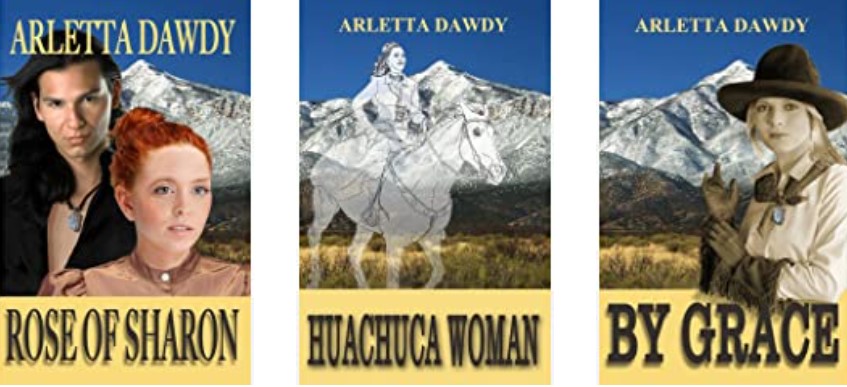
    Note From Marlene: Arletta Dawdy has written a wonderful series of historical fiction: entertaining, engaging, and “escapism” reading.

  • The Joy of Creativity

    By Suzanne Murray

    Years ago I heard Nobel Prize winning Irish poet Seamus Heaney give a lecture at the University of Washington. In the middle of this very academic speech, he paused, threw up both his hands and said, “Oh, just write for the joy of it” and then dipped back into the lecture.

    I don’t remember anything else from the talk, but Heaney’s sudden burst of inspiration stayed with me because it really captured an essential element in being creative.

    Whether you are cooking a great meal, growing a beautiful garden, writing a poem or singing in the community choir, you likely feel a deep sense of satisfaction and a joyfulness that comes with being creative.

    Creativity draws on the best of human nature: perception, imagination, intellect, inspiration, courage, intuition, and empathy. The urge to create asks us to bask in the experience of the world, to see, feel, taste, hear, and smell the magnificence around us. It allows us to celebrate, with a spirit of gratefulness, every aspect of our lives and the beauty and complexity the world offers.

    It can help us make meaning from our sufferings. Being creative also breaks us free from our ruts and habits allowing us to look at the world anew. We are able to tell a story that touches others, envision a unique way of solving a problem or offer counsel with fresh clarity, even if we have struggled with the same material or ideas a hundred times before. Embracing our creativity allows us to tap a deeper, more insightful way of knowing beyond our conscious mind and thoughts.

    In looking for your own ways of being creative you can start by celebrating your uniqueness. There never was, nor ever will be, anyone exactly like you. In exploring your uniqueness is there a central preoccupation, an interest or passion that runs through your life? There can also be more than one.

    If you can’t name it right now, think of something that you are fascinated by again and again. The possibilities are infinite; from needlework to rock climbing, from bird watching to playing the piano, from English country dancing to writing haiku, from gardening to giving foot massages. Look for what brings you joy and then begin taking actions to embrace your creativity and enjoy the process. One small step a day will set you down the creative path to increased happiness and fulfillment.

    Excerpted from “How Being Creative Makes Us Happy” on Suzanne’s Blog. Please go to Creativity Goes Wild and scroll to June 3, 2022 to read the entire article.

    Suzanne Murray is a gifted creativity and writing coach, soul-based life coach, writer and poet, EFT practitioner and intuitive healer committed to empowering others to find the freedom to ignite their creative fire, unleash their imagination and engage their creative expression in every area of their lives

  • Good Old Writers

    Victoria Zackheim

    Today’s guest blogger, Victoria Zackheim, writes about how to keep up the energy, faith, and courage to write.

    I recently walked into my newly built kitchen and discovered a large, grayish rectangular stain on the quartz counter. Had I placed a hot pan there? Not likely. Spilled bleach? Definitely not. I wiped, scrubbed, gently scoured… nothing helped. And then I lifted my arm and noticed a change in the shape of the stain. I had been trying to remove a reflection of light coming through the kitchen window.

    This is the opening paragraph of an essay I wrote about aging. I smiled as I wrote what I expected to be the preface of my new book. However, I’ve been told by literary agents and several editor friends that writing about aging might be cathartic for me, the writer, but it doesn’t stir up much interest among the public. Really? In a country with an increasing elderly population? The last count put us at nearly 17%. That’s a lot of old people, and I’m willing to bet that a good many are readers.

    Forget that we elderly are climbing mountains, running marathons and, in many cases, the country. We are a presence, a power, a voting force, and a major supporter of our county’s economy.

    And we can write … but do we?  

    I often wonder how many of us older writers don’t write because we’ve been led to believe that no one gives a damn about what we have to say. I’m not talking about those gifted (and, by the way, older) authors who create exciting characters in literary fiction and mysteries, men and women who perform death-defying acts to catch the bad guy, or face society and its warped mores to find the truth about life. The work of writers such as Jeffery Deaver, Jane Smiley, Anne Perry and Caroline Leavitt sells like crazy, but they’ve spent years, decades, establishing their reputations both here and abroad. No, I’m referring to that world of writers who never get their place in the sun, and still refuse to give up.

    And what about memoirs? The names that pop into my head are Abigail Thomas, Carrie Kabak, and Christine O’Hagan. They write with heart and soul, and they leave age behind.

    Are you held back by age? By the who wants to read something written by someone my age? syndrome?

    I teach Personal Essay in the UCLA Extension Writers’ Program, online classes only, and spend nine weeks working with students ages twenty to ninety, and who are motivated, excited, and energized by the joy and freedom to write. I also conduct workshops at writers’ conferences, which is where I learned a valuable lesson about age. I’ve had students in their sixties, seventies and eighties, but no one taught me more about the importance—and yes, the unimportance—of age, than a student who was about to celebrate his ninety-third birthday. At first, some of the younger students (mostly middle-aged) ignored him, until it was his turn to stand up and read the first draft of his essay. He stood, wobbled a bit, and then leveled those young whippersnappers with a poignant, beautifully written, and very funny piece, a vignette from his life. His writing was simple, straightforward, honest, and he didn’t give a damn about what he said, as long as he was telling his story. That was more than a decade ago. I hope he’s still writing.

    So, how do we, as older writers, find the means to write? Or perhaps the real question should be: how do we keep up the energy, faith, and courage to write? My agent is pitching my first mystery novel. I have to wonder how many editors will Google me, discover my age, and then think, “Oh dear, oh my, at that age, we can’t nurture her along, and we certainly can’t count on sequels.” The responses to my agent have been “soft” rejections. Soft or hard, no is no.

    Now, let’s look at another conundrum. As an older writer, what can you possibly write that anyone wants to read? Uh, hello! You have many more decades of life experience than up-and-coming (read: young) writers. Do they search for their glasses when they’re perched their head? Have they put their keys in the refrigerator, or tried to answer the phone with the TV remote? Or get frustrated when attempting to turn on the TV with their cell phone? When I do this, and casually mention it to my children or grandchildren, they smile. That is, they smile indulgently, hoping I don’t notice the pity or fear rushing through their hearts. But when I relate the same faux pas to friends of my age, I’m sure to get (1) a laugh and (2) a story about what happened to her/him that matches mine. We are a grand and wonderful people, we oldies.

    So, what am I saying? I guess I’m suggesting that older writers need to forge ahead. Screw the age; write what you know. Write what you are. If you write what you think will sell, that’s fine, we all need to make a living. But be good to yourself and carve out some time where you can be you. Old. Wise. Funny. And, yes, even a bit tasteless! (You know, the stuff you don’t want your children to read until after you’re dead … or you’ve published under a pseudonym. My children still don’t know about the time I … never mind.)

    Aging gracefully relies on accepting ourselves. If we don’t accept who we are, it will show up in our writing. Our older characters might be very well-behaved, pontifical, wise, which can be synonyms for dull. Create the characters first and see where they take you. I love Elizabeth George’s younger character, Barbara Havers, and Anne Perry’s new-series character, twenty-something Elena Standish. But I also gravitate towards the older and wiser. Is there a fictional character more fascinating and complex than Elizabeth Strout’s Olive Kitteridge? Or Wallace Stegner’s Lyman Ward in Angle of Repose? And I would be remiss not to mention Santiago, Hemingway’s memorable and haunting character from The Old Man and the Sea. (I seriously doubt that The Middle-Aged Man and the Sea would have received such acclaim.)

    So, yes, we are older writers, but in no way does that mean we are old. And I ask you, what’s more exciting: creating characters and plot lines, or worrying about sleeping through the night and having regular bowel movements?

    Carol Channing lived to ninety-seven. That gives me nearly twenty years to write, fall in love, manage crepey skin and liver spots, learn to make pasta on one of those machines, and write several sequels to the mystery that will be published one fine day.  

    What can you do to keep your creative juices flowing? Here are some ideas:

    1. Daydream. That is, daydream about the plot and characters of the novel, play, memoir, essay, screenplay, short story you always wanted to write— the one you imagined during that long drive, when your imagination was going wild. Now is the time.
    2. Be courageous. It doesn’t take courage to write at this age, but it does take courage to put the work out there to be judged.
    3. Trust yourself. I worked with a writer who held onto her essay for my anthology because she wanted feedback from her writing group. I convinced her to send it to me instead, since I would be her editor. It was brilliant. Over time, she has learned to trust herself.
    4. Ask for feedback. While it isn’t always helpful, there might be comments that lead you to better understand what you’ve written. But remember that you must be discerning. Not everyone has a good eye for good writing, so be sure you invite someone into your heart who is kind, trustworthy, and loves to read. And never forget the person you must trust more than anyone … you!

    I have a dear friend, Aviva Layton, who is about to become eighty-nine. (Notice I didn’t say “turn eighty-nine” because that sounds too much like fruit going rotten.) She does Zumba twice a week and works around thirty hours a week editing manuscripts. Aviva believes that old age is absurd, but it also has its advantages. She can tell a gorgeously handsome and sexy man that he’s gorgeous and sexy without his thinking she has ulterior motives … even if she does. And she never has to hoist her luggage onto the overhead bin. If I’m putting together a new anthology that fits into anything relating to her life, she’s invited. Aviva’s work is passionate, funny, real and never sugar-coated. At this age, sugar-coating anything is a waste of time.

    So, what can you do to bring joy and creativity to your golden writing years? Take your vitamins, try to exercise, wear your mask in public if you choose. And carve out quiet time. Not for resting, but for contemplating your next writing project.

    Don’t be afraid to play with ideas. Play with scenes. Play with characters and plots. Play with fantasies about how to spend the royalties. But whatever you do, don’t play it safe.

    Victoria Zackheim is the author of the novel, “The Bone Weaver,” and creator/editor of seven anthologies, including the international bestselling “The Other Woman,” that she adapted to theater and has been performed in several dozen theaters across the United States. She wrote the documentary “Where Birds Never Sang: The Story of Ravensbrück and Sachsenhausen Concentration Camps,” which aired nationwide on PBS.

    Zackheim is a playwright and screenwriter, with two plays and a feature film now in development. She teaches creative nonfiction in the UCLA Extension Writers’ Program and is a frequent conference speaker and writing instructor in the US and abroad. She lives in Northern California.  

  • Crafting Short Fiction

    “If I had more time, I’d write a shorter story.”— Mark Twain

    Today’s Guest Blogger, Guy Biederman, talks about crafting short fiction.

    I’ve always been intrigued by the challenge of creating something small that has big power. Giacometti said he wanted to make a sculpture the size of a matchbox, but so dense no one could lift it.

    The first micro story I remember reading was “Coup de Grace” by Ambrose Bierce, with a gotcha ending. O. Henry’s “Gift of the Magi used” a similar technique. I was astonished by the wallop a short piece could pack.

    As a young writer, I cut my teeth on Raymond Carver’s work. Carver’s stories weren’t always short, but they were spare and vivid, conveyed feeling, empathy and understanding, and explained very little. I didn’t know what he was doing or how he did it. I only knew that reading his work was like glimpsing beautiful pebbles through clear water on the bottom of a lake. And I wanted to write like that.

    I began to practice, and later teach what I called low fat fiction, the art of expressing more with less. And I began to apply what I learned to the short form.

    As a gardener, I became fascinated by bonsai—how a miniature plant in a pot evoked the grace, power, and wonder of an ancient tree; how pruning created space between leaves and branches that defined what remained. But how to create that empty space, that room between the sentences in fiction?

    What I learned from reading Carver and others, was the compelling power of evocation. To evoke rather than explain is a strong and efficient style of craft that creates room for readers who bring their imaginations to the page and make the experience their own. I call this practicing the reader’s art. By providing opportunities for them to have their own aha moments, readers can sync with a story and make profound connections, and in this way, writer and reader together create something new that may or may not even be on the page.

    In the 80’s this genre of very short stories went by many names including short shorts, palm-of-the-hand stories, and smoke-long-stories (short enough to be read in the time it takes to smoke a cigarette).   

    Today we know them as micro and flash fiction, defined by word counts which vary from publisher to publisher; generally, micros are under 400 words, and flash runs up to 1,000.

    Subgenres include the well-known six-word stories, 100-word stories, and even six sentence stories.

    It’s tricky business—what to include, what to leave out, how much to reveal, how much to distill, and that’s part of the craft. Micro fiction and prose poetry are close cousins. Both are spare, rely on metaphor, vivid language, and lyrical rhythms.

    And they don’t always have conventional story endings. No-doubt-about-it endings can be satisfying and pack a punch. But there’s also something exquisite and expanding about not so much ending a story, but landing it, finding a place to bring it down (and walk away in one piece!); the way a painting extends beyond the frame, a story beyond the page.

    Artful ambiguity is a useful, streamlining technique that creates possibilities, while using sharp, clear, specific language to conjure distinct images and pictures. And it’s not the same as vagueness.

    When I read fiction, I don’t look for answers.

    I look for understanding. Astonishment. A turning of the corner.

    Ambiguity can make way for those moments without reducing big picture questions or enigmatic milieus to narrow explanations with neatly wrapped answers that risk draining the juice from a complex, dynamic story.

    Imagine turning all the lights on in your house and walking across the street to see how you live. That’s how I look at fiction. It may not be my life, my house. But I know it, understand it, and feel it. As Fellini said, “All art is autobiographical, the pearl is the oyster’s autobiography.”  Truth.

    I tend to riff within limits in my rough drafts, say for ten minutes or a single page. Surface limits can provide helpful containment. Try writing on the back of an envelope, or an ATM receipt with a negative balance. Space dictates what you include, like living on a boat. So does balance.

    In the rewrite, I check for pace and flow, removing the scaffolding of excessive adjectives and adverbs, compressing, and distilling the prose, trying to get to the essence of what I began. Hemingway believed you could take out what you know, once written, and the reader will feel it as if it is still on the page. But if you leave out something that you don’t know, it creates a hole in the story.

    This is one of the mysteries of craft, a discovery we make along the way, in what for me is a lifelong apprenticeship in the astonishing, compelling genre-bending form of very short fiction. What I know is this: if you’re feeling it when you write it, the reader will feel it too. That’s a beautiful way to create a small story with big power while expressing more with less and allowing a story to linger long after the book has been closed. That’s good fiction. The shorter the better, the finer the craft.

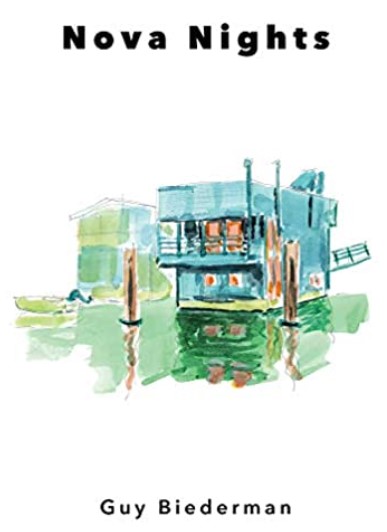
    Guy Biederman teaches short fiction and is the author of five collections of short work, including Nova Nights (Nomadic Pres,), Edible Grace (KYSO Flash Press), and Soundings and Fathoms, stories (Finishing Line Press).  

    His work has appeared in many journals including Carve, Flashback Fiction, MacQueen’s Quinterly, Bull, great weather for Media, Riddled with Arrows, The Disappointed Housewife, and Exposition Review.

    He’s been a creative-writing midwife since 1991. His collection of short work, Translated From The Original: one-inch-punch fiction will be published by Nomadic Press in 2022.

    You can purchase a copy of Nova Nights (and support a really great independent publisher).

    Note From Marlene: Right before I read “Crafting Short Fiction,” I sent off a submission to a contest with the theme of “imagine.” After reading “Crafting Short Fiction,” I was surprise to realize I created “room for readers who bring their imaginations to the page and make the experience their own.” At least, I hope that’s what I did.

    But when I wrote it, I didn’t know I was doing that. So, yay, for playing with words, making changes bonsai style for writing that opens the door for possibilities and also respects the reader.
    I like to think that’s what I did with my contest entry. And, maybe I did~!

    Your turn: Just write!

  • Do you need a developmental editor?

    Shirin Yim Leos

    Guest blogger, dev-editor, and author Shirin Yim Leos, answers the question she’s most often asked: What is developmental editing, does it really make a difference, do I need it and how much—HOW MUCH?!?!—can I do for myself?

    What is Developmental Editing?

    It’s the big, high level, Is the book working? edit.

    Does it make a difference?

    Resoundingly yes. Ask any author with a career.

    Do I need it?

    No writer can accurately see their own work. It’s a fact, like refraction through water or distortion through atmosphere.

    How much does developmental editing cost?

    It varies, but here are some recently published rates in The Write Life.

    How to be your own Developmental Editor

    Can I do it for myself?

    Try to duplicate a dev editor’s distance. They come to your pages cold and you can replicate that:

    Put your writing away in a drawer for 3-6 months. I can hear you yelling, BUT I’M IN A RUSH TO GET PUBLISHED!!!! Anyone in a rush shouldn’t be attempting to get traditionally published. That’s just the truth. It is a loooong process even with the best of luck. If the clock is ticking that badly for you, consider self-publishing.

    Find a rubric, a new lens that will let you evaluate the work with some objectivity. If you’re writing commercial or genre fiction, a beat sheet might be helpful. Save the Cat Writes a Novel is often recommended. The book is backed by an entire website of beat sheets, classes, and podcasts that you can download.

    If you’re writing literary fiction, Donald Maass’s The Emotional Craft of Fiction focusses on creating and manipulating the reader’s emotional journey.

    Freytag’s Pyramid in its modern rendition is useful as a draper’s dummy to lay your work against; to see if what you’ve made is in the actual shape of a book. (Don’t underestimate this. Remember when you can’t see, it’s very hard to discern shape. My own work invariably has a too-long sleeve and a missing collar when it’s submitted as “perfect” to an agent or editor. I am always amazed in retrospect by how I suspected X, Y, or Z on some subliminal level but could not see it.)

    Learn as much about editing, as opposed to writing, as you can. I teach dev editing in my workshops.


    Buy as much professional help as you can afford. I used to advise writers to go to writers’ conferences (here’s the AWP list) and sign up for consultations with editors. The Writing Day Workshops, especially, focus on getting writers in front of editors and agents, and vice versa. Of course, now there is also the online equivalent of a 24/365 writers conference dedicated to helping you get your manuscript and query in shape for pitching: Manuscript Academy, with its extensive faculty of editors and agents.

    In whatever conference-like setting you find us, participating editors are taking huge cuts to our fees out of good will to the organizers. Take advantage of this!

    Here’s a tip: the most useful thing to have a dev editor read for a short consultation is your synopsis, or your query and synopsis, if you can squeeze it in. Save first pages for when you’re sure your story is in great shape and you have focused on polishing that powerhouse first chapter.

    Of course, you can also book editorial consultations through most editors’ websites. It will cost you more than at a conference, but it will also be to your own schedule and in a less hectic environment.

    If you want feedback on your entire book but can’t afford a dev edit, many editors offer manuscript analyses that are not as detailed as dev edits. I don’t offer these (I’m so anal that if I read your book, I’ll have too much feedback to fit into a brief assessment), but my dev editor friends Susan Chang and Lisa Manterfield both do.


    Make the most of free opinions. Join writers’ groups. If you don’t know where to find one, reach out to genre-specific or regional organizations like SCBWI or the California Writers Club, or organize one yourself.

    The chats or cafeterias of writing conferences, classes, and events are a good place to introduce yourself and your idea of forming a group. Go to writing retreats where work will be reviewed or critiqued.

    Develop a list of beta readers—people you trust whom you can swap whole-manuscript critiques with. Be generous with your own time and assistance, and it might be returned to you in spades.

    Of course, the aim of all this is to get your manuscript ready for an agent.

    Developmental editing sharpens your arrow for your one shot. Because, you probably will only get one shot with a particular agent.

    When it comes to finding your many targets, here are a few possibilities:

    1.  If you know the books you’d love yours to appear next to, look at their acknowledgements. Nearly all authors thank their agents. (Sometimes, you have to plug a few names into Google to figure out who’s who.) Build a list this way. Everyone on this list will have liked a book like yours well enough to acquire it; and been competent enough to sell it. This is what I’d call a vetted and targeted list; an A list.

    2. You can also build a list through good-old research. Websites such as ManuscriptWishList, querytracker, and publishersmarketplace make it easy to find agents, see what they’re wishing for, what they’re buying, what they’re selling, and for how much. So you just have to do the leg work of matching the agents who do X to the X you want doing. Then, PLEASE, visit their websites, browse through their client lists, and read their submission guidelines before querying. Be a professional! Do your homework!

    3. If you can, compile a list through networking. They say the average first novel takes seven to nine years. In all that time, hopefully you’ll have become part of a writing community. Ask all the published authors you know whether they would recommend their agents. Always ask what they like best about them, and what is most challenging. Depending on your personality, some traits are deal breakers. If an agent sounds good for you and your book specifically, ask that author friend if they would mind giving you a recommendation. This is not something pushy, desperate, and despicable. This is how most agents prefer to acquire their new clients!

    4. When you have your lists of agents, see if you can find them at conferences—the Writing Day Workshops are organized specifically for this purpose, and Manuscript Academy provides a very similar service. Attend classes and workshops these agents give. See if you admire them as professionals and like them as people. And see if they like you! Pay for a consultation. This may not be a pitch, depending on the conference, but it is exposure. At the very least they’ll have seen your work and given you real feedback on how to further sharpen that arrow for the next agent.

    Until then, happy writing!

    SHIRIN YIM LEOS is an Ezra Jack Keats Award-winning author and a developmental editor. She has coached writers who have secured multi-book deals from Big Four publishers, and was the founder and former Head Goose of Goosebottom Books.

    Shirin also leads writing retreats and teaches writing and publishing for universities and conferences internationally. You can find out more about her services and her twenty published books at shirinyimleos.com.

  • Create a Hygge Calendar or List

    Photo and heart, by Susan Lawrence

    We hear a lot about being grateful, giving thanks, gratitude lists, and silver linings.

    But what if you just aren’t feeling it?

    How about creating a hygge calendar? I read about this in a Facebook group.

    Make a list of things to be mindful about, a way to help get out of the doldrums and into a feeling of calm, care, and positivity.

    Pay attention to one item each day.

    Personalize your calendar and use it as advent calendar, or as a way of looking at old things in a new way.

    Hygge: A quality of coziness and comfortable conviviality that engenders a feeling of contentment or well-being, regarded as a defining characteristic of Danish culture.

    Hygge Advent Calendar ideas, or a list of how to create a feeling of coziness:

    1. Light a candle during meals.

    2. Chalk a friendly greeting on a sidewalk.

    3. Share an uplifting poem or a story with friends.

    4. Bundle up and sit outside in the evening with twinkle lights.

    5. Read children’s books about Christmas and winter.

    6. Drive around and look at Christmas lights

    7. Hold or look at an item that belonged to a beloved family member, or a beloved friend.

    8. Phone a family member or a friend, just to say hello. Talk about a fun or memorable event you shared.

    9. Make something, it could be a baked item or a craft item.

    10. Sit outside for ten minutes and look at trees.

    11. Write a thank you note or a note just to say “Hi, I’m thinking about you.” Mail it!

    12. Boil cinnamon and orange peels to make the house smell good.

    13. Turn off all lights except for a candle or two (recommend battery operated). Get comfy under a warm blanket. Sit with the quiet.

    14. Look at family photos.

    15. Send a donation or donate your time to helping others.

    16. Make a nest of pillows and read a familiar and cozy book.

    17. Stand at a window and gaze at the view.

    18. Donate money or food to a food bank.

    19. Make paper snowflakes.

    20. Spend some time with a neighborhood pet.

    21. Take a few, deep, nourishing breaths. Breathe in. Breathe out.

    22. Soak feet in mineral salts while listening to music.

    23. Zoom into GROOVE dance with Diane Dupuis, Yoga with Adrienne, Feldenkrais, Insight Timer meditation.

    24. Write, using prompts from The Write Spot Blog.

    Thank you, Susan Lawrence, a speech therapist, in Los Angeles for this inspiration. Susan created her Hygge advent calendar by making a heart shaped wall hanging with pieces of gold paper, each one has a cozy activity written on it and placed in the pockets randomly.