
Stan and the Moon Shadow

  • Stan and the Moon Shadow

    Memorable writing that sparks imagination. Lean in. Hear the writer’s voice on the page.

    Stan and the Moon Shadow

    By Su Shafer

    It was THE SOLAR ECLIPSE DAY! 

    When he got out of bed, the moon was moving in the sky.

    As it always was, of course, but with more excitement that day than usual. 


    It was common place for the moon to be seen in the daytime, but today 

    It would meet the sun face to face and wear its fiery crown, as 

    The Earth looked on, far below.


    It was a big day for the moon, but for Stanley, not so much.

    Just another passing shadow added to a life 

    Where everything was painted with a leaden umbra.


    When he opened his eyes, his room overflowed with a dull gloom


    More than darkness, as if the blackness in his dreams spilled 

    Out of his head and flooded the air, staining the carpet like an oil spill, 


    Turning white walls a dirty gray.

    Flipping the light on, the shadows scattered like roaches, 

    Cowering behind the dresser, huddling under the chair. 


    Dispersed but not dispelled. 

    But still, this was a victory. Always the goal of his day. 

    There’s no way to rid oneself of shadows, 


    But he could, if he tried, keep them at bay. 


    They were loitering everywhere:

    Swirled into the black of his coffee, 


    Pressed between the newspaper pages 

    As he breakfasted on granola and obituaries. 

    They peeked out of the cat kibble as he poured it in the bowl.


    Every step on the porch covered the one below with a cold carpet of shadow. 

    His hand grasping the rail for balance sent a dark portrait of his frailty

    To the concrete canvas of the patio. 


    He felt the shadows growing around him, lurking. 


    Hovering over him like a Stygian claw, 

    Then slipping back to nonchalance when he turned.


    But they would get him one day, he knew. 

    It’s what happened to people his age.

    One day, perhaps soon, he would blink or sneeze, 


    And a shadow would rush in like a sneaker wave 

    And swallow him whole. And he’d be gone. 

    Alone and lost in a dark endless void of nothingness.


    He didn’t need to look up to know when the trickster moon stole the sun’s blazing crown. 


    The day darkened and became the moon’s shadow. Then the show was over.


    The moon took off the golden crown with a quick bow and moved off stage.


    That’s all we get, Stanley thought. Even the moon. Just one little minute to shine in the sun.

    Su Shafer is a creative crafter, fabricating bits of writing in poetry and short stories, and other bits into characters that appear in paintings or sit on various bookshelves and coffee tables.

    She lives in a cottage on the Olympic Peninsula of Washington, where the tea kettle is always whistling and the biscuits freshly baked.

    One never knows who might stop by to share a rainy afternoon.

    Su Shafer’s writing can be enjoyed on the Sparks pages of The Write Spot Blog, The Write Spot to Jumpstart Your Writing: Discoveries and The Write Spot: Musings and Ravings From a Pandemic Year.

  • Night Knight

    Memorable writing that sparks imagination. Lean in. Hear the writer’s voice on the page.

    Night Knight

    By Su Shafer

    We spend almost every night together.

    I’m not away from home often

    But when I am, I ache

    And I don’t sleep well.

    I am uncomfortable with

    The hardness of strangers

    The impersonal coarseness

    Or aloof purist sterility.

    There is never the welcoming

    I get at home.

    The soft embrace,

    The understanding.

    At home there is no judgment

    Or pressure that I am not doing enough,

    No criticism that I am not enough

    My bed cradles me like a mother.

    I am held in a cocoon of love

    I never want to leave.

    I close my eyes and my bed hums

    A silent lullaby

              Sleep dear one

              Tired caterpillar

              Your work will wait

              Dream of wings

              And drinking flowers

              Wake up the butterfly

    That you are.

    Su Shafer is a creative crafter, fabricating bits of writing in poetry and short stories, and other bits into characters that appear in paintings or sit on various bookshelves and coffee tables.

    She lives in a cottage on the Olympic Peninsula of Washington, where the tea kettle is always whistling and the biscuits freshly baked. One never knows who might stop by to share a rainy afternoon. And all are welcome.

    You can read more of Su Shafer’s writing here:

    Herald

    Burgeoning

    And in The Write Spot Anthologies, available from local booksellers and on Amazon (print and as ereaders):

    The Write Spot to Jumpstart Your Writing: Discoveries

    The Write Spot: Musings and ravings From a Pandemic Year

  • Push Past The Fluff

    When you are freewriting and there is more time to write, but you feel ready to stop . . . try to keep going. Push the limits. Push past the urge to go no farther.

    After the fluff is written, deeper writing can happen. Perhaps a doorway to intuitive writing will open.

    One of the benefits of writing fine details when freewriting, besides exploration and discovering forgotten items, is that details are what make stories interesting and make them come alive.

    I Feel Statements
    The reason for “I feel” statements in freewrites is that this is a way to learn and access your emotions about what happened. This is what personal essay or  memoir writing is all about. The facts are interesting, but what the reader wants to know is:

    ~ What the narrator gained

    ~ The narrator’s emotions

    ~ What lesson was learned

    ~ The epiphany or the “aha” moment

    Freewrites

    The Freedom of Freewrites

    Freewrites: Opening Doors to Discoveries

    Just Write!

    #amwriting #justwrite #iamawriter

  • Barbara’s Braid

    Memorable writing that sparks imagination. Lean in. Hear the writer’s voice on the page.

    Today’s Sparks is a pantoum.

    Barbara’s Braid

    By Karen Ely

    Weaving strands of amber honey

    Over, under, around and through

    Silky locks of shimmer sunlight

    Plaited patterns, three by two


    Over, under, around, and through

    Brush strokes cultivate the threads

    Plaited patterns three by two

    A tapestry of golds and reds


    Brush strokes cultivate the threads

    Silky locks of shimmer sunlight

    Plaited patterns, three by two

    Weaving strands of amber honey


    Karen Handyside Ely was born and raised in Petaluma, California. She delights in difficult crossword puzzles, the Santa Rosa Symphony, and traveling with her husband, James.

    Karen has been published in The Write Spot to Jumpstart Your Writing: Discoveries, The Write Spot: Reflections, The Write Spot: PossibilitiesThe Write Spot: Writing as a Path to Healing, and The Write Spot: Musings and Ravings From a Pandemic Year.  All available at Amazon and your local bookseller.
    Discoveries is on sale for $6.99 at Amazon for a limited time.

    Writers Forum hosts Saturday afternoon writing for the month of October 2021. Free on the Zoom platform.

  • Chuckstable

    Memorable writing that sparks imagination. Lean in. Hear the writer’s voice on the page.

    Chuckstable

    By Lynn Levy

    Dana cracked her gum and then smoothed it against the roof of her mouth. She pushed her tongue through, making that all-important thin membrane that would become the bubble, and Bobby watched, thinking that the gum made her tongue look as pink as the boa she was wearing. Which was saying a lot.

    There was no explaining, really, why Dana was wearing a boa at all, but Bobby knew her better than to ask. Dana had on a boy’s tank top, cut-off jeans, and Goodwill Kiva sandals with one of the straps broken. She also had a scab on her left knee that grossed out the toughest kid in the neighborhood, and a thin white scar on her right arm from the time she’d fallen out of the big old oak on a dare that she could climb higher than the boys. The bone had stuck through, but Dana didn’t cry. After that she made her own rules, and nobody stopped her. If she wanted to wear a pink boa to catch snapping turtles, that’s what she did.

    Dana blew the bubble and popped it, and used her tongue to pull the broken film back into her mouth.

    Bobby pushed his old safari hat down over his forehead, hoping the shadow would hide his eyes. If Dana caught him staring, he was sure he’d shrivel up and die, though he wasn’t sure why. He wasn’t even sure why he was staring, actually, it was just that over this last summer, somehow Dana had gotten really … interesting.

    While he watched, she took a couple of quick lithe leaps across the flat stones, until she was in the middle of the creek, cool water riding over her feet, making the creek surface a different shape right there, two smooth glassy bumps that no longer looked like feet. Dana crouched and looked down into the water. She let her fingers dangle just below the surface, the current drawing little wakes around each one. She didn’t seem to notice the ends of the boa dipping into the creek, the feathers shrinking with wet.

    Bobby jumped a little when she squealed. “It’s a big one!” she called. Then, annoyed, “Are you gonna come help me or what?”

    Bobby ambled over to the creek bank as if he was just himself, instead of how he felt, like he was someone meeting Dana for the first time and shy because of it. He’d known Dana since their Mommas had let them play out in front of the trailers, in undershirts and no pants.

     “What do you want with them snappers, anyway?” Bobby asked.

    “I wanna put one in Duane’s outhouse,” she said. “On accounta what he said about Chuckstable.”

    Chuckstable was Dana’s dog and the love of her life. He was also the ugliest thing God ever put together. What Duane had said was actually pretty funny, but didn’t bear repeating unless you liked the taste of soap.

    “His Pa finds it, he’ll just kill it,” Bobby said. Dana looked up at him, squinting. The light caught her eyes, and the browns and greens flickered just like the creek bottom.

    “Ya think?” Dana asked.

    “Uh huh,” Bobby said.

    Dana sighed, and leaned forward, reaching into the water to stroke the turtle’s shell once, carefully, from behind. Bobby noticed the way the knobs of her spine pushed against the tank top, and had the weird thought that she’d be safer in life if she had a shell too.

    “You’re right,” she said, standing. The wet ends of the boa came out of the water and clung around her knees. “But it was fun to think about.”

    Originally published in The Write Spot to Jumpstart Your Writing: Discoveries, print version available for $6.99 for a limited time at Amazon.

    Lynn Levy’s writing has also been published in The Write Spot: Possibilities and The Write Spot: Musings and Ravings From a Pandemic Year. All available in print ($15) and ereaders ($3.49) at Amazon. E-reader available with Kindle Unlimited.
    All the Write Spot books are also available through your local bookseller.

    Lynn Levy lives in Northern California with her husband, an endless parade of wild birds, and one dour skunk who passes by nightly. She and the skunk have an understanding.

  • Journey

    Memorable writing that sparks imagination. Lean in. Hear the writer’s voice on the page.

    Journey

    By Pam Hiller

    The first leg of our trip to Nashville began with a Thursday afternoon flight. As Jon spent the three hours attending to job details on his laptop, I found myself increasingly staring at cloudscapes from my window seat. Snow covered mountaintops appeared to float on a sea of white clouds. Sunset over New Mexico’s red rock formations astounded with light, shadows, reflections, as earth and sky interacted. Dusk’s purple light soothed west Texas plains where vein-like rivers flowed. The night sky, increasing lightning flashes on the horizon, thrilled as our plane was diverted from Dallas to Wichita Falls.

    A question began emerging in my mind and heart. I felt myself a part of the grandeur, the immense mystery I was observing. On the other hand, it was apparent that an individual life is literally invisible in nature’s vast scale. Does a single human existence really matter?

    Saturday afternoon we attended a ceremony naming our former high school auditorium after a beloved drama teacher. City officials presented a declaration from the mayor declaring it Kent Cathcart Day in Nashville. Two former pupils gave speeches describing this man’s profound impact in teaching students to dare living authentically. Approximately half of the people in the audience were students from his first theater class in 1972 through his last class in 1999.

    Once the speeches ended Kent sat in a brown leather armchair on the stage, a fatherly figure sharing his thoughts and observations. Amid the laughter and memories, he expressed a few simple statements about his faith, in a way as a public school teacher he hadn’t before. He told us that every morning before teaching he would attend an early morning mass. He spoke of allowing one’s active life to lead to a place of silence where God could be heard. He emphasized that whatever spiritual path one followed making room for this silent space was an essential component. As in our youth, we listened spell-bound.

    Post celebration several former classmates met at a nearby home. We talked late into the night describing adventures (and misadventures) connected to time we spent in our home away from home, classroom S-01. As the evening progressed it became apparent that each of us had felt seen, attended to by Kent, in ways that deeply affected us both as teenagers and adults.

    So, to return to my question—does a single human life matter? What I experienced that weekend is that each life radiates outward in circles we can’t possibly imagine. While I still felt awed by the unknowable mystery of it all, I also felt more grounded in the feeling that the integrity of each person’s actions is important. We all contribute to the world in ways that are obvious, and in ways we may never know.

    Pam Hiller draws upon the storytelling traditions of her Tennessee childhood as inspiration for her writing. She has been blessed with a mother, relatives, and friends who know how to tell a good tale. Book-filled libraries have provided her with endless sources of wonder and interesting thoughts to ponder. It is Pam’s wish to write from the heart, from life experiences that influence her changing sense of being alive.

    Originally published in The Write Spot to Jumpstart Your Writing: Discoveries, on sale for $6.99 for a limited time at Amazon.

    You are invited to post comments on the Writers Forum Facebook page.

  • I could never . . . Prompt #599

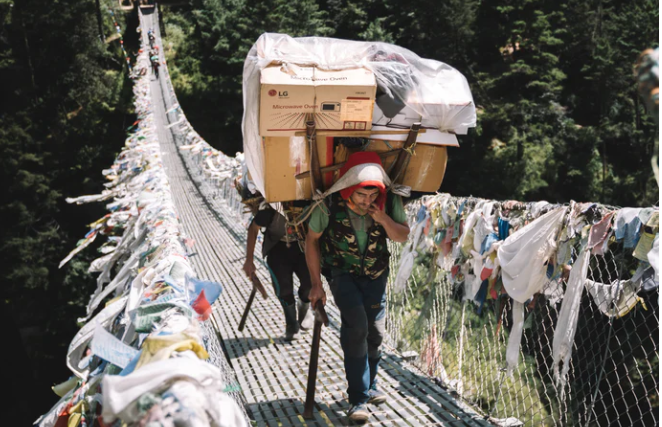
    Nepal suspension bridge. Photo by Mick Truyts, Unsplash

    Writing Prompt. Choose one and Just Write.

    I could never get rid of . . .

    I could never like . . .

    I could never go to . . .

    I could never eat . . .

    I could never get over feeling guilty about . . .

    I could never forget . . .

    Pick one or make up your own:
    I could never . . .

    This writing prompt is from “The Write Spot to Jumpstart Your Writing: Discoveries” along with 57 other writing prompts. Discoveries is on sale for $6.99 at Amazon for a limited time. ereader is $2.99 or free on Kindle Unlimited.

  • An Exercise in Barbecuing

    Memorable writing that sparks imagination. Lean in. Hear the writer’s voice on the page.

    This Sparks page on my website, The Write Spot, is, hopefully, a place for entertaining, fun, and enlightening reading.

    “An Exercise in Barbecuing” by DS Briggs is one of the funnier stories in Discoveries.

    The Write Spot to Jumpstart Your Writing Discoveries is for sale for a limited time for $6.99

    An Exercise in Barbecuing

    DS Briggs

    Very recently I leapt into the world of backyard barbecuing. For years I have secretly wanted to learn to barbecue. In my family it was always my Dad’s domain. However, I love grilled foods and got tired of waiting for Mr. WeberRight to BBQ for me. I proudly acquired a very big, shiny new Weber BBQ. It came with a grown-up sized grill width of twenty-two and a half inches. I dubbed my new friend “Big Boy.”

    Unfortunately, for me, Big Boy came in a big box with far too many pieces. It was with a definite leap of faith to undertake putting Big Boy together. He did not have written directions, nor a you-tube video and I have no degree in advanced “IKEA.”

    Instead, Big Boy came with an inscrutable line drawing and lots of lines leading to alphabet letters. Still, I have my own Phillips’s head screwdriver. I used to call it the star-thingie until an old boyfriend corrected me. But I digress. Suffice to say, after trials and even more errors, I constructed Big Boy.

    Okay, so it took me three hours instead of twenty minutes, but Big Boy was upright and proud. I just wanted to admire my handiwork by this time and Big Boy was clean, so very clean. In fact, he was too clean to use. I postponed the baptismal fire and nuked my dinner that night. In a couple of days, after repeated trips to the store for important and essential tools of the trade: A cover to keep Big Boy dry and clean, real mesquite wood to feed him, and long-handled tongs. For my own protection I bought massive mittens. I was almost ready to launch Big Boy. 

    A few forays into the garage for additional must haves—my landlord’s trusty but rusty charcoal chimney fire starter can with a grate on the bottom and handle on the side and a dusty, spidery partial bag of charcoal in case my mesquite wood failed to turn into coals. I was finally ready to light up the barbecue. I chose to inaugurate Big Boy on a humid, somewhat breezy day. No gale force winds were predicted. As a precaution, I hosed down the backyard weeds. I found matches from the previous century and a full Sunday paper for starter fuel. The directions to stuff the bottom of the charcoal chimney can with crumpled newspaper and then load up the top part with either charcoal or wood sounded easy enough.

    I chose to use the mesquite wood based on advice from Barbecue Bob, a friend of mine. I lit the chimney and soon had enough white smoke to elect the Pope. I waited the prerequisite twenty minutes for coals to appear. Nada. Nope. No coals in sight. The wood had not caught fire, although the paper left a nice white ash. Hungry, but not deterred, I re-stuffed the bottom of the charcoal chimney with more newspaper and set the whole chimney on top of a mini-Mount St. Helens pile of newspaper. I found smaller bits of wood since the lumber did not ignite. I lit the new batch of newspapers again. After a second dose of copious white smoke, miracle of miracles, the splinters of wood caught fire. Finally, it produced enough smoke for the oleanders to start talking.

    “You do know it is a red flag day.” I know bushes don’t really talk, so I assumed the warning came from the owner of the fish-belly-white legs and flip-flops standing behind the tall, overgrown oleanders.

    Having no clue what Flip-Flops meant, I explained that I was trying to learn how to BBQ. I asked what she meant by red flag day and she said that it was extreme fire danger in the hills. Aside from the fact that there was not a hill in sight, I told her that I had the hose at ready. I also asked Flip if BBQing was banned on red flag days. She didn’t know, however, I think I heard the word fire bug. Perhaps she just wanted to let me know that she knew who was playing with matches on a red flag day in case the fire department asked.

    Reassuring Neighbor Fire Watch, I carefully emptied the chimney’s coals onto Big Boy’s smaller, lower but still sparkling clean grill. Using my mitts, I gently crowned Big Boy with the very clean, shiny huge upper grill. The sacrificial chicken had, at last, a final resting place. Whoosh! The previously white Pope smoke was now black and voluminous. Turns out olive oil makes lots of good smoke and less-than-helpful flare ups of flame. With my hands still ensconced in bright red mittens and using a very long tong, I turned the chicken. Only slightly blackened. I kept turning the chicken every five or ten minutes. More black, but not at the briquet stage—yet. I figured I had better recheck my BBQ Bible, the thick one with pictures so you can compare your results with theirs. Their advice was to cook the chicken until it had an internal temperature of 189 degrees Fahrenheit. I hoped Fire Watch was not watching because I dangerously left my BBQ unattended to go rummage through my kitchen drawers in search of an instant read thermometer. I knew that I would need it someday when I bought it a decade earlier. I inserted it and watched it slowly rise to 145 degrees. Only 44 more degrees to go but I was starving and the coals were cooling! I knew this because according to said Bible you hold your hand above the coals and count three Mississippi’s for good heat.

    By the time I had counted “One Mississippi, two Mississippi, three Mississippi . . . fifteen Mississippi,” even I could tell the coals were dead. I pulled the chicken off the grill. The skin was definitely done. Delicious? No. Blackened? Yes. Delectable? No. Vaguely resemble the BBQ Bible’s picture? Not at all.

    So for the lesson summary: Two hours of perseverance resulting in one hardly edible, even when finished-in-the oven chicken. Adding insult to injury I had a very dirty, sticky, greasy, too-large-for-my-sink grill to scrub.

    Lesson learned: find a home for Big Boy and call take-out.

    DS Briggs resides in Northern California with Moose, her very large, loving, and loud hound/lab mix. She has been privileged to contribute to Marlene Cullen’s Write Spot books: Discoveries, Possibilities, and Writing as a Path to Healing.

    Share your barbecue story on my Writers Forum Facebook Page.

  • About Anthologies

    What do you think when you hear a book is an anthology?
    Some people may be delighted with thoughts of reading from a variety of authors. Others may groan, remembering antiquated stories in outdated books.

    Me? I’m excited to produce anthologies so that a diverse group of writers can be introduced into the writing scene.

    My third anthology, The Write Spot: Reflections was recently published with the help of two authors who didn’t even know they were cheering me on.

    Eleanor Henderson and Anna Solomon, co-editors of Labor Day: True Birth Stories by Today’s Best Women Writers, wrote an article, “Labor of Love,” printed in Poets & Writers magazine, May June 2014.

    “Labor of Love” was my steadfast companion on my journey from “What am I doing?” and “Will this work?” to the completion of three anthologies.

    Excerpt from “Labor of Love”

    “We’ve always loved anthologies. As new writers, we buried ourselves in them, finding stories, poems, and essays that shaped and inspired our own work. Now we return to them when we need a good laugh, or comfort — when we need the sort of perspective that only multiple voices can provide. The best anthologies are like the best mix tapes: individual pieces playing with and against one another, resulting in an eclectic, vibrant chorus.”

    Beautiful, gorgeous writing by Eleanor and Anna.

    “Labor of Love” describes their journey from conception of their idea for an anthology to the birth of their successful book.

    “When we checked in with our agents, they were tepid about the idea.”

    Eleanor and Anna persisted. They had faith in their project, gathered birth stories, found a publishing house and their book was published.

    Their final words, and these are the words that kept me going when I had doubts about producing anthologies:

    “Don’t lose faith. So the word anthology might turn some people off at first. But if you develop a unique idea and stay true to your vision, eventually it will pull readers in.”

    One of the challenges for The Write Spot series of books was what title to use. I wanted a title that indicated these are books to inspire writing and also books that are entertaining. With the third book, I simply shortened the title.

    The Write Spot anthologies are available for $12 at Amazon.

    The Write Spot to Jumpstart Your Writing: Discoveries

    The Write Spot to Jumpstart Your Writing: Connections

    The Write Spot: Reflections

  • What’s the latest? Prompt #348

    Things are settling down at Cullen Corner after the Holidaze. I hope everything is going well for you.

    It’s been quiet here on The Write Spot Blog on account of the holidays: Decorating, undecorating, traveling to be with family, having family here, watching Hallmark holiday movies, watching Doc Martin and The Amazing Mrs. Maisel  ( highly recommend), the usual December-January busyness.

    Since I last posted, I changed the title on the recently published The Write Spot: Discoveries to better reflect the contents.

    New title, same contents:  The Write Spot to Jumpstart Your Writing: Discoveries.

    Now, I’m working on the next anthology. I hope you are active with a project that you enjoy.

    Today’s prompt:  What’s the latest?

    I’m loving all the wonderful reviews of Discoveries. Here’s the latest review of Discoveries.

    Review by Diana McCurdy in The Sonoma County Gazette, founded by Vesta Copestakes.

    Book Review: The Write Spot to Jumpstart Your Writing: Discoveries

    Book groups proliferate so why not writing groups? That old beatnik, pre-hippie poet, Kenneth Rexroth said, “Against the ruin of the world, there is only one defense: the creative act.” And with so much unease in our society, with threats of war, polarization of political ideologies, hurricanes and fires why not diffuse some of that negativity by creating? Let us write stories, and poems, and essays, perhaps to stave off some ruin and stay semi-sane at least.

    Marlene Cullen is the creator of Jumpstart Writing Workshop. In a comfortable, non-threatening atmosphere, participants write and write and write. Their products turned out be so compelling that she wanted to share them with all of us. She has assembled a charming anthology entitled Discoveries. Discoveries is a compendium of all different kinds of creative acts and for each selection the creative process is described in detail.

    Writers are given a “prompt.” At the end of each piece we are told exactly what the inspiration was. For example, one writer recounts a comic interlude with a recalcitrant Weber BBQ. The impetus for this was, “write about a leap you have taken.” At the end of each author’s section there is a mini-biography and some words of encouragement that describes their process.

    Part of the delight elicited by this collection is the disparate range of topics. This little book includes something for everyone’s preferences. Subjects include old-fashioned laundry rituals, the great hot lunch, cold lunch school dilemma, hormones, romance, gloves and soap.

    The ending segment reads like a lesson plan to start a writing group of one’s own. There are hints on what to do if your creative juices are stuck, a list of prompts and a generous bibliography. Entries are short and in our busy, very busy lives it is easy to pick up the book and read a few inclusive selections and then put it down for another day to discover a different author’s work. Available on Amazon.com,

    Diane McCurdy was born in Santa Rosa.  Her dad had ranches so she learned the value of hard work at an early age.  She has a BA from SF State and an MA from SSU in English Literature and several teaching credentials, two grown children and three cats. She’s been  all over Europe, Mexico, Hawaii and visited schools in Japan and China and stayed with relatives in Brazil.  Diane has a lifelong interest in film.  Her mother met her father when she was selling tickets at the box office of her father’s theater, the first motion picture house in Sonoma County.