We read for many reasons and different kinds of pleasures. One of those pleasures is recognition—of a moment, a place, a feeling state. It’s the writer’s job to find language for those moments, those feeling states, that allows the reader to access their own feelings, that makes them think, “Oh, I never thought of it that way before. I could never find the words or the language for that.” Illuminating ordinary life, to me, is one of the most beautiful ways to write and to read. —Dani Shapiro, in conversation with Suleika Jaouad
I’m a worrier, trying to be a planner. I imagine what could go wrong so I can plan for when that happens. I suppose I should say “if” it happens. My worries seldom happen. Instead, things happen that I could never have imagined.
But, as Leo Buscaglia said, “Worry never robs tomorrow of its sorrow, it only saps today of its joy.”
A therapist said to me, “Worry is modern man’s voo-doo.”
I get that.
“Worry is like a rocking chair: it gives you something to do but never gets you anywhere.”– Erma Bombeck
Well, as I sit and rock, I could plan what I would do if my worries came true.
“When I look back on all these worries, I remember the story of the old man who said on his deathbed that he had had a lot of trouble in his life, most of which had never happened.” – Winston Churchill
So where does that leave us? Some writers play the “what-if” game all the time. They get some of their best ideas that way.
I think we need to know when our worry-thinking disables us and when our worry-thinking helps us.
It’s good to have a plan if an immediate evacuation becomes necessary, such as having a to-go bag ready to go at a moment’s notice. And having an emergency kit easily accessible is a good plan.
Being positive can help worriers. Not dwelling on “something bad is bound to happen.” But rather, be prepared.
Part of that preparation might be positive thinking for mental health.
“The best and most beautiful things in the world cannot be seen or even touched – they must be felt with the heart.” — Helen Keller
In times of difficulty, or chaos, “look for the helpers,” as Mr. Rogers said.
“Nothing is impossible, the word itself says ‘I’m possible’!” Audrey Hepburn
“Try to be a rainbow in someone’s cloud.” — Maya Angelou
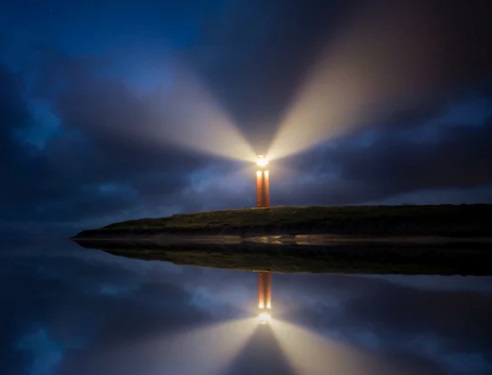
If you are writing the clearest, truest words you can find and doing the best you can to understand and communicate, this will shine on paper like its own little lighthouse. Lighthouses don’t go running all over an island looking for boats to save; they just stand there shining.—Anne Lamott, Bird by Bird
“As Ray Bradbury says, don’t rewrite—relive. Your fiction is about creating emotion in the reader, and you can’t do that well without feeling it yourself.” —”The Geyser Approach To Revision,” James Scott Bell, July/August 2011 Writer’s Digest
Note from Marlene: This is true for memoir writing also.
“You’ve finished your first draft . . . You’ve written hot. Now you’re ready to revise cool with the help of creative spurts.
. . . wait at least two weeks before you do a first read-through of a draft. Then, go through it as fast as possible, as if you were a reader, resisting the urge to tweak anything just yet.”
Good advice for those who can do this. This isn’t my style, but it might be yours.
I do agree with waiting to revise. Let go of the attachment to your writing, your beautiful writing. Keep your darlings in a separate file if they can’t be used in the writing you are revising. They might be perfect passages for another piece of writing.
“Stories are how we make sense of our lives, how we attempt
to impose some discernable order on the chaos of existence, and such attempts
make the chaos bearable.” — Bret Anthony Johnston, “Narrative Calisthenics,”
Poets & Writers, Nov/Dec 2008
Writing is the way I try to make sense of my life, try to find meaning in accident, reasons why what happens happens. Sometimes just holding a pen in my hand and writing milk butter eggs sugar calms me. Truth is what I’m ultimately after—truth or clarity. Writing memoir is a way to figure out who you used to be and how you got to be who you are. — Abigail Thomas, “Thinking about Memoir,” AARP magazine, July/August 2008
Stories
should be aimed not at our heads but at our hearts.
“And this is
where things get interesting, because description actually allows access to our
hearts in a neurophysical way.”
I have
wondered why reading something with sensory detail leaves more of an impression
than writing that doesn’t have sensory detail.
According to
studies, “when we read about an odor, it engages the exact same part of the
brain as actually smelling it, and those parts of the brain reside in the lower
region, alongside our emotional centers. . . When you write using smells, or
images, or sensations, you’re actually gaining access to the emotional area of
the brain, and this is why stories can take such precise aim at the heart.
Words like
lavender, cinnamon, and soap, for example, elicit a response not only from the language
processing areas of our brain, but also those devoted to dealing with smells. The
brain, it seems, does not make much of a distinction between reading about an
experience and encountering it in real life; in each case, the same
neurological regions are stimulated.”
Excerpted
from “The Heart and the Eye: How Description Can Access Emotion,” by J. T.
Bushnell, Jan/Feb 2013. Poets & Writers Magazine
J. T. Bushnell applies neurophysics to effective writing, shedding light on how strong description gains access to the emotional area of the brain.