“You have to be able to fail until you achieve what you want to be.” —Jon Batiste

“You have to be able to fail until you achieve what you want to be.” —Jon Batiste

Sy Safransky has this to say about editing:
Readers sometimes ask how much I edit my own writing.
I edit until each paragraph has lost the ten pounds it gained over the winter.
I edit until each sentence can survive three days in the wilderness on its own.
My father taught me to look at a sentence and, if it didn’t deserve to live, shoot it between the eyes.
Sy Safransky, The Sun Magazine, May 2011
“Stories are how we make sense of our lives, how we attempt to impose some discernable order on the chaos of existence, and such attempts make the chaos bearable.” — Bret Anthony Johnston, “Narrative Calisthenics,” Poets & Writers, Nov/Dec 2008

Writing is the way I try to make sense of my life, try to find meaning in accident, reasons why what happens happens. Sometimes just holding a pen in my hand and writing milk butter eggs sugar calms me. Truth is what I’m ultimately after—truth or clarity. Writing memoir is a way to figure out who you used to be and how you got to be who you are. — Abigail Thomas, “Thinking about Memoir,” AARP magazine, July/August 2008
Stories should be aimed not at our heads but at our hearts.
“And this is where things get interesting, because description actually allows access to our hearts in a neurophysical way.”
I have wondered why reading something with sensory detail leaves more of an impression than writing that doesn’t have sensory detail.

According to studies, “when we read about an odor, it engages the exact same part of the brain as actually smelling it, and those parts of the brain reside in the lower region, alongside our emotional centers. . . When you write using smells, or images, or sensations, you’re actually gaining access to the emotional area of the brain, and this is why stories can take such precise aim at the heart.
Words like lavender, cinnamon, and soap, for example, elicit a response not only from the language processing areas of our brain, but also those devoted to dealing with smells. The brain, it seems, does not make much of a distinction between reading about an experience and encountering it in real life; in each case, the same neurological regions are stimulated.”
Excerpted from “The Heart and the Eye: How Description Can Access Emotion,” by J. T. Bushnell, Jan/Feb 2013. Poets & Writers Magazine
J. T. Bushnell applies neurophysics to effective writing, shedding light on how strong description gains access to the emotional area of the brain.

J.T. Bushnell wrote, “I once burst into tears during a Tobias Wolff reading . . . as Wolff intoned the final passages from ‘Bullet in the Brain,’ I broke the silence of the packed auditorium with a gasp, a sob.”
Bushnell goes on to explain his strong emotional reaction.
“It was the final scene that set me off.”
This is what he remembered. Heat. A baseball field. Yellow grass, the whirr of insects, himself leaning against a tree as the boys of the neighborhood gather for a pickup game.
“Half a page later, the story ends with the passage that brought me to a fever pitch.”
For now Anders can still make time. Time for the shadows to lengthen on the field, time for the tethered dog to bark at the flying ball, time for the boy in right field to smack his sweat-blackened mitt.
“These passages by themselves seem innocuous enough. Each offers a series of descriptions, nothing more. But the conclusion I’ve come to over the years is that the description is exactly what produced my reaction.
By description I mean the concrete, the things we can observe with our five senses: sight, sound, smell, taste, and touch. I do not mean simple adjectives. I do not mean descriptions such as ‘The weather was glorious.’ Glory is an abstraction. The glorious is useless because it can’t show us anything concrete.
It can’t show a white-hot sun perched overhead, or a sky so hard and blue that a fly ball might shatter it. It can’t show a pitcher’s shadow puddled under his cleats, or heat rising from the ground in shimmering corrugation. It can’t produce the smell of hot aluminum bleachers. It can’t let you taste the sweat on your lip when you go too long between slugs of cold beer. Only concrete description can do that.
As novelist Richard Bausch advises, . . . a good story is about experience, not concepts and certainly not abstractions. . . . get rid of all those places where you are commenting on things, and let the things stand for themselves. Be clear about the details that can be felt on the skin and in the nerves.”
Excerpted from “The Heart and the Eye, How Description Can Access Emotion” by J.T. Bushnell, Jan/Feb 2013 Poets & Writers

“I write because I believe my words can change the world. Every paragraph, every sentence, every syllable I construct is written with the express intention of changing people and their families. I hope as you read this you are in fact changing and I hope you’ll let your families read this so they can change too.
Of course I’m kidding.
I write for cash and because as a child I was told I had excellent penmanship.”
“What’s the writing that makes you happy? That’s the writing to do.”
Doug Ellin, Creator, Executive Producer, “Entourage”
From September 2005 issue of Writer’s Digest magazine
“Comparison is a threat to joy. We tend to move through life comparing ourselves to others, and it’s anti-creative and pointless.” — Tony Goldwyn. actor
“The personal essay begins as an act of exploration. We write in order to figure out where we’re going and make sense of where we’ve been.” — Susan Bono
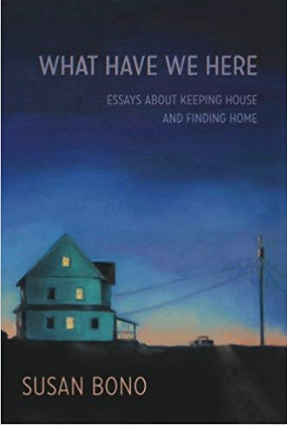
Susan Bono is an extraordinary writer whose words go right to the heart. You can read her excellent writing in her collection of short essays in
What Have We Here: Essays about Keeping House and Finding Home.
Susan is a writing teacher and freelance editor specializing in memoir. She facilitates writing workshops at Copperfield’s Books in Petaluma. California.
 “A writer’s problem does not change. It’s always how to write truly and having found what is true, to project it in such a way that it becomes a part of the experience of the person who reads it.” — Ernest Hemingway
Photo by Breana Marie