What does your character want? What gets in the way? Prompt #133

  • What does your character want? What gets in the way? Prompt #133

    Your character could be fictional or a real person.

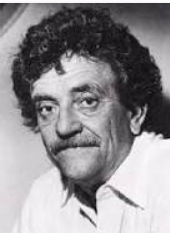
    Kurt Vonnegut says to “make your character want something.” There are several ways to go about this.

    Have your character do something unexpected . . . something that surprises everyone and weave in a problem.

    You can put your conservative character in an improv situation where he/she has to rap or act in a scene.

    Your male character might find himself on stage, learning how to hula or belly dance.

    Your female character might find herself in a lumberjack contest.

    Have your wild character volunteer to help with bingo in an assisted facility.

    Have your character do something unusual.

    Remember these are freewrites, where you write freely for 12 to 15 minutes. This doesn’t mean you have to use these character vignettes in your novel, essay or memoir. Have fun playing around with characters.

    Have fun making your character uncomfortable, make him or her squirm.  Worms on a fishing pole come to mind.

    Now, here’s how to really get into the heart of your character:

    What does your character want? What gets in the way?

    For prompts on character development, take a look at:

    Character development, discovering characters, prompt #132

    Flesh out your character, prompt #131

    Other character’s point of view, prompt #109

    Grow your characters, prompt #48

    Just Write!

  • “The key to a good essay is conflict, and . . . Victoria Zackheim

    “The key to a good essay is conflict, and the story’s (and character’s) arc. People have to change during the story, whether fiction or non-fiction. — Victoria Zackheim, interviewed by Chris Jane in JaneFriedman.com.

    Victoria Zackheim is the author of the novel The Bone Weaver and editor of six anthologies:

    He Said What?

    Women Write About Moments When Everything Changed

    The Other Woman

    Twenty-one Wives, Lovers, and Others Talk Openly About Sex, Deception, Love, and Betrayal

    For Keeps: Women Tell the Truth About Their Bodies, Growing Older, and Acceptance

    The Face in the Mirror

    Writers Reflect on Their Dreams of Youth and the Reality of Age

    Exit Laughing: How Humor Takes the Sting Out of Death

    and the upcoming FAITH: Essays from Believers, Agnostics, and Atheists (Feb. 2015).

    Victoria’s play, The Other Woman, based on her first anthology, will be featured in OneNight/OnePlay, and her play Entangled, an adaptation of the memoir Entangled: A Chronicle of Late Love, is in development at Z Space in San Francisco.

    Victoria’s first screenplay, MAIDSTONE, is now in development. She is story developer and writer of Where Birds Never Sang: The Story of Ravensbruck and Sachsenhausen Concentration Camps, aired nationwide by PBS.

    Victoria teaches Personal Essay in the UCLA Extension Writers’ Program. Victoria was a 2010 San Francisco Library Laureate.

    Note from Marlene: I have taken classes by Victoria. She is an amazing teacher, well worth the price (and it wasn’t that expensive!).

    Want to challenge yourself?  Take one of your characters (fiction or non-fiction) and do what Victoria suggests . . . give him or her a conflict.  Spend thirteen minutes on a freewrite. See what happens.  Need a boost?  Take a look at Prompts 132 and 133 for ideas on character development.

  • Guest Blogger Jane Merryman titillates with ‘What’s in a Title?’

    Jane MerrymanWhat’s in a Title by Guest Blogger Jane Merryman

     Naked Lunch

    A Crack in the Edge of the World

    The Borrowers

    Book titles. Delicious. They provide entertainment in themselves, never mind what’s between the covers. The words on the front offer promise, titillation, or confusion. Of course, some titles are strictly workaday: Wildflowers of North America; The History of England from the Accession of James II; Math Formulas and Tables. But other titles are delightfully misleading, some are curiously ironic, others are satirical or even nonsense.

    A Moveable Feast

    Fezzes in the River

    Manhattan Transfer

    The title may or may not be an exact pointer to what’s inside, but it’s definitely a label that fixes itself in mind and memory. Take Pride and Prejudice—it has a lilt to it. But do you really want to plod through several hundred pages of unillustrated text enumerating the consequences of a couple of vices, or would you rather read about landing a husband? From its title, you don’t know how much you might or might not enjoy reading this book.

    As a librarian I’ve spent many hours “reading the shelves,” an actual entry on the official list of library chores. I select a block of shelves and check every book, making sure it’s filed correctly by Dewey Decimal Number, author’s last name if it’s fiction, or subject’s name for biographies. This exercise affords plenty of time to savor the mystique of the title, pushing aside what I know of the work itself. I’ve read The Great Gatsby, but to someone who hasn’t (yet), what is a gatsby? No matter, the alliteration is the hook.

    One Hundred Years of Solitude sounds as if it could get soporific really fast, but it doesn’t. Men Are Like Streetcars, Memoirs of a Geisha, and The Plague all live up to their promise. War and Peace appears to have taken on too much. A Thousand Acres seems more do-able. Nine Stories is something I could definitely finish.

    Some titles tell you right away that Things Fall Apart, The Mambo Kings Play Songs of Love, and Friday the Rabbi Slept Late. At times they advise you to Play It As It Lays, to Go Tell It on the Mountain, or that You Can’t Go Home Again.

    My Family and Other Animals, Chocolat —these titles make us smile in agreement. The Lexus and the Olive Tree, A Clockwork Orange, Up the Down Staircase, A Wrinkle in Timethese fill us with consternation.

    The Naked and the Dead is one of those titles that leads us somewhat astray since it’s about the fully clothed and the living. Seeing Through Clothes might disappoint some readers with its lengthy footnoted discussion of the history of garments and fashion. Some books seem to be wanting to tell us about royalty—The African Queen, All the King’s Men, and The Prince of Tides—but they never make it to the palace.

    Authors can lift their titles from other works, such as the Bible, Shakespeare, and famous and not-so-well-known poets, and give them a resonance that sticks with us. We have East of Eden and The Sun Also Rises, For Whom the Bell Tolls, The Winter of Our Discontent, and The Grapes of Wrath. In nursery rhymes writers found When She Was Good and When the Bough Breaks. A book of travel essays went to a play to find its title, The Kindness of Strangers, which helps explain its contents, but are the others so transparent?

    Birds figure in many titles: The Maltese Falcon, The Painted Bird, Lonesome Dove, and Wild Swans. And of course mockingbirds, eagles, swallows, and blackbirds are all roosting on the library shelves, too. Little Birds, though, is not at all about ornithology.

    Titles beckon—invite us to go on a Forbidden Journey, to take The Road from Coorain, to venture Beyond the Khyber Pass, and catch The Polar Express. They offer to take us to a special place, anywhere from The House on Mango Street, to Under the Volcano, to Hiroshima, or suggest that we stroll down Revolutionary Road, Half Moon Street, and Lonely Avenue. Bridges turn up uncommonly often in titles—bridges to Terabithia, of San Luis Rey, at Toko-Ri, over the River Kwai, and on the Drina—and lead us on fraught, hardly light-hearted journeys.

    Need I go on? Haven’t you been tempted to read a book just because its title played with you? There’s a world—a universe—out there in books. Their titles might tell us exactly what is inside, what information we will tap into, what kind of adventure we will take off on. Some merely hint at the experience to come. Others don’t give us a clue, even after we’ve read the whole thing from foreword to appendix. But that doesn’t matter. Reading a shelf of titles is a pleasure in itself without even opening the books. Take Chocolat—’nuf said.

    In my opinion, though, all books should bear the subtitle Great Expectations.

    Jane Merryman specializes in copy editing: correcting grammar, spelling, punctuation, usage, and, as we say in the profession, infelicities.


  • Character development – discovering characters. Prompt #132

    For this two-part prompt, we’re going to develop a character, either fictional or based on reality (especially if you are writing memoir).

    How do writers develop characters?   How do you get to know your character beyond their looks, their desires and where they went to school?

    Step One: Give your character a hobby or an interesting job. The more unusual, the better. Bee-keeping? Needlepoint for a man. Bucking horses, art aficionado, chemist, skywriter, laundromat manager, tornado chaser.  You can look up unusual jobs that pay well by clicking here, such as: Cruise ship entertainer, ice cream taster, human statue, hot dog vender, dog groomer, personal shopper, funeral director.

    Sketch how your character might spend an hour of their work day, or hobby time: gathering honey, purchase yarn and patterns, ranch and corrals, visits to art galleries and museums, mixing potions in the basement.  You might paint a picture what an hour of their job looks like:  what do they see, who do they interact with, what do they think while working.

    Spend some time with this before going to the next step.

    Step Two: Interview your character as a journalist would. Stymied? Look at interviews in magazines, newspaper articles or look online and see what others have done.

    You can interview your character from Prompt #131, or create a new character.

    We’ll continue with character development with the next prompt.

          skywriter.1                             Laundromat.1                     clouds.tornado.1

    Skywriting photo by Breana Marie

  • Make characters want something right away . . . Kurt Vonnegut

    Vonnegut“Make characters want something  right away — even if it’s only a glass of water. Characters paralyzed by the  meaninglessness of modern life still have to drink water from time to time. …  When you exclude plot, when you exclude anyone’s wanting anything, you exclude  the reader, which is a mean-spirited thing to do.” — Kurt Vonnegut


  • Modern Love, The New York Times

    Heart.black outlineModern Love is an essay column in The New York Times.

    “Modern Love is an ideal place for beginning writers to break in with a piece written from the heart.” — February 2015 issue of Writer’s Digest magazine.

    Click here for how to submit essays to Modern Love.

  • Flesh out your characters. Prompt #131

    You can use this prompt for fleshing out your fictional characters or for characters in your memoir.

    In works of fiction, we think of characters. When writing memoir, we think real people. But, when you write about real people, they become characters in a story.

    With this prompt, you can create character profiles for the real people in your life and for your fictional characters.

    Prompt: Make a three-column list. Label the first column “What I know,” the second, “How I know it” and the third, “How I show it.”

    First column – create a list with one or two-word descriptions about the character. Second column – write down how you know the particular characteristics.

    For example, if the person is known to be cheap, in column 2, you could write, “brings own teabags to restaurants.” Or, “carefully saves paper bags for lunch, been using the same bag for six months.”

    Third column, How I Show It: Jot down short notes about how you might convey the characteristics to a reader. In the case of the cheap friend who brings his teabag to restaurants, you might write, “Scene: character pulls out several teabags from jacket pocket, just before entering restaurant.”

    Your turn: Bring your characters by showing vivid details about their everyday habits.

    This prompt was inspired from The Writer magazine, June 2005, “Frank Talk About Writing Your Memoir,” by Sol Stein

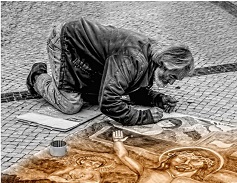
    Sidewalk artist                      Street kids                 Laundry machines and legs

  • Guest Blogger Clara Rosemarda – writing with depth and clarity

    ClaraGuest Blogger Clara Rosemarda reveals how to write with depth and clarity.

    Clara writes:

    Many years ago I took voice lessons from a master teacher. He worked with people
    who believed they were tone deaf. I was one of those people. My voice seemed flat as the ground I walked on, and I was too embarrassed to sing unless I was in a group large enough to swallow the sound of my voice.

    My teacher, robust and powerful, sat opposite me on the floor of his music studio. With full-bodied fingers born to make music he plucked the strings of his tambura going up and down the scale. Then he sounded a note and had me repeat it. At first I couldn’t reproduce the exact sound, but after a few tries and great concentration, I was able to. He told me I had a good voice which was a surprise to me. Once I got the hang of it, whenever I missed a note, he looked straight at me with his burning brown eyes, and asked where I had gone. Then he’d have me try again, and again, until I finally got it.

    These few lessons taught me that the problem was not with my voice, but my inability to stay focused and present. Although I was capable of deep concentration in many other areas, the life-long belief that I couldn’t sing disrupted my ability to listen and to replicate what I heard. Frightened that I would get it wrong, I tried to think my way through instead of trusting that if I listened I would be able to repeat the sound.

    Even though I don’t plan on giving a recital in Carnegie Hall or anywhere for that matter, I do enjoy singing now for the pure pleasure of it. Most importantly, I no longer consider myself tone deaf. I have developed the ability to concentrate when I’m singing, to listen deeply, and to be present with the sounds. When you are of two minds, neither one can be used to its fullest.

    The same is true with writing. When your mind is concentrated on a single thought or image, when you ARE the writing, and not jumping ahead of yourself, or thinking of HOW you are writing, you will write with depth and clarity.

    In the initial creation, all that is required is that you put pen to paper and keep your hand moving. Stay with your original thought, rather than allowing the editor to sit on your shoulder telling you not to say that, or how stupid this is, or what makes you think you’re a writer? To sound a clear note, you cannot be of two minds; your mind must be fully present and focused on a single point.

    EXERCISES:

    1. “His reflection in the mirror … ” Write for 1 0 minutes.
    2. “Walking through … ” Write for 15 minutes.
    3. “When I woke up that morning … ” Write for 20 minutes.
    4. Read these pieces aloud to yourself, listening mindfully, as if someone else had
      written them. What did you, the reader, hear that you didn’t hear as you were writing?

    CLARA ROSEMARDA M.A. is an evocative writing teacher, poet, memoirist, intuition counselor, and workshop leader. She has been in private practice in Santa Rosa, California for over thirty years where she works with beginning as well as mainstream writers. Clara teaches workshops at Santa Rosa Junior College and internationally. In her private sessions as well as her teaching she helps people connect to and act from their most authentic selves. She was co-creator and coordinator of the popular writers’ program, The Writer’s Sampler, of the Sebastopol Center for the Arts. Her prose and poetry are published in literary journals and anthologies. She is co-author and co-editor of the anthology, STEEPED: In the World of Tea (Interlink Publishing, 2004). Clara has two poetry chapbooks: “Doing Laundry” (a letterpress limited edition, Iota Press, 2013) and “Naked Branches” (WordTemple Press, Small Change Series, 2014).

    Note from Marlene:  If you have a chance to take a workshop with Clara. . . do it!  I did and it was a transformative experience.

  • Revealing Conversation . . . Prompt #130

    People talkingPretend we’re at a party, sitting together talking quietly. Then you see someone you know and you want to tell me about that person. They can’t hear us. What will you tell me about that person?

    Or: Imagine any two people having a conversation about a third person.

    With this prompt, you can practice writing dialogue, revealing more about the conversants than the object of their discussion.

    Remember what Ted A. Moreno said in yesterday’s quote, “Making a pronouncement, judgment or criticism about someone else reveals little about them, but reveals much about you.”

    We’ll expand upon these characters with the next prompt on The Write Spot Blog.


  • Making a pronouncement, judgment or criticism about someone else . . .

    “Making a pronouncement, judgment or criticism about someone else reveals little about them, but reveals much about you.”   — Ted A. Moreno

    Note from Marlene: I agree with Ted. Watch what you say and how you act, because your words and your actions reflect more about you than about the other person.

    However. . . this can also be used as a way to reveal your character’s traits (fictional character or real person). I know this isn’t what Ted had in mind . . . but it’s such a profound idea. . . I thought sharing it here, on a writing blog . . . might also be helpful as a way to reveal characters’ personalities.

    Watch for tomorrow’s blog post, where we’ll explore this concept as a method for character development.

    Ted A. MorenoTed A. Moreno, C.Ht.

    Creator of the Moreno Method for Life Transformation

    Hypnotherapist and Success Performance Coach

     Check out Ted’s book:

    “The Ultimate Guide to Letting Go of Negativity and Fear and Loving Life”

    Offices in South Pasadena and Covina

    (626)826-0612 / (909) 257-8260

    Phone Sessions Available

    Ted A. Moreno helps people quit smoking, let go of fear and anxiety, and create personal and business success.