The Power of Storytelling—Now Proven

  • The Power of Storytelling—Now Proven

    Guest Blogger Frances Lefkowitz writes:

    The life of a freelance writer is full of the uncertain (“where will my next assignment come from?”) and the mundane (“did I spell that source’s name right?”), coupled with high deadline pressure and middling compensation. But every once in a while, I get to track down fascinating regular people and ask them to tell me stories. That’s what I did for a recent article for Good Housekeeping on the power of storytelling. The assignment was to write about the new evidence that storytelling has benefits for the health and wellness of individuals, families, and communities, and I had to read my fair share of academic research journals and talk to my fair share of M.D.s and Ph.Ds. But I also got to sit back, relax, and listen to tall tales.

    The best, most enduring stories, it turns out, are those that contain both hardship and humor. Like the one Evelyn Karozos, who comes from a large Greek family in the Midwest, told me about how the whole family used to eat dinner in the parents’ bedroom on sticky summer nights—because that was the only room with an air conditioner. Or the one a southern grandmother—and who can beat Southerners for storytelling—told me the one about her great grandpa, who once wooed a wealthy widow by wrapping the few dollar bills he had around a wad of newspaper, then casually letting it drop from his pocket, leaving the impression that he was rolling in money.

    And then there was the one from Emily Pickle, a young mother from Florida, who recounted a bittersweet story about the time her grandmother was going through a health crisis in which she suffered temporary dementia-like symptoms. “This was the year the Gators won the championship, and the quarterback was Danny Wuerffel,” she told me, adding, “Football is a very big deal where we come from.” When her mother and uncle went to visit Grannie in the hospital, they found her repeating, “Danny Wuerffel, Danny Wuerffel” over and over, as if she were reciting a prayer. When Pickle’s Uncle Jay shared the anecdote with the rest of the family, he mimicked Grannie’s reverence, rocking back and forth, repeating the beloved QB’s name, eliciting laughter and tears in his audience. “It was awful, but it was funny, too, the way he told us,” she pointed out. And beneath the laughter and the tears, Uncle Jay was sending an important message to the rest of the family, that “Grannie’s going to recover from this; she’s going to laugh, we’re going to laugh, and this will be one more family story — not a family tragedy.” And he was right.

    Psychologists call these “redemptive stories,” because they “redeem” a negative experience, finding some silver lining in a bad event. The point is NOT to be a pollyanna and sugarcoat the fear, danger, or difficulty. The point is to acknowledge the negativity, and also find some kind of lesson or benefit in it—even if that benefit is simply that the family came together to overcome a challenge. When people hear these stories, they get a laugh, a release of tension, a sense of belonging, and a signal that together, we can find ways to carry on.

    I tell you all this because, as writers, we deal in stories. We distill them and write them down and spruce them up and pass them on. And by doing so, we are not only making a livelihood; we are contributing to the health and well being of the people who read us.

    Click here to read the Good Housekeeping article.

    Frances LefkowitzFrances Lefkowitz is the former Senior Editor of Body+Soul (aka Martha Stewart’s Whole Living) and Book Reviewer for Good Housekeeping, as well as the author of the memoir To Have Not. She writes and edits fiction and nonfiction, and teaches for The Sun magazine’s writing workshops, the Omega Institute’s Memoir Festival (with Cheryl Strayed), Catamaran Literary Review’s August 2015 retreat, and other events.

    Frances blogs about writing, publishing and footwear at PaperInMyShoe.com
    Photo by Giacco Yanez

    Frances will join other editors at Writers Forum on May 21. 2015 in Petaluma . . . meet editors, chat with editors, find an editor to help polish your manuscript.

  • Lorian Hemingway Short Story Competition

    The Lorian Hemingway Short Story Competition invites writers of short fiction to enter the 2015 contest.

    “The competition has a thirty-five year history of literary excellence, and its organizers are dedicated to enthusiastically supporting the efforts and talent of emerging writers of short fiction whose voices have yet to be heard.”

    Prizes and Publication:

    The first-place winner will receive $1,500 and publication of his or her winning story in Cutthroat: A Journal of the Arts. The second – and third-place winners will receive $500 each. Honorable mentions will also be awarded to entrants whose work demonstrates promise.

    Eligibility requirements:

    • Stories must be original unpublished fiction, typed and double-spaced, and may not exceed 3,500 words in length. There are no theme or genre restrictions. Copyright remains property of the author.
    • The literary competition is open to all U.S. and international writers whose fiction has not appeared in a nationally distributed publication with a circulation of 5,000 or more. Writers who have been published by an online magazine or who have self-published will be considered on an individual basis.

    Submission requirements:

    Deadlines and Entry Fees:

    The entry fee is $15 for each story postmarked by May 1, 2015 and $20 for each story postmarked by May 15, 2015.     Footprints in sand                                                               Photo by Breana Marie

  • That’s puzzling! Prompt #141

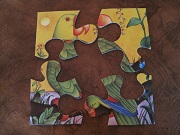
    Today’s prompt:  A piece of the puzzle.

    PuzzleWrite whatever comes up for you!

    Save in a word document.  Post on The Write Spot Blog.  Let’s see what you come up with for this prompt.  Just Write!

  • What? Prompt #140

    Fill in the blank, then keep writing:       WHAT?

    What the __________?

                         What is ___________?

                                   What is the ________?

                                              What if ___________?

  • Redwood Anthology – Journeys

    Submission Deadline for the 2015 Redwood Anthology:  March 1, 2015

    Theme:   Journeys

    Eligibility: Members of the Redwood Writers Branch of the California Writers Club. You can join Redwood Writers Branch, no matter where you live. Click here for membership information.

    RW AnthologyThis year marks the 10th anniversary of Redwood Writers anthologies. The theme is Journeys. There are many types of journeys: travel adventures, life passages, heroes’ journeys, pilgrimages, odysseys, and flights of fancy. All journeys begin in one place and end in another, having elements of challenge, change, and transformation.

    Note: Submissions are required to reflect the theme, which may be interpreted broadly.

    If your piece is selected, you will be assigned an editor to work with you through the publication revision/editing process.

    Submission Guidelines

    • Each Redwood Writers member may submit up to 2 pieces in any genre. For example, you may submit 1 poem and 1 prose piece, 2 prose pieces, or 2 poems.
    • Prose pieces may include flash fiction and nonfiction, short stories, memoir vignettes, essays, interviews, and journalistic pieces up to 2,000 words.
    • Poems are limited to 50 lines (about 2 pages).
    • Only original, previously unpublished work which reflects the theme will be accepted.
    • Standard formatting required: 1-inch margins on all sides; double-spaced, 12 pt. Times New Roman font. Poems may be single-spaced.
    • Document formats accepted: Microsoft Word (doc and docx) and Rich Text Format (rtf).
    • All work should be proofread and polished to the best of your ability. Typos, misspellings, and grammatical errors will reduce the likelihood of piece(s) being selected for publication.

    Submission Method

    We will not be accepting submissions by email. Instead, we will utilize a new, easy-to-use online submission form.

    If you have any questions about the theme, submission guidelines, or submission method, please contact Amber Lea Starfire at amber – at – writingthroughlife.com.

  • The Healing Power of Images Prompt #139

    Today’s prompt is inspired from Poetic Medicine by John Fox, “The Healing Power of Images.”

    Morning glory“A morning glory at my window satisfies me more than the metaphysics of books” — Walt Whitman

    “Images are drawn from sensory experience and help us to feel what the writer or speaker is communicating. Whitman is more satisfied by the morning glory because it is real and alive, it communicates something to him about reality that is particular, clean and unmistakable. Images offer us direct experience. They can show themselves to us through any of the senses.”

    Think about the house you grew up in, or where you spent most of your childhood. Or, if you want to write from your fictional character’s point of view. . . picture a place where the protagonist spends a lot of  time.

    Petaluma MuseumNow, think about routes you routinely took . . . to school. . . or the library. . . a store . . . or playground

    Travel back in time, or to your imaginary place, and see the sights and scenery. If you are working on fiction. . . use this prompt to visualize your story’s setting.

    Owl.3Zoom out like an owl and observe the activity below. Perch on a rooftop or a pole or a high wire.

    Let’s have the owl observe something on your daily route, or your character’s. A place that evokes a strong memory for you.

    Take a moment and picture this place. . . an intersection, in front of a store, a front yard, a back yard, an untamed place or a place filled with human or animal activity . . . a familiar place, either from real life, or make it real with your imagination.

    Zoom down, get closer to the action. Perch where you can clearly see details of the place you have selected.

    Prompt: Describe as precisely as you can, the images and direct sensations you see, hear, feel, intuit, smell.

    Use sensory detail: Smell, sound, taste, touch, visual: a vendor’s food cart, sewer sour milk smell, wind chimes, brakes screeching, popcorn, hot dogs, brittle wood on telephone pole, dirt, yard ornament, cigarette butts.

  • My tribe. Prompt #138

    Today’s writing prompt is inspired from Your Mythic Journey by Sam Keen and Anne Valley-Fox.

    Cavemen.1“Pre-modern people didn’t think of themselves as individuals — they were members of a tribe as well as of a family. Ancient philosophers knew that human dignity begins with ‘We are a people, therefore I am.’ Modern people are tribal too but we call our tribes by different names — churches, corporations, states, nations. Each of us was nurtured within and shaped by several corporate bodies, voluntary organizations and professional corporations that molded our values and behavior — schools, athletic teams businesses, clubs, temples, and local, national, and international governments.”

    Prompt: I am from . . .

    Note from Marlene: You can write from your personal experience, or write from your fiction character’s point of view. You may have written on this prompt previously. It’s a good one that can be used repeatedly, new things may come up, or clarification about an event may surprise you.  Remember: Just write, no editing as you write, no judging, no critiquing. Just write!

  • Rescuing Your Past – Barbara Sher

    Barbara Sher in Rescuing Your Past says:

    “People say we should let go of the past and move on. But you’ll never move into your future unless you take your beloved past with you. And that’s exactly as it should be.”

    “Rescuing Your Past,” from I Could Do Anything If Only I Knew What It Was by Barbara Sher

  • The Past – from different perspectives.

    The following is inspired by Your Mythic Journey by Sam Keen and Anne Valley-Fox.

    Chapter 4, “The Past” It’s Still Happening.

    “We love the present tense. Be here now. Yesterday is gone and best forgotten: our tradition is to have no tradition. We aren’t Europeans buried in ancient tombs and cathedrals and medieval ruins. We were born yesterday and we will be young forever. Over thirty is over the bridge. Age embarrasses us; remembrance is a function of senility. We exile the aged to Sun City leper colonies so they won’t impair our illusion of endless summer.

    But history is not so easily dismissed. Repressed memories, national or personal won’t stay down. To be alive is to have a past. Our only choice is whether we will repress or re-create the past. Childhood may be distant, but it is never quite lost; as full-grown men and women we carry tiny laughing and whimpering children around inside us. We either repress the past and continue to fight its wars with new personnel or we invite it into awareness so that we may see how it has shaped the present.

    The moment you begin to tell your stories you may find that memory is a trickster who picks and chooses scenes. What happened to you in the past has yet to be determined. Ninety-nine times you tell the story of the way you were whipped for stealing apples you didn’t steal. Then in the hundredth telling, you remember that you did steal them and the whole scene changes. Your memories of what happened to you in 1953 will be different in 1975, and again in the year 2000.”

    Lola.200 Prompt:  Think of an incident that one or more people might see very differently.

    Tell the story beginning with the words, “This is how I see what happened…”

    Prompt: Write the story from the other person’s perspective.

    No matter whether you use these prompts or not . . . Just Write!