Narrative Winter 2015 Story Contest

  • Narrative Winter 2015 Story Contest

    Do you have some writing ready to submit? Could you get it ready real fast?

    Narrative Magazine’s Winter 2015 Contest ends Tuesday, March 31 at midnight, PST

    This contest is open to all fiction and nonfiction writers: shorts, short stories, essays, memoirs, photo essays, graphic stories, all forms of literary nonfiction, and excerpts from longer works of both fiction and nonfiction.

    Entries must be previously unpublished, no longer than 15,000 words, and must not have been previously chosen as a winner, finalist, or honorable mention in another contest.

    Narrative is looking for works with a strong narrative drive, with characters we can respond to as human beings, and with effects of language, situation, and insight that are intense and total. We look for works that have the ambition of enlarging our view of ourselves and the world.

    Narrative welcomes and looks forward to reading your pages.

    Submission Fee: There is a $23 fee for each entry. And with your entry, you’ll receive three months of complimentary access to Narrative Backstage.

    Awards: First Prize is $2,500, Second Prize is $1,000, Third Prize is $500, and ten finalists will receive $100 each. All entries will be considered for publication.

    All contest entries are eligible for the $4,000 Narrative Prize for 2015 and for acceptance as a Story of the Week.

    Submission Guidelines: Please read Submission Guidelines for manuscript formatting and other information.

  • My heart hurts. . . Prompt #147

    Today’s writing prompt is inspired by my dear friend, Eva.

    You can always write on variations of these writing prompts. For example:

    My heart hurts when . . .

    I want to tell you about the time my heart broke . . .

    The phrase “full of heart” means . . .

    beach filled heartWrite from your personal experience, or write fiction. Just write!

    Photo by Jeff Cullen. Click here to see Jeff’s portfolio on fotolia.

  • Self-editing and Wordsmithing

    Guest Blogger Linda Jay writes about self-editing and wordsmithing:

    I’ve noticed a topic popping up more and more in books, workshops and seminars, even those offered by Writer’s Digest. Targeted mostly toward indie authors (perhaps you’re in that category), these books, workshops and seminars encourage writers to self-edit their own work before they self-publish.

    Now, self-editing is fine. Going through your manuscript’s rough drafts several times over a period of weeks searching for errors and omissions, perhaps even reading the text aloud to catch awkward phrasing or redundancies or overcomplicated construction, is certainly not going to hurt—and possibly might even improve—your writing.

    But let’s face it, there’s only so much self-editing an author can do. Frankly, you as the author are too close to the subject matter to be objective, even if you take a break from the material and come back to it later.

    In my opinion—and I’m not just saying this because I happen to be an experienced book manuscript copyeditor—an author truly needs an editor’s fresh perspective to make his or her writing as excellent and polished as it can possibly be.

    Recently I made editorial suggestions to an author, pointing out missing information and details in her novel; of course, she hadn’t left out facts intentionally. But on the other hand, she hadn’t noticed that she needed to “fill in the blanks” in that particular section of text so that a reader could understand the characters in-depth.

    I also offered specific ideas for improving the text that the author hadn’t thought of, but was happy to implement immediately:

    • short titles summing up each chapter,
    • translations of Latin terms and phrases so that the reader will understand their meaning,
    • clarification and explanation of obscure historical points,
    • easily understood transitions between scenes.

    The Role of Traditional Publishers?

    Traditional publishers no longer pay for the routine editing of manuscripts, and self-publishers often believe that they cannot afford to hire a professional editor.

    If you as an author have done your best self-editing but are still convinced that you want a professional editor to work with you, ask the editor to work on just a few chapters at a time. That way, it’s within the realm of financial possibility.

    Far beyond being merely a spell-checker, a good copyeditor is essentially able to “hear” what an author has written, and sense how a piece of writing will be received by other readers. An experienced copyeditor will also notice if the writer has made unfounded assumptions about the subject matter or the intended audience.

    In other words, self-editing is indeed useful, but it will never take the place of the opinions and comments of a professional wordsmith.

    The two processes should be used in tandem.

    Originally posted in Joel Friedlander’s blog, The Book Designer, on October 5, 2012

    Linda Jay is a manuscript copyeditor with decades of experience, specializes in business, novels, memoirs, spirituality, women’s issues, academic topics and fantasy (vampires, zombies)

    Linda will be on a panel of editors at Writers Forum in Petaluma on May 21, 2015.

  • The Silence of the L’s

    Guest Blogger Jane Merryman writes about the silence of the L’s:

                In the Danish language nearly 32 percent of the letters are silent. In French the number approaches 28 percent—I would have thought much more than that. About 16 percent of the letters in English words are silent. Think about it: would, could, should. And half. That l shows up in the strangest places. And then there’s wall—why do we need two l‘s there?

                I attended junior high and high school at a Catholic school for girls in Menlo Park, California. The nuns were Americans, but the religious order was French and operated schools around the world. All students, from kindergarten through twelfth grade, attended a French class every single day. By the time I graduated from high school I had advanced even into the dense forest of subjunctives. (That was when I learned English also has subjunctives, but we just ignore them.) In college I decided to branch out and signed up for Spanish. What a joy, what a relief, what an ace of a class! Every letter is pronounced. Yes, you have to get used to the fact that the j sounds like h, but you can depend on it—when you look at a word you know how to pronounce it. Much later, when I planned to travel in Italy and took evening school conversation classes, I found that Italian was much the same as Spanish. Of course there is the c gotcha— sometimes it sounds like ch, and sometimes has the hard c, or k, sound, but otherwise Italian has none of the silent letter pitfalls of French or English. Learning Indonesian also proved to be a similarly giddy pleasure. It has the same c/ch effect and, for that reason and its musical quality, is called the Italian of Asia. When I have to use a phrase I find in my handy little Indonesian Berlitz manual, I am confident I can pronounce the whole thing correctly and be understood.

                I commiserate with students of the French language. They have to learn to add silent letters to the end of many words, especially verbs. The only consonants that are pronounced at the end of French words are c, r, f, and l, the consonants in the English word careful. What a great mnemonic. I learned this lesson in one sitting. So we have avec with a final hard c sound; gentil and hôtel; pour and jour; and chef. However, tu parles (you speak) and ils parlent (they speak) are pronounced the same as je parle (I speak). Aaargh!

                As much as I feel sorry for French schoolchildren, I pity all those newcomers in English as a Second Language (ESL) classes. As if they didn’t have enough problems, they have to contend with the inconsistencies that crowd into speaking English. For every rule of grammar there are exceptions. English seems to be nothing if not exceptions, and silent letters are typical atypicalities.

                We have that pesky combination of gh. Sometimes it’s silent on the end of a word as in though. And silent in the middle of a word: blight, slight, ought. It can change the vowel sound as in bough and thought. Then it assumes a sound quite unlike its spelling, as in rough, tough, cough, trough (which can be pronounced with a final f or a th).

                There’s the curse of the final e. It’s supposed to tell us that the vowel that comes immediately before it has a long sound: hate, delete, cite, cone. We have lone, pone, and hone, but where did gone come from? Prelate and prejudice are among the words that break the rule.

                Consider the strange case of sure. In this instance a letter is missing, the h after the s. And there’s that final e. The u is not the sound of the u in dune or perfume; it’s more like an e, but not a long e, or a short e, just something like an e, but certainly not a long u. And, speaking of u, why does u have to come after q. It makes sense in quagmire but not in mystique (from the French, so of course it has silent letters!).

                Melvil Dewey was a fanatic about reformed spelling—notice the spelling of his first name. This is the same Melvil who invented the Dewey Decimal System, which is used to arrange libraries around the world. When not sorting out books, Dewey championed the elimination of extraneous letters from English words. But it never caught on. He was just regarded as a crackpot.

                            The problem of all our silent letters stems from the fact that English is a mongrel language. Anu Garg, the guru of the A.Word.A.Day website, recently explained it this way:

    If the English language were a cake, its batter would have Germanic flour. Sugar, butter, and milk would be of Norse, French, and Latin origins, not necessarily in that order. And on top of that would be icing with little flourishes here and there made up of dozens of languages—Arabic, Chinese, Spanish, Hindi, and others—it has borrowed from.

    I feel compelled to add that our condiment ketchup is a poor relation of the Indonesian spicy sauce kecap, in which the c has the ch not the k sound. I cood go on, but you wood probably be thoroly bord. And, remember, we English speakers have it easy compared to the Danes. I heard their language is impossible to learn from a book!

    Jane Merryman.1Jane Merryman specializes in copy editing: correcting grammar, spelling, punctuation, usage, and, as we say in the profession, infelicities.

    If you live in the area, join us on May 21, 2015 at Writers Forum in Petaluma, California. Jane will be a panelist on an Editors’ Forum.

  • Make characters real and likable.

    Play around with different ways to describe characters in stories.

    Here are examples of how to make characters real and likable and how to capture readers’ interest.

    What we keep.112What We Keep by Elizabeth Berg

    “My mother was dressed in her beautiful yellow summer robe, the tie cinched evenly into a bow at the exact center of her waist, but her auburn hair was sticking up in the back, an occasional occurrence that I always hated seeing, since in my mind it suggested a kind of incompetence. It was an unruly cowlick, nearly impossible to tame — I knew this, having an identical cowlick of my own — but I did not forgive its presence on my mother. It did not go with the rest of her looks: her deep blue eyes, her thin, sculptured nose, her high cheekbones, her white, white skin — all signs, I was certain, of some distant link to royalty.”

    Splinters of Light.112Splinters of Light by Rachael Herron

    “When my daughter kissed me at midnight that year, I missed my old life a tiny bit less than I had the previous New Year’s. Paul was becoming more and more adept at dodging phone calls from his first daughter as he busied himself with his new family, but his leaving us meant I got this little girl all to myself. A girl with his blonde eyebrows and my concern for wrongs to be righted. A little girl who liked to suck the rinds of our homegrown lemons (making faces all the while) as much as she liked to lick the honey spoon I handed her in the kitchen.”

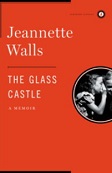
    The Glass CastleGlass Castle by Jeannette Walls

    “I was sitting in a taxi, wondering if I had overdressed for the evening, when I looked out the window and saw Mom rooting through a dumpster. It was just after dark . . . I was stuck in traffic two blocks from the party where I was heading.

    Mom stood fifteen feet away. She had tied rags around her shoulders to keep out the spring chill and was picking through the trash while her dog, a black-and-white terrier mix, played at her feet. Mom’s gestures were all familiar—the way she tilted her head and thrust out her lower lip when studying items of potential value that she’d hoisted out of the Dumpster, the way her eyes widened with childish glee when she found something she liked. Her long hair was streaked with gray, tangled and matted, and her eyes had sunk deep into their sockets, but still she reminded me of the mom she’d been when I was a kid, swan-diving off cliffs and painting in the desert and reading Shakespeare aloud. Her cheekbones were still high and strong, but the skin was parched, and ruddy from all those winters and summers exposed to the elements. To the people walking by, she probably looked like any of the thousands of homeless people in New York City.”

    Note from Marlene:  It occurs to me that this might be what it’s like for an actor to get into character: inhabit another personna. . . make that character alive.

    Your Turn . . . think of a real person. . . write about his or her mannerisms, quirks, habits, weave in physical description. Bring this person to life on the page. Just Write!

  • Zoetrope All-Story

    About: Zoetrope: All-Story is a staff of two, assisted by a small team of brilliant and generous volunteers, who are collectively dedicated to reading and responding to the 12,000 submissions All-Story receives annually. To aid in this commitment, writers should submit only one story at a time and no more than two stories a year.

    Zoetrope.1Submit: Before submitting, non-subscribers should read several issues of the magazine to determine if their works fit with All-Story. Electronic versions of the magazine are available to read, in part, at the website; and print versions are available for purchase by single-issue order and subscription.  http://www.all-story.com/

    Zoetrope: All-Story considers unsolicited submissions of short stories and one-act plays no longer than 7,000 words. Simultaneous submissions are accepted. First serial rights and a one-year film option are required.

    All-Story does not accept submissions via e-mail. Mail manuscripts to:

    Zoetrope: All-Story
    Attn: Fiction Editor
    916 Kearny St.
    San Francisco, CA 94133

    Zoetrope: All-Story invites writers to take advantage of the Virtual Studio, a free online writers’ workshop sponsored by All-Story and its publisher, Francis Coppola. Writers are encouraged to support the small and independent publications to which they submit; magazines such as All-Story depend on subscriptions to survive, ensuring forums for publication of new and emerging writers.

    Start your engines now: The Zoetrope: All-Story 2015 Short Fiction Contest opens July 1, 2015; for details, please visit the website this summer.