New ways of looking at old- Prompt #247

  • New ways of looking at old- Prompt #247

    If you have been writing for awhile, you might notice that you keep writing about the same things over and over again: how Aunt Luella always sticks her nose in everybody’s business; how Uncle Ray tells those awful jokes and doesn’t seem to notice that no one laughs; how Nonna’s getting on everybody’s nerves, should Aunt Silvie be put in assisted living and what the heck is up with Joey’s latest tattoo?

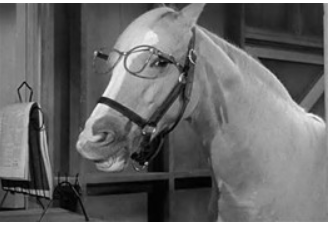
    Mr. Ed The Talking HorseWe all have our stable of characters that we dwell about incessantly. Here’s an opportunity to look at old things in new ways. Inspired by the poem, The visible and the in-      by Marge Piercy

    Read the stanza below (or the partial stanza), then quickly make a list of everybody this reminds you of. No prolonged thinking. You can always add names later.

    Ready? Go!

    First stanza of The visible and the in-:

    Some people move through your life
    like the perfume of peonies, heavy
    and sensual and lingering.

    This reminds me of:


    Some people move through your life
    like the sweet musky scent of cosmos
    so delicate if you sniff twice, it’s gone.

    This reminds me of:


    Some people occupy your life
    like moving men who cart off
    couches, pianos and break dishes.

    This reminds me of:


    Some people touch you so lightly you
    are not sure it happened.

    This reminds me of:


    Others leave
    you flat with footprints on your chest.

    This reminds me of:


    Some are like those fall warblers
    you can’t tell from each other even
    though you search Petersen’s.

    This reminds me of:


    Some come down hard on you like
    a striking falcon and the scars remain
    and you are forever wary of the sky.

    This reminds me of:


    We all are waiting rooms at bus
    stations where hundreds have passed
    through unnoticed and others

    have almost burned us down


    This reminds me of:
    and others have left us clean and new
    and others have just moved in.

    This reminds me of:


    That’s it. You can leave this as-is. Or the next time you write about Sophie and how she stole your lipstick in seventh grade. . . use some of these descriptions to expand upon her character, to draw out this experience with specific detail.

    Of course this will work for fictional characters, also.

    Have fun with this. Recreate the characters (real and imagined) who populate your real estate.

  • A poem, from the inside out . . . Prompt #246

    Today’s prompt is inspired by Poet Georgia Heard, who suggests the following as a way to create a poem from the inside out.

    Choose something on your body: a strand of hair, a nail, a ring, glasses, a belt, a necklace, an item of clothing, a freckle . . . anything!

    1. Describe the object with as much detail as possible.
    1. List all the feelings that the object evokes. Be specific.
    1. Create similes for the object: It is like. . . It reminds me of . . .
    1. Put yourself in the place of the object. Take on the voice of the object and write from the object’s perspective.

    Take your time with this. Read what you have written. Add anything that comes up while reading.

    Take a few moments to reflect. Settle in with what you have written. When you feel done with this part, go on to the next, the poetry part.

    You don’t have to rhyme, or follow any rules when writing your poem. You simply need images and inspiration and emotions. Anger, pain and bursts of joy are perfect material for poetry.

    Do not strive for perfection. This is still the freewrite phase of writing.

    When you are done and completely satisfied, then . . . set your writing aside for a day or two.

    Come back to it when you are ready to revise and polish. Then set it free: Share with a friend, submit to a journal, post on The Write Spot Blog. We would love to read your inside out poem.

    Watering can girl. J.Pierce


    Girl with watering can and daisy, beaded pin by J. Pierce.


  • The First Poem — Lucille Clifton

    Night Sky. Colby Drake

    “Poetry began when somebody walked off a savannah or out of a cave and looked up at the sky with wonder and said, ‘Ah-h-h!’ That was the first poem.” — Lucille Clifton

    Photo by Colby Drake
  • Got fiction, essay , poetry, art? West Marin Review wants.

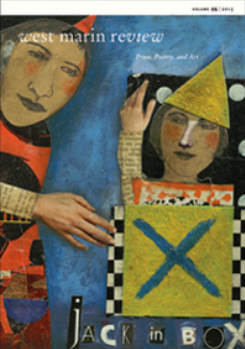
    West Marin ReviewFiction! Essays! Poetry! Art! Got any? West Marin Review, a literary and art  journal, wants ’em.

    Deadline:  September 1, 2016. West Marin Review is such an upbeat publication, this should be called Upline: September 1, 2016.

    Need ideas for material to write about? Click Prompts. Choose one and write. Edit. Submit.

    West Marin Review Submission Guidelines.

    Cover art for current issue of West Marin Review.


  • Imagine that . . . Prompt #245

    Have you heard of imagist poetry?

    “Imagism called for a return to what were seen as more Classical values, such as directness of presentation and economy of language, as well as a willingness to experiment with non-traditional verse forms. Imagists use free verse.”  Wikipedia

    The Red Wheelbarrow, by William Carlos Williams (1883 – 1963) is an example of an imagist poem.

    so much depends

    upon

    a red wheel

    barrow

    glazed with rain

    water

    beside the white

    chickens.

    There have been many discussions and theories about this simple little poem.  Was it meant to be simple, or is there hidden meaning, plumbing the depths of our sub-conscious?

    “I was fumbling around, looking for a way to make sense of my life, and seized on William Carlos Williams’s poems . . .  His poems were experimental yet safe—a combo I craved in my extra-dark teenage years.”  Craig Morgan Teicher, Poetry Foundation

    One teacher describes imagist poems as “use of exact words, avoid clichés, create new rhythms, freedom  of subject choice, presents an image, is tight/distilled/concentrated, and uses suggestion rather than stating things directly.” This teacher said, “Post WWI, people lost a lot of hope in religion and Williams was commenting on this. ”

    The teacher elaborated:

    “So much depends

    The use of 3 words in the beginning is a reference to the holy trinity.

    a red wheel

    barrow

    The second stanza: barrow is separated from wheel. “Barrow” is a large mound of stones, which symbolize Christ’s burial. “Red” represents the blood of Christ.”

    The teacher continues: “A wheelbarrow is used for hauling things, much like Christ carried mankind’s burden on himself. There’s transmogrification happening (unusual transformation). The wheelbarrow becomes Christ, the rain water symbolizes Holy water, and the white chickens represents angels.”

    Or, as another teacher said, “Williams, a country doctor, had been up all night with a sick child. He may have looked out the farm house window and saw this scene.”

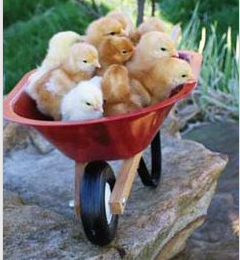
    Red wheelbarrow and chicksWhat do you think?  Is The Red Wheelbarrow full of hidden meaning, or is it a simple American haiku?

    Today’s Writing Prompt:  Write an imagist poem. Use any or all of these words:  tricycle, put, truly, blue, roll, next, afraid, upon, shape.


  • Is serialization in your future?

    Guest Blogger Daedalus Howell reveals a tried and true method to reach new audiences.

    The revolution will be serialized. As it’s always been. Much of episodic entertainment, from our favorite shows on Netflix or premium cable to the summertime superhero blockbusters, are issued in discrete elements that comprise a whole story. Comic books have long functioned in this manner, ditto popular literature, which was once serialized in newspapers. And, of course, there’s the staggeringly popular Serial podcast, which not only popularized a new storytelling medium but so embraced the concept of serialization that it branded itself with it. Clearly, serialization is back, representing to some, a vanguard in publishing. It can also be an integral part of your creative process.
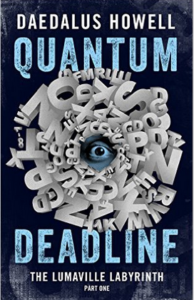
    Howell.Quantum DeadlineThis is what I’ve found creating Quantum Deadline, a sci-fi crime romp that comically explores the death of newspapers through the foggy lens of a reporter tripping through the multiverse. Like many authors, my project found its first iteration as a National Novel Writing Month novel — one November, I arranged 50,000+ English words in a manner that produced the general effect of a novel. Despite the fact that the result was an unholy (if occasionally inspired) mess, I remained committed to seeing it through the bitter end of a Kindle download.

    I put it in the proverbial drawer through the winter to cool and found when I exhumed it the following spring, I was ready to rewrite it. That said, there is no “National Rewriting Your Novel Month” and I loathed the notion of working alone sans the esprit de corps I’d experienced with NaNoWriMo.

    I tried. I failed. I had no sense of accountability or “ticking clock” to compel me back to the work. Not that I was enthralled with the prospects I perceived in the book, it’s just that, as a career-long newspaper columnist, I’d grown accustomed to a weekly deadline. And someone to enforce it. With a speculative, self-generated project like Quantum Deadline, there was neither a deadline nor an irate editor to make me deliver. That’s when I began to contemplate serialization. I needed to feel accountable and I needed a schedule — two aspects of serialization that I theretofore hadn’t realized were possibilities.

    Moreover, I suspected serialization would allow me to “course correct” if I found that my readers were losing interest or recognize possibilities in the work that I hadn’t. I think of it as akin to The Lean Startup concept of creating a “minimum viable product” that allows for pivots between plot points.

    “The fundamental activity of a startup is to turn ideas into products, measure how customers respond, and then learn whether to pivot or persevere,” writes Eric Reis, The Lean Startup’s main advocate and author of a popular business tome of the same name.

    If we replace the term “startup” with the word “writing,” the path to serialization becomes self-evident. Instead of hunkering down, alone in the back of a Starbucks, the premise of releasing iterations of your work while refining it allows you the opportunity to grow and create community around it in the meantime.

    The trick is to be responsive to the concerns of your readership rather than defensive. You’re creating a feedback loop, not a combat zone. You don’t need to completely alter the vision of your paranormal YA romance when your readership is flagging, nagging or otherwise bagging on your work. However, you do have the opportunity to make adjustments in the next installment (and retroactively as well — serial readers are very forgiving, I find, so long as you point to relevant changes that improve their enjoyment of the work).

    Likewise, authors are advised to read Austin Kleon’s excellent book Show Your Work!, which extols the virtues of sharing your creative process as a means of cultivating an audience. Much in the same way film studios invite entertainment reporters on set to drum up interest in a film prior to its release, Kleon suggests sharing your process and inspirations as you create. This notion also dovetails nicely with “rewriting in public” through serialization.

    Writing a serial not only creates both context and momentum for one’s creative output, it cultivates community with your work as its rallying point. Chapter by chapter, week by week, you steer us deeper into your creative world — a world we may not have seen were it not for the revolutionary resurgence of the serial. As Gil Scott-Heron said, “The revolution will put you in the driver seat.”

    Note from Marlene: The “Now What” feature of National Novel Writing Month supports  “the revision and publishing process. It’s an extension of our anything-goes, wombat-infused noveling philosophy, with the added aim of helping you fulfill your novel’s potential: from first draft to final.”

    Daedalus will be the April 21 Writers Forum presenter, talking about, “Write Who You Know: How to Use Your Personal Life in Your Fiction And Memoir Writing Without Ruining Your Relationships.”

    Daedalus Howell is the author, most recently, of Quantum Deadline. He hosts the Culture Dept. podcast, is a radio personality on KSVY and KSRO, hosts the TV show 707, and blogs for Men’s Health and Petaluma’s Rivertown Report. Otherwise, he’s at DaedalusHowell.com.
  • Random words plucked from a poem . . . Prompt #244

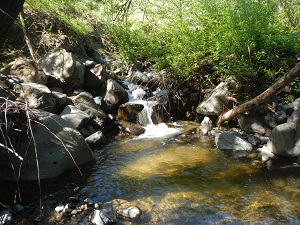
    Random words (plucked from a poem) as a writing prompt. Tell a story, truth or not, with these words:

    Creek.Karen heavy               linger        delicate

    footprints      flat             maroon

    foam                hard          perfume

    Or use the photo as a writing prompt.

    Set your timer for 15-20 minutes. Write. Polish. Post your writing on The Write Spot Blog.

    Photo by Karen Bobier

  • The Bitter Oleander is ready for your submission.

    Bitter Oleander

    The Bitter Oleander Press:

    Home of Fine Poetry Collections and The Bitter Oleander: A Journal of Contemporary International Poetry & Short Fiction

    The Bitter Oleander Press publishes works that contain imagery revealing a “world we thought we knew but were mistaken.”

    We believe in bringing our readers and writers face to face with each other, with the reality of our uncommon world, like the one that exists in grape seeds blown by hurricanes into hidden corners doors form when closed.

    The Bitter Oleander prefers “poetry devoid of clichés and predictable twists of well-worn or entrenched truths. We prefer a heightened music driven by a profound linguistic rhythm.”

    “Because we are open to submissions from all cultures, people and languages, we regard their investment of time spent submitting and creating to be very critical. We pride ourselves on answering every request, every order, every submission, every letter of gratitude and annoyance personally because we feel there’s absolutely no substitute for that one-to-one exchange which can and should take place between an editor and writer. Building this bond emphasizes the importance such interaction can have on one’s work and on one’s publication. We’re indebted to all those poets and writers for making us what we are and for all the trust they continue to place in us.”

    Fiction: word count ~ 2500.

    Poems: No more than 8.

    Accepts Submissions year-round, excluding July.

  • First Lines Make Great Prompts . . . Prompt #243

    First Line BooksFirst lines from books can be sparks for freewrites.

    Read the sentence and then write whatever pops into your mind.  Don’t over think it. Go with the flow and just write.

    Here are a few for you to play around with.

    “Some time ago, when I was 6 or 7 or 8 years old, it would occasionally happen that I’d walk into a room and certain people would begin to cry.”   The Lost by Daniel Mendelsohn

    “The phone rang.”   Booked by Die by John Dunning

    “Footsteps on the forest floor made a noise like paper crumpling in a child’s fist.” The Half-Life by Jonathan Raymond

  • Jane Dystel: How long should it take to write a novel?

    Jane DystelToday’s Guest Blogger is Jane Dystel, president of Dystel & Goderich Literary Management:

    Over the weekend, I finished a remarkable first novel.  The author had taken many years to complete this work and, in the end, I think the time it took her to do so has paid off (of course, only the marketplace will tell).

    Thinking about this – the time it takes a writer to finish a book – brought to mind how different each writer’s process is.  I found this very interesting piece on the subject in the Huffington Post.

    I have clients who take many years to finish their novels, much like the writer whose work I read this weekend.   Then, there are those who actually ask for deadlines (from me) by when they should have their next manuscript completed.  And then, of course, there are those who can conceptualize their stories and write them down much much faster.

    In the end, there is no right answer to how long it should take a writer to complete his/her manuscript.  It is what works for each individual.  I find it’s best not to compare your process to others’. Do what feels right for you.

    Originally posted on the Dystel and Goderich website, February 29, 2016, “How Long Should It Take Me To Write My Novel?”

    Note from Marlene: Jane’s thoughts about self-publishing are in the May 2016 issue of The Writer Magazine. Here’s an excerpt: “As an agency, we are now more interested in developing . . . authors’ careers and helping them be successful hybrid authors—those who are traditionally published and continue to self-publish at the same time.”

    Jane Dystel, President, has been an agent since 1986. Her publishing career began at Bantam Books. She then moved to Grosset & Dunlap, where she was a managing editor and later an acquisitions editor. From there, she went on to become Publisher of World Almanac Publications, where she created her own imprint. When she joined the agency that would soon become Acton and Dystel, Inc., she quickly developed a reputation for honesty, forthrightness, hard work, and real commitment to her authors and their writing careers. In 1994, with a growing roster of clients, she founded Jane Dystel Literary Management, which became Dystel & Goderich Literary Management in 2003. Born in Chicago, Jane grew up in Rye, New York. She is the daughter of publishing legend, Oscar Dystel, who is currently a consultant for DGLM. In her teens, she was an accomplished figure skater. Jane received her BA from New York University and attended Georgetown law school for one year before leaving for her first job in publishing. She has an abiding interest in legal subjects. She is married to Steven Schwinder and has a daughter, Jessica, and a son, Zachary. She lives in New York City with her family and two dachshunds and is a tenacious golfer.