Today’s writing prompt: Ice cream


Brevity is an online journal, publishing short narrative essays (750 words or less).
Employing strong verbs and using sensory detail increase chances of your writing being selected.
“There is no room for throat-clearing in search of a point. . . You need each sentence to do more than one thing . . . provide setting, forward the action and give insight into character, all at once.” Founder and editor Dinty W. Moore, interviewed by Kerrie Flanagan, The Writer August 2015
Information about using sensory detail can be found in the Just Write section on The Write Spot Blog.
Good Luck!

Today’s random words writing prompt: honey, drunk, fast, feet, power, languid
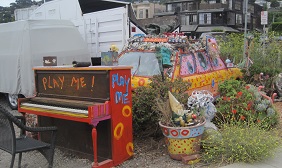
You can also use the photo below as a writing prompt.
It will be fun to see what you do with this!
Guest Blogger Steve Fisher writes about Musical Writing
Writing is a mysterious craft. Part inspiration, part perspiration. This is about inspiration. Or rather one form of it. Music. When I’m looking for a magic tonic of creativity, I turn to motion picture soundtracks.
Think about some of the most effective films you have seen. Chances are they started with a great script, added competent and creative direction, exceptional performances, sublime cinematography and brilliant editing. But perhaps the crowning element was the evocative score. What would Star Wars be like without John Williams’ majestic symphonic score? How effective would Titanic be without James Horner’s haunting themes? How chilling would Psycho be without Bernard Herrmann’s staccato strings? A good film can be made great by the music. A film can also be ruined by a bland or misguided score. In deference to the filmmakers, I won’t cite examples.
So what does that have to do with writing? We’re all affected by music, one way or another. When you sit down to write, play the kind of music that evokes the emotion or atmosphere you are trying to achieve. Take a moment to immerse yourself in the melodic environment. Then try putting pen to paper, fingers to keyboard, ingesting the music continuously as you do so. You may find a new richness wending its way through your words.
Try this for an exercise. Select four tracks of music, each with a different sensation—upbeat, somber, romantic, whimsical. As each plays, write. It doesn’t matter what: poetry, prose, screenplay, essay. They don’t have to go together. Just do it to see how it feels.
When you’re ready to actually use music to work by, be selective. Match the musical themes to the emotional ones you are trying to achieve. You may just find additional inventiveness. And the labors of writing may become more harmonious.
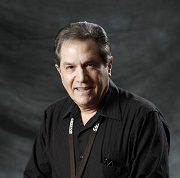 Steve Fisher has written for television, film, stage and print for more than 3 decades. He sleeps in formaldehyde to keep his youthful good looks.
 Today’s writing prompt: Shopping
Set your timer for 15-20 minutes and write about Shopping.
“As long as there’s a persistent audience for reading novels, then there’s going to be some way for them to be published.” —Jane Smiley, interview by Adrienne Crezo, Writer’s Digest September 2015
Jane’s daughter works at Book Country, an online writing community where you can share your work-in-progress and receive feedback from community members.
“Connect with fellow writers on the discussion boards and learn from accomplished authors and editors on the blog.”
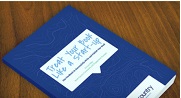 Information at Book Country, “Treat Your Book Like a Start-up“
Writers have been told to “show” rather than “tell.” Do you wonder what that means?
Barbara Poelle, “Funny You Should Ask,” Writer’s Digest, September 2015 says this about that:
“Telling supplies information while showing explores information. In order to expand a narrative into more showing, think about the complete sensory experience of a scene.”
If you rely on narrative, you run the risk of an “information dump,” where you give all the facts in a few sentences. Poelle suggests, and I agree, “Don’t fall into the trap of quickly getting information ‘out of the way’ so you can ‘get to the story.’ . . . Take your time to explore [the facts] through action, dialogue and the senses of the characters involved.”This way, you set the scene with a “kinetic feel.”
All well and good, but what does this really mean?
I played around with some scenarios:
#1: I set my timer. I have thirty minutes to finish this blog post before starting dinner. My husband and I had to eat early so I could be at my writing workshop by 6:30 pm, my Monday evening commitment. In the old days, this would have been impossible, since there would have been carpooling for kids’ activities, overseeing homework and laundry.
So, you know that I’m just as busy now as when the kids lived at home. But you don’t know how I feel about my current commitments nor how I feel about being an empty-nester. Now, I’ll try for a kinetic feel:
#2: Twisting the dial on the timer to go off in thirty minutes, I settle into my cushy chair. Dinner would be easy, salad with whatever leftovers I can ferret from the fridge. My husband isn’t as picky as the kids were. Back in the day, it would have been pasta with marinara sauce and garlic French bread. Carbs for calories to sustain them through ballet, piano, baseball, soccer, basketball (depending on time of year) practice. Sometimes I miss the patter of sports-clad footwear and washing uniforms. I got so used to being interrupted, now I interrupt myself. I’ll be humming away, concentrating on a blog post when I must check Facebook. Twenty minutes later, I realize I need to prepare prompts for tonight’s writing workshop. Completely absorbed in creating clever and inspirational prompts, I remember I need to finish the blog post in time for tomorrow morning’s post. The timer dings, sending my heart racing. Gotta go.
So, what’s the difference? #1 is an “information dump.” Not too much detail, just a list of facts. You might not be able to “see” or “feel” this scenario.
#2:You can infer I am on deadline (setting the timer) and I am capable of cooking a nice dinner. You might imagine I miss the days when my activity-bound children needed me, but I’m pretty happy and content with my life now as an empty-nester with more me-time. #2 has more of my personality, so the reader might feel a connection . . a kinetic connection with me.
 Your turn: Write about something you routinely do . . . implementing sensory detail. Go ahead. . . Write with gusto as you writhe in agony over what to expound. Just write!
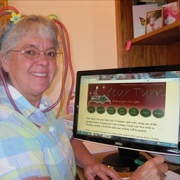
Candid shot of Marlene hard at work in her corner office. Can you see the wheels turning and steam rising as she madly meets deadlines with blog posts! Ignoring conventional punctuation, feeling free to dance along the page, her faux dreads keeping time to the muse.
Writer Advice announces its Fourth “Scintillating Starts” contest.
$20 ENTRY FEE — 3 PRIZES OF $100
B. Lynn Goodwin, Writer Advice: Whether you’re writing fiction, memoir or another prose genre, entice us. Grab our attention. Make us want to know more. Give us reasons to care. Submit the opening (up to 1500 words) of your book (any prose genre).
Your cover letter must include your contact information. We don’t need a summary nor your publishing history. We’re looking at the manuscript opening, not the query.
This contest is for those who have not yet received a contract for submitted work.
Send your work to Writer Advice through Writer Advice Submission Manager.
Lynn Goodwin will respond like an agent or editor who is looking for good writing that will sell. You’ll get perspective and insight. The prizewinners will be published.
Deadline: 11/10/15.
 Note from Marlene: Don’t wait until the deadline to submit! Lynn’s offer of perspective and insight about your submitted writing is very generous. But, if everyone waits until the deadline. . . well, I’m thinking you will get more substantial comments if you enter sooner than later. So . . . get your piece as polished as you can and submit soon!
If you type “B. Lynn Goodwin” in the “Search for” box on the home page of The Write Spot Blog, you will find articles by Lynn that have been featured here.
Writing Prompt: Change
Or: Changes or Change is coming or Change is about to happen.
What do you have to say about change?
Do you like change? Hate it?
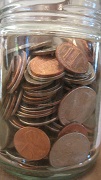 What about that change jingling in your pocket or purse?
Write about change.
Guest Blogger Hoby Wedler writes about: The Often Over-looked Magic of the Nose: Exploring Smells Around You
I was born blind. Growing up as a blind child forced me to pay closer attention to my nose than perhaps most people learn as children. I use my nose as a method of observing my surroundings, for navigation, to note whether or not food has spoiled, and most importantly to smell, taste and describe food and wine.
It is important to note that not all blind people pay as close attention to their noses as I do. Many of my blind friends walk right past unique aromas that I easily pick up on. Thus, my love for thinking about aroma certainly does not stem specifically from my blindness.
While I love describing aromas of many things, I notice whether they are pleasant, unique, off-putting, etc. I will use this opportunity to describe aromas of a few relatively common areas that I find exciting. I am a part-time wine educator and so I pay close attention to smells. I have found that the best way to get people excited about wine is to describe its aroma and flavor using common things or places they are familiar with. Here are a few of my aroma descriptions to give you a “taste” of how I enjoy describing aroma.
Bars have a bizarre smell because they smell clean to me but also like people. I’d describe the aroma of a bar as a mixture of the type of cleaner they use (usually bleach to keep sanitation), citrus fruit, alcohol fumes, leather (not sure why this one is so present), usually old wood, people, sometimes cigarette smoke, and paper money. I know this is a bit esoteric and strange but it’s the best description of bar smell I could come up with. There are some bars in downtown Petaluma that I think of as having fairly iconic smells. Andresen’s on Western and Volpi’s on Washington come to mind right off.
Other places that have very distinct aromas are banks, movie theatres, coffee shops (of course), parks with lawn and water features, swimming pools (and I’m not talking about right up next to the pool; I am able to identify the pool just by driving by the center where it’s housed), print shops, dry cleaning establishments, to name a few specific places.
If we just focus on our vision, I think we lose all of what we’re discussing to our visual distractions. I’ve spent a long time pinning down the smells of different things I encounter in my day to day life and I find it to be thought-provoking and intriguing.
Being able to describe aroma is like learning a new language. People need to develop an aromatic vocabulary. Smell is another language. For example, if you look at a picture of a dog, you might think of a furry thing that runs around and goes “Woof.” If you look at a picture of a ripe fig, you might think of the fruit and what you know about it. If I hand you a glass with crushed fig in it, however, it may be much harder to come up with the word “fig.” With practice and attentiveness to the nose and aromas, anyone can develop a strong aromatic vocabulary.
Note from Marlene: I had quite an enjoyable email exchange with Hoby stemming from my inquiring if he could describe the “bar smell.” Pinning down that particular smell fascinates me. Hoby came up with leather (yes, leather-topped barstools and booths), wood (of course: stools, chairs, bar top) and money (aha! I hadn’t thought of that). Perspiration. . . (oh, yes,) and cigarette butts in tin can ashtrays, stale beer. I hadn’t thought of using a variety of material to describe “bar smell.” Now, I know . . . use my nose to play detective and capture precise smells. Thanks, Hoby!
I have known Hoby since he was born. As I researched material for this post, I learned more about Hoby that I didn’t know. I am amazed by this remarkable young man and his family. If you have time, click on the links to learn more about opportunities for the visually impaired, what growing up blind was like for Hoby and his family and his zest for life. Hoby credits Learning Ally for being a life-changer.
 Henry “Hoby” Wedler is a fifth-year Ph.D. candidate at the University of California, Davis, founder and director of the nonprofit Accessible Science, and host of truly blind wine and beer tasting experiences. Hoby was raised in Petaluma, California where early on he fell in love with beautiful Sonoma County. When he’s not busy working towards his Ph.D. in organic chemistry or leading his blind or visually impaired chemistry camp students in conducting lab experiments through touch and smell, he turns his attention to wine and beer – where he’s passionate about wine and beer flavor, accurate flavor descriptors, and how wine and beer flavor and aroma relate to chemistry.
In May of 2012, Hoby was one of only fourteen individuals honored at the White House as part of President Obama’s Champions of Change program, for leading the fields of science, technology, engineering, and math (STEM) for people with disabilities. The Champions of Change program was created as a part of President Obama’s Winning the Future initiative that recognizes outstanding individuals for the work they are doing to serve and strengthen their communities.
Hoby was inspired by programs offered by the National Federation of the Blind in high school, and with encouragement from professors, colleagues and others, he gained the confidence to challenge and refute the mistaken belief that STEM fields are too visual and, therefore, impractical for blind people.
Hoby founded and teaches at an annual chemistry camp for blind and low-vision high school students. Chemistry Camp demonstrates to the students, by example and through practice, that their lack of eyesight should not hold them back from pursuing their dreams.
Hoby hosts Tasting in the Dark, a completely blind wine tasting experience at Francis Ford Coppola and other Napa-Sonoma wineries. The surprising and enlightening wine tasting, where guests are blindfolded, explores how flavors and aromas in wine are accentuated when experienced in complete darkness. Hoby believes that when a sighted person is in complete darkness, he or she feels more vulnerable and his or her senses become more heightened because vision is not a distraction, bringing out more flavors in a wine or beer.
In 2013, Hoby partnered with Sierra Nevada Brewing Company to host beer tasting in the dark, “Sightless Sipping.” This event, similar to blind wine tasting, allows guests to enjoy beer at an entirely new level. According to the Sacramento Bee Newspaper:
