 What do you think about tattoos?
Do you have a tattoo? What is it? Where is it? Why?
If you don’t have a tattoo, would you ever get one? If yes, what do you envision it will be?

What do you think about tattoos?
Do you have a tattoo? What is it? Where is it? Why?
If you don’t have a tattoo, would you ever get one? If yes, what do you envision it will be?
Many of us have heard “start your story in the middle of the action, or the height of the conflict.”
David Lavender suggests “start at the height of desire.”
You need not worry about being dull if you can present within the first few hundred words a definite character in the grip of a definite emotion.
“But introducing a character and his motives to an audience must be done deftly and without explanation. For example, if setting up a boy-loves-girl story, Lavender says, ‘I must show the boy immediately engaged in wanting the girl. I must do it with unobtrusive little touches. I must bring it out through the way he acts and what he says, being at all times careful not to let the reader guess that he is having something explained to him.’” — Nicki Porter, August 2015 The Writer magazine

How do we convey the sense of touch, or feel, or kinesthetic (motion) in writing?
“The key to good imagery is engaging all five senses.” Five Types of Imagery:
“The five senses: visual, auditory, kinesthetic, olfactory (smell), and gustatory (taste).”
Previous posts about using sensory detail in writing: visual, auditory and olfactory.
Now, let’s explore using the sense of touch to embellish and enhance writing.
Sometimes, the best way to learn is by example, learning from what others have written.
“At school, the guilt and sadness were like wearing clothes still damp from the wash,” and “Whenever I moved, I felt as though I were touching something icy.” —Family Life by Akhil Sharma
I know what that feels like, so when I read this, I can feel those damp clothes and know what the author wants to convey.
Here’s an example of using movement in writing:
“By the thirteenth loop, my hands were cement-scuffed and my head was spinning from being at knee height for so long, but the parade of hoping, bear-crawling, push-upping women showed no sign of slowing.” — Natural Born Heroes by Christopher McDougall, describing parkour (a training discipline using movement developed from military obstacle course training.)
McDougall could have written “I was worn-out” or “I was tired.” Instead he uses specific details: “cement-scuffed” and “my head was spinning.” He employed strong verbs: “bear-crawling” and “push-upping.”
With this type of strong writing, readers can feel the chafed hands and most of us probably can relate to “head-spinning.” I can see “bear-crawling” and “push-upping.”
A note about parkour: “Practitioners aim to get from one point to another in a complex environment, without assistive equipment and in the fastest and most efficient way possible. Parkour includes running, climbing, swinging, vaulting, jumping, rolling, quadrupedal movement, and other movements as deemed most suitable for the situation.” — Parkour, Wikipedia
Looking at websites about physical activities (martial arts, gymnastics,dance, etc) could help you find action verbs.
In Vex, Hex, Smash, Smooch, Let Verbs Power Your Writing, Constance Hale regales readers with her unique style about usage of the English language, especially strong verbs. Constance has been dubbed “Marion the Librarian on a Harley, or E. B. White on acid.” Kathy Myers wrote an excellent review of Vex, Hex, Smash, Smooch.
Practice using strong verbs and specific descriptive words to make your writing strong and create images the reader can see and sense. You can go to Parkour Images, choose a photo and describe it, using sensory detail. Just write!
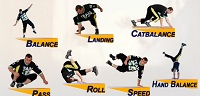
Basic Parkour Movements
Have you wondered how Chicken Soup for the Soul chooses their stories? Do you have a story you think might qualify for selection for being published? What you need to know about Chicken Soup submissions:
Recipe for A Winning Chicken Soup for the Soul submission
A Chicken Soup for the Soul story is an inspirational, true story about ordinary people having extraordinary experiences. It is a story that opens the heart and rekindles the spirit. It is a simple piece that touches our readers and helps them discover basic principles they can use in their own lives. These stories are personal and often filled with emotion and drama. They are filled with vivid images created by using the five senses. In some stories, the readers feel that they are actually in the scene with the people.
Chicken Soup for the Soul stories are written in the first person and have a beginning, middle and an end. The stories often close with a punch, creating emotion, rather than simply talking about it. Chicken Soup for the Soul stories have heart, but also something extra—an element that makes us all feel more hopeful, more connected, more thankful, more passionate and better about life in general. A good story causes tears, laughter, goose bumps or any combination of these.
Submit Your Story
Visit the Chicken Soup Story Guidelines page, which will answer many questions about subject matter, length, and style. Following these guidelines will give you the best possible chance of being accepted.
For a list of current topics, complete with descriptions and deadlines, please visit: Possible Book Topics page.
 Note from Marlene: Don’t worry if “your” topic isn’t listed. Check every month or so, your topic might be on their new list. Follow submission guidelines.
When submitting, it’s very important to follow submission instructions. Do exactly what they want. If you don’t, your piece will be disqualified no matter how fantastic the writing is.
Chicken Soup for the Soul is “always looking for new talent.” That’s you, my friend. Keep writing and revising and have your piece ready when your topic pops up.
 Imagine you are on a tropical paradise vacation.
Sitting on the lanai, hearing the waves lap against the shore.
Smell the ocean breeze.
Feel the soft wind on your face.
See the light curtain billow in the gentle breeze.
Settle back in your rattan chair, cool refreshing drink nearby.
Hear the ice clink against the side of your glass as you sip your refreshing drink.
Hear the gentle wind chimes.
Breathe deeply, enjoying the fragrance of fresh, tropical flowers – the heady scent of orchids, plumeria, roses. Perhaps pink, climbing roses.
 See a piece of fruit. . . an orange. Feel the bumpy, heavy skin. Peel it. Feel the texture of the orange free of its heavy skin. See the uniform sections connected into a symmetrical arc of segments . . . .a globe. Carefully, slowly pull on one of the segments. So slowly that you see the burst of juice that squirts out. Inhale. Smell the refreshing fragrance that erupts as the orange is broken into segments.
Prompt: Write about a favorite time that involved family, friends or food.
Or: Write about a vacation.
Just Write!
Excerpt from The Martian Chronicles by Ray Bradbury:There was a smell of Time in the air tonight.
What did Time smell like? Like dust and clocks and people. And if you wondered what Time sounded like, it sounded like water running in a dark cave and voices crying and dirt dropping down upon hollow box lids, and rain. Time looked like snow dropping silently into a black room or it looked like a silent film in an ancient theatre one hundred billion faces falling like those New Year balloons down and down into nothing. That was how Time smelled and looked and sounded.
 Marlene’s Musings: I love the idea of writing what Time smells like. . . sounds like . . . looks like. . .
Your Turn: Choose an item, an object, a thing, that interests you. . . what does it smell like? sound like? look like?
Picture the house you grew up in. Or, any house where you have lived.
Walk into the kitchen. See the table and chairs, the counter, the cupboards.
Open a cupboard door. . . or walk into a pantry.
Take a deep breath. Notice the smells.
Open the spice cabinet. Inhale and . . . what are those many and mysterious smells?
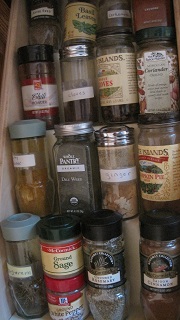 Prompts, multiple choice:
What food reminds you of the kitchen in the house where you grew up? Memories surrounding that food?
OR: What nourishes you?
Or: I grew up with . . .
Shel Silverstein’s Where the Sidewalk Ends “resonates because Silverstein wrote for the ear. Purposeful rhythm. Calculated pace. Challenging riffs. Delightful melodies. Words selected as much for their sound as their meaning.” —Jack Hamann, “For the ear — Writing with rhythm,” The Writer, July 2015
Tips to make writing stronger, inspired by Jack Hamann, “For the ear.”
Alliteration is a stylistic device in which a number of words, having the same first consonant sound, occur close together in a series: But a better butter makes a batter better.
Marlene’s Musings: Have fun with this. Choose a prompt and write. Then, revise, using the tips above.
How do you put the sensory detail of smell in writing? Let’s sniff out ideas.
Take a deep breath and imagine the smell of:
fresh lemons
watermelon
chocolate
coffee
fish – cooked, or freshly caught
roast turkey right out of the oven
popcorn – movie popcorn with melted butter
How would you describe these smells to someone who cannot smell or who never smelled these particular scents?
What does a crunchy red apple smell like? Does a red apple smell the same as a green apple? Does an apple smell different if it’s crunchy or mushy? If it’s cold, it might have that earthy smell of a river. Or an apple might smell like a hot summer afternoon in an orchard. Can you put apple smell into words?
If you can, walk through an orchard or a field where the earth has recently been plowed. Inhale. Describe that earthy smell.
What does a river smell like?
Describe fresh cut lawn.
What about describing smells for other things? What does” old,” ancient” and “calm” smell like?
Here are some ideas:
old . . . smells like parchment paper
ancient . . . smells like musty book
calm . . . smells like summer rain candle
But what does parchment paper, musty book and rain candle smell like? Can you describe these smells?
How about adding sounds:
“old” sounds like coughing and wheezing
“ancient” sounds like rattling breath
“calm” sounds like church . . . sitting in church
The following is from The Martian Chronicles by Ray Bradbury:
There was a smell of Time in the air tonight. . . What did Time smell like? Like dust and clocks and people. And if you wondered what Time sounded like, it sounded like water running in a dark cave and voices crying and dirt dropping down upon hollow box lids, and rain. Time looked like snow dropping silently into a black room or it looked like a silent film in an ancient theatre one hundred billion faces falling like those New Year balloons down and down into nothing. That was how Time smelled and looked and sounded.
A glorious line about smell: “The air took on its mossy evening smell.” — Elizabeth Sims, September 215 Writer’s Digest.
Your turn: How do you infuse smell in your writing? Tell us. We want to know.

Talking Writing features stories, poetry and first-person journalism.
Talking Writing is a nonprofit literary site that features essays, first-person journalism, and poetry. New material is published weekly, focusing on provocative themes.
” Great writing makes us want to sing or shout or argue, and TW’s innovative format opens virtual doors to readers and writers everywhere. As the publishing industry continues to transform itself online, Talking Writing exemplifies why luminous stories and well-executed journalism matter more than ever.”
Talking Writing magazine publishes four issues a year—Fall, Holiday, Winter, and Spring.
Submission deadlines for upcoming themes can be found in TW’s Editorial Calendar.
Holiday 2015 – Writing and Faith Submission Deadline: September 14, 2015
How do you tackle life’s Big Questions? During the holiday season, our annual faith issue will examine why writing is such a powerful tool for soul searching, creating meaning, and defining one’s spiritual beliefs.
