-
Just Write Magic Carpet Ride
 For inspiration to Just Write: Click on a topic below and you will arrive at a (hopefully) inspirational post. Just like being on a magic carpet ride!
The following are from the 2013 Just Write Posts
Gorgeous Writing by Melanie Thorne
Fabulous Character Sketch, Elizabeth Berg
Natalie Goldberg talks about writing practice
Twelve Steps to Successful Writing by Marlene Cullen
Amy Zhang and Your Scraps of Writing
How to get in the mood to write by Marlene Cullen
Don’t think. Don’t Plan. Just Write. Marlene Cullen
Natalie Goldberg’s Six Rules of Writing
Get Started. How to use prompts. Marlene Cullen
Pass On The Dream And Tell Its Truth – Natalie Goldberg
Elizabeth Berg demystifies how to describe characters
Debbie Macomber had so many rejections . . .
Writing about place, August Kleinzahler
Three top Pointers About Writing Personal Essay by Kelly Caldwell
One way to learn how to write, get a book in your genre by Marlene Cullen
-
The Blue Moon Literary & Art Review is ready for you
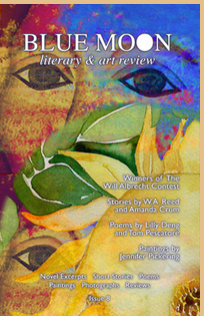 The Blue Moon Literary & Art Review publishes poetry and fiction of all genres, including literary fiction and murder mystery. They are especially interested in short stories and excerpts from novels in progress.
Click Submission Guidelines for complete instructions.
Something Unique with Blue Moon: Ever wonder why your piece wasn’t selected? Blue Moon offers a Critique Service: If (and only if) you would like a written critique of your work, include a $10.00 Critique Fee with your mailed submission.
What a deal!
-
Random Words #163
 Use these words in a freewrite:
elaborate, bitter, cool, leave, mist, arm, moon, bare, peach, vision
Post your writing on The Write Spot Blog.
-
Guest Blogger Jordan Rosenfeld reveals secrets of successful writers.
 Guest Blogger Jordan Rosenfeld: 5 Habits of Persistent Writers (That you can adopt, too).
Show me two equally capable writers and I’ll show one who succeeds at her publishing dreams and one who struggles. What’s the difference between them? And no, the answer isn’t luck, or “being born with it.” The writer who succeeds persists. What does this mean, precisely? We hear a lot about persistence–is it just a numbers game, where if you keep submitting the same story or novel eventually it will just magically land? No, that’s blind hope. Persistence is passion + commitment + practice. Below I’ll walk you through seven strategies for becoming a persistent writer, and I promise you the answer will not include self-immolation or losing sleep.
Find a Passion Root: One of the most amazing things about rose bushes is that they are notoriously difficult to kill by chopping or cutting. You can prune it down to a tiny little nubbin, and next season you’ll simply have a fuller, more glorious rose bush. You have to cut out its root, its heart, to kill such a persistent, gorgeous flower. We writers can take a lesson from the rose, even if it’s not your flower—if you can identify those qualities and reasons that make you passionate about your writing—whether you do it for work or pleasure—you will forge a root that is incredibly difficult to kill inside you despite the many vagaries of the field, from rejection to comments from trolls. You do this by identifying why you write, what it means to you, and how you can use it to serve yourself and others.
Set Boundaries: It took me nearly a decade to stop allowing interruptions to my writing time—answering the phone to friends in need, getting up to answer my husband’s shouted-across-the-house questions, or making overlapping commitments that would cut into my writing time. I don’t cancel on my clients, I don’t show up late to appointments, so why would I not treat my own writing time with the same respect? The more you build strong boundaries around your writing time, the more you train yourself and others to treat it with respect (and you’re more likely to get it done). But in order to do this you first have to do the next step:
Treat Creative Time as Work Time: When you sit down to write, especially when it’s NOT for work (but even if it is), you have the right to let your friends, family and pets know that you are no longer interruptible. Shut doors, put up “writer at work” signs, do whatever you can to approach your own writing with serious intent and others will follow suit. Not to mention, the only way to find inspiration is to show up and make time for it. Inspiration rarely comes in lightning bolts, but often comes when you prime the pump and let a little imperfect writing flow first.
Don’t be an Island: The mistake many of us make in this already isolated craft, is to do everything in isolation, perhaps to even take pride in this state of being. But you need the support of other writers who get what you go through, and their eyes on your work to see past your blind spots. I firmly believe in trusted allies you can kvetch to, seek cheerleading from, and rely upon for helpful but critical feedback.
Revise: Many of us writers are addicted to the fresh outpouring of a new draft—that’s the stage at which it feels like release, flowing out of us at last onto the page. And as much as we’d all like to produce finished work on the first try, there’s beauty in the revision process, which David Michael Kaplan calls “re-seeing.” Though you may feel a stab of fear at the idea of having to cut and pare, snip and trim, take comfort in the knowledge that even the NYT bestsellers have editors, and rarely is a piece of writing ever published that hasn’t been revised.
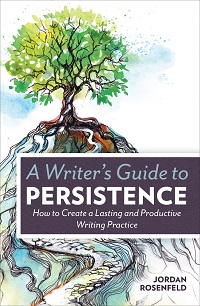 Jordan Rosenfeld is the author of A Writer’s Guide to Persistence, Make a Scene, Write Free (with Rebecca Lawton), the novels Forged in Grace and Night Oracle and the forthcoming novel Women in Red, and Writing Deep Scenes (with Martha Alderson). Her work has appeared in: AlterNet, Brain Child, Bustle, DAME, GOOD, Mental Floss, Modern Loss, New York Times, The Nervous Breakdown, Ozy, Role/Reboot, Rewire Me, Salon, the San Francisco Chronicle, STIR Journal, Sweatpants & Coffee, Washington Post, and The Weeklings.
 -
Hands. Prompt #162
Today’s Writing Prompt: Hands

-
“Not only is it OK to risk failure; it’s necessary.” Anthony Doerr
 Anthony Doerr, winner of the 2015 Pulitzer Prize for fiction, believes “We need to live with the fear that we will stink, that no one will pay any attention, that we will fall like trees in an empty forest: the fear that we are going to take our glorious, flawless, nebulous ideas and butcher them on the altar of reality.”
“Not only is it OK to risk failure; it’s necessary.”
Marlene’s Musings: Feel better now? If a Pulitzer Prize winner can think it’s okay . . . no, it’s necessary to fail. . . then let’s all fail. No worries about your writing. . . Go for it. Just Write!
Quote from “Costume Drama,” Real Simple magazine, October 2014.
-
Every day I fail.
“I’m a novelist. Every day I fail. My drafts — when I complete them, which is not often —are inevitably shadows of what I had hoped they would be.” — Anthony Doerr
Sound familiar? Writers often experience failure. . . whether it’s receiving rejection notices or failing to complete writing projects. But . . . to not try, really, is to fail. So, if you have unfinished short stories, plays, poems, manuscripts. . . dig them out, blow off the dust and see if you can get back into this project. If not. . . move on to a new piece of writing.
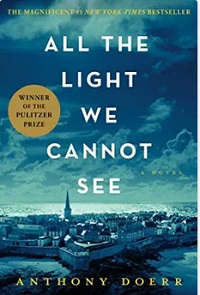 Anthony Doerr was awarded the 2015 Pulitzer Prize for fiction. And yet, he has doubts about his writing, just like the rest of us. “I can’t ever fully execute the glorious and inarticulable dreams in my head. Even on my best days, I just manage to cobble together the failures of many other days and assemble an imitation of the original vision. Only months later, once something is published, does it become plain to me how many failures I needed to accumulate to arrive at something that feels remotely complete.”
Marlene’s Musings: I know it’s hard to sit in chair sometimes and keep writing. But if you are a writer, or a want-to-be writer, that’s what you have to do. Get organized, get your water, settle yourself and . . . Just Write.
Quotes excerpted from “Costume Drama,” Real Simple Magazine, October 2014.
-
Why should you submit to literary journals?
Why should you submit to literary journals?
June 2015 issue of The Writer magazine answers:
“Even though many don’t offer payment, literary journals are a great way to get your writing’s foot in the editor’s door. Some writers may overlook smaller publications to concentrate on bigger projects, but doing so could be a mistake. Whether you’re looking to apply to an MFA program or want to build your publishing portfolio, publication in a literary magazine or journal can be a useful first step toward your dream career.”
For the next few Saturdays, I’ll post information about literary journals as places you can submit your writing. I welcome your comments and suggestions.
~Marlene
-
Tweak, form, shape and sculpt . . . Prompt #161
Choose one topic from below, these are prompts that have recently been posted here on the Write Spot Blog:
Prompt #158: If pets could talk
Prompt #159: Unforgettable
Also Prompt #159: Strange But True
Prompt #160: Only in America
Also Prompt #160: Happy Endings
Today’s writing prompt: After you have written a freewrite (from above list), write one line for every four sentences from that freewrite. Take out all unnecessary words.
Condense or distill your writing to the most important aspects.
Tweak, form, shape and sculpt until you have a poem. Then . . .
Submit to The Voices of Lincoln Poetry Contest.
 No fee to enter. You don’t have to be a resident of Lincoln to submit. Send by July 25, 2o14 Go for it!