Suffering from a creativity dry spell? Look to your nighttime dreams.

  • Suffering from a creativity dry spell? Look to your nighttime dreams.

    Guest Blogger Susan Audrey writes:

    I didn’t begin paying attention to my nighttime dreams until my dreamscapes started showing up in my waking life.

    The first instance was fairly benign: I dreamt of a man with dark hair, wearing a white, button-down shirt, standing to my right and talking on a pay phone (yes, this was awhile ago). And the next morning, after I dropped my kids off at daycare, I saw this exact scene: the same man, same hair, shirt, and pay phone. This really got my attention!

    I found out later that these are called precognitive or premonition dreams –– they show you the future. I wasn’t sure why this was happening at this time in my life. I was in my thirties and a single mom of two grade schoolers. It wasn’t until years later that I learned that our nighttime dreams are more abundant and more easily remembered during difficult and transitional times.

    Curiosity inspired me to read about, research, and train in dreamwork in the upcoming years, and most importantly, to keep a dream journal. I discovered that by exploring the images, metaphors, and feelings that emerged through my dreams, I had access to a wondrous, self-revealing and self-empowering stream of wisdom. One that’s always there –– and free! And, using this simple approach to cultivating “inner knowing” has helped me to better navigate my life and to get my creative juices flowing for all kinds of creative endeavors, including writing.

    Dreamwork helps us to jumpstart our creativity and keep it flowing in several ways. One is by providing a sort of emotional and physical house cleaning. The messages from our dreams can give us clues about how to work through emotional baggage we may be carrying, remedies that can heal our physical ailments, and ways we can let go of beliefs that may no longer serve us –– freeing us up to give our full attention and energy to embracing our creative sides. If we’re not obsessing about a love we lost or worrying about what to try next to soothe a backache then we’re more present when we sit down at our computer to write or in front of a canvas to paint.

    Our nighttime dreams also offer us an amazing resource for creating –– both as actual themes to work with or, metaphorically, as clues for how to proceed with our work. When we take actual images from our dreamscapes and write about or draw them, they come to life in ways we could never have imagined, revealing things about us we may have never considered. Yet, as we dive in to explore further, either with words or through visual art, what emerges can often feel quite familiar, like switching the light on in a forgotten room of a home we’ve always known. And rather quickly, we can find ourselves in that delightful and precious flow state from which our best creative work emerges.

    Viewed metaphorically, our dream images can also guide us in choosing subjects and approaches for our business writing and projects. We just need to do a little more digging to unearth these gems. For example, if you need to write a promotional piece or an article, you can “seed” your dreams the night before to discover how to start. This is an exercise in which you clearly ask for the information you are seeking by writing your request on a piece of paper and placing it under your pillow before you go to sleep.

    I know that to some, this may sound like an exercise in wishful thinking (one you might share with a child), but through years of experience working with dreams and much research in the approaches of renowned philosophers, psychologists, and authors, including pioneering dream analyst, Carl Jung, I’ve come to trust this process whole-heartedly and have seen amazing results transpire for clients and dreamwork circle participants as well as for myself. The answers to these nighttime inquiries will come, and they arrive in the form of metaphors, symbols, and, sometimes, strong emotions.

    For example, perhaps you’ve asked your dreams to tell you which approach you should take in writing a piece for a client, and a tiger walks through your dreamscape, slowly and methodically circling you. As you learn to work with your dream images and to trust the insights your dreams bring, you’ll learn to view such a scene as a clue, a suggestion as to how to proceed with your writing… slowly, methodically and going around and around your subject to see it at all angles. Or, the tiger itself could suggest the tone of your piece –– should it be colorful, lean, and wild? Should it be written from a hunter’s point of view (metaphorically, of course). You’ll know. Your gut and an inner aha! will be your guides.

    Dream images have led me to the best remedies for physical and emotional challenges; they’ve helped me to change my perspective about a situation to one that is more beneficial for all involved; they’ve provided a heads-up on future traumatic events, so that I could handle them with greater ease and skill, and they’ve kept my enthusiasm for life (and it’s many dimensions) alive. And, they continue to provide me with access to the infinite flow of creativity hidden in my unconscious and just waiting to break free.

    You can learn much more about dreamwork and how it can jumpstart your creativity at Susan’s Writers Forum presentation, “Learn How to Access Your Infinite Creative Flow Through Dreamwork,” on June 18, 2015, in Petaluma.

    Susan Audrey Susan Audrey is a multi-disciplined Dreamwork Practitioner who specializes in guiding individuals and groups through the fascinating and transformative journey of discovering the wisdom of their dreams. She has also worked as a writer and editor for various forms of media for over 20 years and is currently a writer for The Shift Network located at The Institute of Noetic Sciences in Petaluma.

    You can find out more about dreamwork at Susan’s Blog, The Night Is Jung.

     

  • Only in America or Happy Endings. Prompt #160

    Today’s Writing Prompt is either/or.

    Write about “Only in America.”

    Or write about “Happy Endings.”

    Today’s prompts are inspired by Voices of Lincoln Poetry Contest. Deadline: July 25, 2015.

    You don’t have to be a resident of Lincoln to submit to this contest, sponsored by Lincoln Public Library.

    Lincoln Library Poetry Contest

  • Inside myself is a place where . . .

    Inside myself is a place where I live all alone and that’s where you renew your springs that never dry up. — Pearl S. Buck

    Marlene’s Musings:  And that’s where writers come alive. . . from your imagination, you spin tales that inform, entertain, enhance and make life enjoyable. Keep writing!

    Pearl S. BuckSomething I just learned: Pearl Sydenstricker Buck, also known by her Chinese name Sai Zhenzhu, was an American writer and novelist. As the daughter of missionaries, Buck spent most of her life before 1934 in China. Thanks, Wikipedia!


  • What is a freewrite and what is a writing prompt?

    So. . . what is all this talk about freewrites and writing prompts? What does it all mean?

    A freewrite is a style of writing that is . . . well. . . freeing. The writer hears or reads a word, or a phrase, and just starts writing. Often a timer is set, so there is the “under the gun” feel of a deadline, a limited time to write.

    Click here for more information about freewrites.

    I post writing prompts writing prompts, on The Write Spot Blog. Sometimes the writing prompts are fun and playful. Sometimes they inspire memoir type writing. Other times they work well for fiction writing.

    Mostly the prompts are what you make of them. . . you can go light and stay on the surface, skating on the edge, or you can go deep.

    This type of writing is an opportunity to explore and perhaps come up with ideas for writing or . . . for solutions to situations. . . or for personal growth and transformation.

    Shed your ideas about what perfect writing means.   Give yourself permission to be open to whatever comes up. Writing isn’t always about talent, it’s about practice and going into another dimension. Rather than write for an audience, write from an instinctual level.

    Creative writing is an act of discovery. Immerse yourself in writing. Let go of your worries and write. Write to a satisfying inner desire to go to a meaningful place.

    Go deeper into the recesses of your mind and really write. Write from the well that stores the fears. Let the tears come, let your stomach tie up in knots. It’s okay to write the story that is difficult to tell.

    Get through the barriers to go to a deeper level. See your story and tell it.

    Want to practice this freewrite type of writing? Right now? Ready? Here ya go:

    Sorrento.Street

    Take an imaginary walk through your hometown and see what people and what places pop up. Take a few minutes to remember the smells, and notice what feelings come up as you walk through your town.

    Write what you remember about your town. Just write.


  • McSweeny’s Internet Tendency wants your humor

    McSweeny’s Internet Tendency is in the market for short, conceptual humor. “We strongly recommend reading through our archives to get a sense of the style of writing we’re after.”

    Editor Christopher Monks says, “We want to draw you [the reader] in quickly with a funny title and an easy-to-latch-onto concept.” Monks “looks for a mixture of lowbrow and highbrow humor, with reference to pop culture and current events.” — The Writer magazine, June 2015

    Length: 1,00 words is ideal

    Send: In the body of the email

    Payment: “There will likely be none. If there is any, it may come very late or in unusual currency.”

    Why you should submit to Tendency: “Writers don’t get rich writing for Tendency; however they often find their work reprinted on other literary websites.”

    Click here for submission guidelines.

  • Unforgettable, or Strange But True . . . Prompt #159

    Another prompt inspired by Voices of Lincoln Poetry Contest. Deadline: July 25, 2015

    Writing Prompt:  Unforgettable . . . or . . . Strange But True

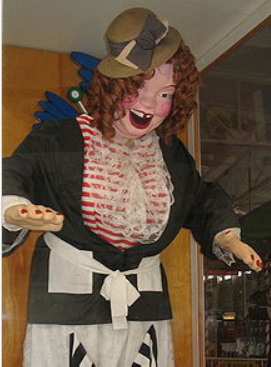
    Laffing SalLaffing Sal is “one of several automated characters that were built primarily to attract carnival and amusement park patrons to funhouses and dark rides throughout the United States. Its movements were accompanied by a raucous laugh that sometimes frightened small children and annoyed adults.”  Wikipedia

    One version of Laffing Sal currently resides at Playland-Not-At-The-Beach, which I had the “pleasure” of seeing and hearing recently at a friend’s birthday party.

    She definitely scared me as a child. I tried to avoid her when my family went to Playland-at-the-Beach in San Francisco, California.

  • How does someone become frightening to one’s self?

    Guest Blogger Ted A. Moreno: How You Became What You’ve Become

    I’m learning a new song on my guitar: “Africa” by the band Toto.

    One line of the lyrics intrigued me:  “I seek to cure what’s deep inside, frightened of this thing that I’ve become.”

    It’s never really explained in the song what that means. How does someone become something that is frightening to one’s self?

    Seems to me that it doesn’t happen all at once, of course.

    It’s more like the frog peacefully floating in increasingly hotter water until he is boiled, never aware of what’s happening so he never jumps out. Kind of like death by a thousand cuts.

    Perhaps a good word would be entropy: the gradual decline into disorder.

    How does someone become someone that they are not happy with?

    • It happens one extra cookie, or additional scoop of ice cream or portion of food at a time.
    • It happens one extra drink or cigarette at time.
    • It happens the day you decide you are not going to take that walk or go to the gym and then one day leads to two days, then three…
    • It happens when you don’t make that extra phone call, or send that card or that letter, or drop by to say hello and then that becomes the norm.
    • It happens when one day you don’t get up on time, arrive on time or leave on time, one day at a time.
    • It happens that one time when you don’t say I love you, or smile, or go out of your way to be generous. It’s easy not to do, so it can happen again and again.

    I heard a saying once “If you stand in sewage long enough, you can become comfortable with it.”

    We can become very comfortable with the gradual lowering of our standards for ourselves, the gradual lowering of our expectations, the lowering of our energy, stamina and strength.

    Then one day we step on the scale, or look at our bank account, or realize that our marriage or business is failing. Maybe the doctor tells us something we didn’t expect.  Or we end up in the hospital, or divorce court, or getting our kid out of jail. And we ask ourselves: How did I get here?

    Answer: One neglect, one bad choice, one wrong word, one bad habit, one “it doesn’t matter” or “didn’t get around to it” at a time.

    No one sets out to become unhappy, unhealthy, unmotivated, unproductive and unsuccessful. The problem all too often is, we neglect to keep our goals in front of us so that we choose each day to do what it takes to be happy, motivated, productive and successful. Sometimes we think that it will happen by itself.

    The good news is that the same principle that tears us down is the same one that can build us up: what we choose to do every single day.

    If you have accomplished anything, triumphed over anything, or become someone you are proud of, it happened every single day.

    Can you walk for 5 minutes a day?
    Can you hold out for one less cigarette a day?
    Can you make one phone call a week? Send a letter a month?
    Save a small amount of money each week?
    Can  up get up 5 minutes earlier each day? Go to bed 5 minutes earlier?
    Can you smile at one person a day?

    If you are able to do any of these, than you have power to become what you love, what you respect, what you admire. Success by the inch is a cinch, by the yard it’s very hard.

    Take steps to cure what is deep inside, whether it’s apathy, resignation, cynicism, or fear. Becoming who you want to be might only take a small action every day.

    Like the song says: “Hurry, it’s waiting there for you.”

    Ted A. MorenoOriginally published by Ted Moreno, April 9, 2015 Ted A. Moreno is a hypnotherapist, success performance coach, published author, educator and sought-after speaker who helps his clients become free from fear and anxiety, procrastination and bad habits such as smoking.


  • If pets could talk . . . Prompt #158

    Today’s prompt is inspired by Voices of Lincoln Poetry Contest. Deadline: July 25, 2015

    Bird by Breana Prompt:  If pets could talk . . .


    Photo by Breana Marie

  • Trust Your Instincts

    Gabriel Packard asked Bo Kaprall: What is the most important thing you’ve learned about writing? — The Writer magazine, June 2015

    Kaprall answered, “Probably the most important single thing I’ve learned about writing is to trust your instincts, because, especially with comedy, it’s so subjective. One person will love it; another person will hate it. Everyone seeks comments and reinforcement or criticism, but really you need to trust your instincts, and that’s harder for someone who’s new at it than someone who’s a little more seasoned.”

    Marlene’s Musings: I agree. When in doubt, listen to your “gut feeling.” Your instincts are right on . . . you just have to trust yourself. With that in mind, when working with an editor . . . listen to what the editor has to say . . . you don’t always have to agree, nor make the suggested changes. Just listen carefully, then go with what your instincts say.

    Bo KaprallBo Kaprall writes, directs and produces Saturday Night Live’s Weekend Update. He has written for The Carol Burnett Show, The Cher Show, The Partridge Family, Welcome Back Kotter, Laverne & Shirley and the Bob Hope Christmas Special, among other accomplishments.


  • Le rire mécanique

    If you want to write comedies, or include humor in your writing, you might want to know about “Le rire mécanique.” The phrase translates as “mechanical laughter.”

    I first came across this phrase in the June 2015 issue of The Writer magazine, in an article by Alicia Anistead.

    Anistead wrote about the French philosopher Henri Bergson and his theory that “whenever real life is suddenly interrupted by a mechanistic imposition, like the banana peel, it is disruptive and triggers laughter.” Bergson called this “le rire mécanique.”

    Bergson developed a theory of how laughter is provoked and described the process of laughter (in particular portrayals by comics and clowns) as “the caricature of the mechanism nature of humans (habits, automatic acts, etc.).” Wikipedia

    Anistead ends her article with a quote by Harvard professor Bob Scanlan, “It [le rire mécanique] pounces on you and catches you unexpectedly. That’s why the pratfall is so perfect. Why that makes us laugh? Nobody knows. But Bergson thinks it’s the interruption of things, a subversion of life as it’s proceeding on its own.”

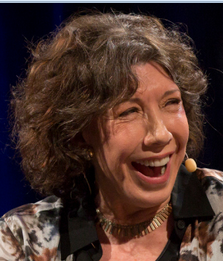
    Lily TomlinMarlene’s musings: I just finished watching Episode 11, Season 1 of Grace and Frankie on Netlix. Now you know my secret vice . . . (not a secret anymore!). The dialogue in the final scene between Jane Fonda’s character (Grace) and Lily Tomlin’s character (Frankie) was hilarious, brilliant and as in le rire mécanique . . . completely unexpected. As my belly laughing turned to snorting, I thought about what made this comedic scene so successful. It was the unexpected.  If you have seen it. . . let me know. Did you like it? I don’t want to go into detail because I don’t want to spoil the surprise for people who haven’t seen it. I’ll just say Frankie’s revelation still has me in stitches.

    Your turn. . . think about Abbott and Costello, the Three Stooges, I Love Lucy, Carol Burnett, Rowan and Martin’s Laugh-In, Lily Tomlin . . . the pratfalls, the unexpected vignettes. . . le rire mécanique. Write a scene that includes a comedic aspect. Just write!