What is memoir good for?

  • What is memoir good for?

    Writing is the way I try to make sense of my life, try to find meaning in accident, reasons why what happens happens. Sometimes just holding a pen in my hand and writing milk butter eggs sugar calms me. Truth is what I’m ultimately aftertruth or clarity. Writing memoir is a way to figure out who you used to be and how you got to be who you are.  — Abigail Thomas, “Thinking about Memoir,” AARP magazine, July/August 2008

  • North American Review

    “As the oldest literary magazine in the nation, our selected works reflect the breadth of the American experience, and encompass any voices that are committed to telling rich narratives that challenge the status quo.”

    From North American Review’s website:

    “We read during the academic year. We close during university breaks. The North American Review is the oldest literary magazine in America (founded in 1815) and one of the most respected. We are interested in high-quality poetry, fiction, and nonfiction on any subject; however, we are especially interested in work that addresses contemporary North American concerns and issues, particularly with the environment, race, ethnicity, gender, sexual orientation, and class. We read during the academic year. We close during most university breaks. The submission fee helps us defer a small portion of our printing and distribution costs.
     

    We like stories that start quickly and have a strong narrative arc. Poems that are passionate about subject, language, and image are welcome, whether they are traditional or experimental, whether in formal or free verse (closed or open form). We publish all forms of creative nonfiction, from personal narrative to lyric essay to immersive journalism; we appreciate when an essay moves beyond the personal to tell us something new about the world.”

    Submission Guidelines

  • Responsibilities . . . Prompt #472

    What responsibilities did you have as a child?

    What was required of you from the adults in your life?

    What responsibilities do you carry over from your childhood?

    What responsibilities do you want to give up?

    You are free to write whatever you want, using these prompts to spark ideas.

  • Receive allowance? Prompt #471

    As a child, did you get an allowance?

    If yes, how much? What did you spend it on?

    If you didn’t receive an allowance, what did you do for spending money?

    If you didn’t receive spending money, do you wish you had? What would you have spent it on?

  • If you could change . . . Prompt #469

    If you could change anything in the world, it would be . . .

    Or . . .

    The time I felt most changed in a single second was when . . .

    Use one or both writing prompts. Just write!

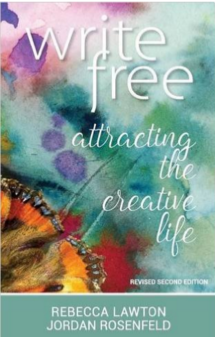
    Prompts are inspired from Write Free – attracting the creative life, revised second edition by Rebecca Lawton and Jordan Rosenfeld.

  • Ninth Letter

    Ninth Letter publishes one issue in the spring and one in the fall and accepts submissions of fiction from September 1 to November 30 and from January 1 to February 28 (postmark dates)

    We are accepting submissions of poetry and essays from September 1 to February 28 (postmark dates). 

    We are interested in prose and poetry that experiment with form, narrative, and nontraditional subject matter, as well as more traditional literary work.

    Please adhere to the guidelines when submitting your work to Ninth Letter.

    Ninth Letter pays $25 per printed page, upon publication, for accepted material, as well as two complimentary copies of the issue in which the work appears.

  • Bella Mahaya Carter & The Priority Pyramid

    Today’s guest blogger, Bella Mahaya Carter offers inspiration with a “Priority Pyramid.” The following is an excerpt from her original post.

    Last November, I worked with Dan Blank, author of Be The Gateway: A Practical Guide to Sharing Your Creative Work and an Audience. In his book, Dan recommends an exercise to help creative professionals get clear about their life and work priorities.

    If you’d like to try this exercise, get fifteen index cards and write down one word on each card indicating what’s important to you. Then prioritize your cards into a pyramid, with your most important priority at the apex, and work down from there. These cards are a wonderful reminder of what matters if you lose your way. Each person will obviously have different words on their cards.

    Here’s what mine looks like:

    For me, a deep spiritual connection with Self comes first. When I lose that I’m like seaweed tossing in the ocean, and life feels disorienting, even painful. After that my priority is my family and also my writing. While the importance of family is obvious, it’s not always been easy for me to explain why my writing holds such a high priority in my life. The best way to describe it is to say that writing enhances my connection with my True Self. It helps me remember who I am.

    Many of my students and clients tell me that writing is also foundational in their lives. It helps them navigate their days with greater clarity and grace, stay grounded, identify and release limiting thoughts, express joy, share stories, and reimagine what’s possible.

    It’s useful to look at priorities independently, but also in relationship to one another.

    I’ve added “I believe” statements to my “pyramid landscape” to remind me why I do what I do.
    I believe in the power of writing to heal and transform lives, and I view publishing and book promotion as opportunities to deepen self-awareness, nourish meaningful connections, and delight in peak experiences while being of service.
    I believe in authentic, creative self-expression.
    I believe that we all have access to unlimited creativity.
    I believe miracles happen when we consciously choose love over fear.
    I believe suffering is not the price of admission to a creative life.
    I believe that freedom and peace of mind are available when we look in the direction of our own innate wisdom.

    I agree with Natalie Goldberg, who, in her book, The True Secret of Writing: Connecting Life with Language, says “you can anchor your mind with your breath, but also you can anchor your mind with pen on paper.”

    But perhaps the most reliable “anchor” of them all is love, which, ironically, is also the ideal launching pad. The best of what gets created through us comes from love.

    This index card—the oldest of my bulletin board relics which I wrote around age six—sat for years beneath a sheet of glass that protected my mother’s mahogany sewing machine table. Mom put in long hours there. It was a palace of creation and love—and so was she!

    I had no clue when I wrote this all those years ago that as an adult I’d need to keep reminding myself to be guided by love rather than fear. Old habits may die hard, but they pass more peacefully—and lose their power over us—when we see them for what they are and let them go.

    Love is patient and kind, and it allows us to start over and reinvent ourselves. Again and again.

    As I sorted through the items I removed from my bulletin board, two of them went right back up. I wasn’t ready to clear these messages. One says, “Listen,” and the other says, “The only time is NOW!” I don’t know about you, but I need reminders like these.

    I’ve also left a lot of blank space on my bulletin boards to create room for what’s coming.

    Writing Circles begin January 29th. Enroll here.

    I have two openings for private coaching clients. Let me know if you’d like to work with me one-on-one.

    I wish you a new year filled with health, happiness, creative expression, and love.

    Thanks for being part of my journey.

    Blessings and gratitude, Bella

    Click to read Bella Mahaya Carter’s original post.
  • It’s a miracle . . . Prompt #468

    Today’s writing prompt:

      It’s a miracle . . . 

    Write whatever comes up.

    Write whatever pops into your head.

    Don’t judge. Don’t edit. Don’t be critical.

    Just write!

    It’s a miracle . . .

  • Jeff Goins & His System

    Today’s guest blogger, Jeff Goins, shares the system he uses to write books and blog posts. 

    Excerpt from Jeff:

    Most writers think writing is a one-step process . . . it’s a three-step process: coming up with ideas, turning those ideas into drafts, and then editing those drafts into publishable pieces.

    The Three-Bucket System . . . how I get my writing done.

    Bucket #1: Ideas

    Capture ideas [and keep] in a place where you can return to.

    Bucket #2: Drafts

    Pull an idea out from the first bucket and start writing. Save in a draft folder.

    At any given time, I have a whole bunch of half-finished chapters and blog posts on my computer begging to be edited and completed.

    The point of this system is to think as little as possible and just do the next thing.

    Bucket #3: Edits

    Pull out one of those drafts and edit it. Either schedule it for a blog post or tuck it away in another folder called “Finished pieces.”

    These are pieces of writing that are more or less ready for the world to see.

    Putting it together

    1. Collect Ideas. Shoot for five ideas. Write down a sentence or a phrase. Just enough to save the idea.

    2. Write and Save.

    When it’s time to write, pull one of those ideas out of that first bucket.

    When you’re done, put this piece in the “drafts” folder and save it for later.

    3. Edit and Publish.

    Edit the draft. Then move it to bucket three, maybe even publish it on your blog or wherever. Then go to bucket one to pull out a new idea and start writing again.

    Do this every day, and you’ll never run out of writing topics. You’ll never run out of things to edit and publish. You’ll never have writer’s block again.

    As long as you remember: writing is not one thing. It’s three things.

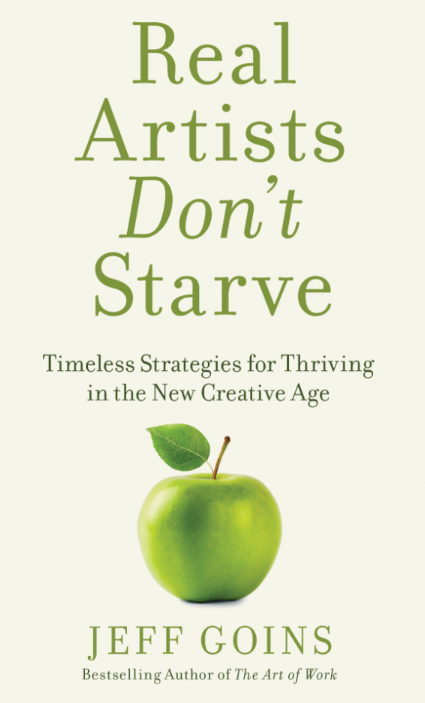
    Jeff Goins is the best-selling author of five books including the The Art of Work and Real Artists Don’t Starve. He shares his thoughts on writing, life, and creative work on his blog.

    Click here to read “The System I Used to Write 5 Books and Over 1,000 Blog Posts” by Jeff Goins.