How to be a better writer

  • How to be a better writer

    Many of us want to learn how to be better writers. The answer is very simple:

    WRITE. Write some more. Keep writing.

    It’s true!  The more you write, the better writer you will become.

    Here are some things you can do to improve your writing.

    READ. Read whatever you like to read. Read the genre you are writing in. Read other genres.

    BE SPECIFIC. ’57 Bel Air Chevy, not car. Sycamore, not tree.  Foxtrot, not dance.

    USE STRONG VERBS. Keep a list of strong verbs in your writer’s toolbox for easy reference.

    Resources for strong verbs

    Thesaurus in any format: Paper, on your computer, internet.

    Books:

    Vex, Hex, Smash, Smooch: Let Verbs Power Your Writing by Constance Hale.

    Strong Verbs Strong Voice by Ann Everett

    Websites:  Tip Sheet Using Strong Verbs  and Writing Tips: Use Active, Precise Verbs

    WRITING MAGAZINES often have article to improve writing: Writer’s Digest, The Writer, Poets & Writers.

    WORKSHOPS & CLASSES: Internet search on “writing” will yield a variety of results for writing workshops: Day-long, weekend, conferences, writing teachers online. If you add your city or county to your search, results focus on writing activities in your area. Consider UCLA Extension online classes.

    The Sonoma County Literary Update is an amazing compendium of writing resources.

    Summary, how to be a better writer

    • Write.
    • Read.
    • Be specific.
    • Employ strong verbs.
    • Peruse writing magazines.
    • Attend workshops and classes

    Pen, gold background


    Whatever methods you use . . . Just Write!

  • The 2River View

    2River View

    The 2River View is an online publication of poetry, published four times a year. 2RV also has a video project.

    Reading Period for seasonal issues:

    Sept. 1 – Nov. 30                      Winter Issue

    December 1 – February 28     Spring Issue

    March 1 – May 31                     Summer Issue

    June 1 – August 31                   Fall issue

    2River considers unpublished poems only; poems that have not appeared in any form of print or digital media, including personal or public blogs.

    Simultaneous submissions can cause problems. If you are uncomfortable with a wait of up to three months, rather than sending simultaneous submissions, consider submitting toward the end of the reading period.

    Before submitting, please read several issues of The 2River View. The poems there best indicate the 2River standard. Each issue of 2RV consists of 10 poets only, and usually there are more than three-hundred submissions for each issue. [Note from Marlene: You could be one of those 10 poets!)

    2River is unable to pay authors for poems accepted.

    Good Luck!

  • What’s under your bed? Prompt #202

    frog2-150x150Today’s prompt: Write about the monsters under your bed.

    Oh, you don’t  have any monsters under your bed?

    Well then, what’s in your closet?

  • What is the scariest season?

    The Halloween season has passed and the holiday season approaches, the time of good cheer and good will. This might be the scariest season for some. Ted A Moreno’s guest blog post might help shoo away our fears.

    Guest Blogger Ted A. Moreno writes about “31 Scary Questions to Ask Yourself.”

    It’s all about scary this week as we approach Halloween and Day of the Dead. 

    It’s a time when it’s fun to be scared, as long as we know that it’s just a movie, or someone dressed up as the walking dead.

    Truth is, there are plenty of really scary things out there.  But by far, the scariest things are those that we hide from ourselves, the things that we are afraid to deal with.

    Unresolved issues that haunt us, pain we can’t seem to release, resentment that traps us in unhappiness. These are the monsters under the bed, the goblins that we spend so much energy keeping locked in the closet, for fear of what they might do if looked at them.

    Of course,  once we turn on the bedroom light, look under the bed and throw the closet door open, we find that there is nothing to fear.

    Shining the light of our awareness on those things that we don’t want to deal with allows us to see them clearly. Then we can take the opportunity to clean them up or straighten things out.

    Asking yourself a few scary questions can help you transform an unseen ghoul into Casper the Friendly Ghost. (Who really just wants to lend a helping hand.)

    Ask yourself these 31 scary questions and see if any of them make you a little freaky. If so, perhaps you are starting to exorcise some demons! Keep asking yourself those questions and see what comes up.

    31 Scary Questions to ask yourself. (Note from Marlene: You can also use these questions to discover more about your fictional character.)

    1. Am I happy?
    2. If I’m not, am I waiting for something to happen to be happy?
    3. Is it possible for me to decide to be happy now?
    4. Do I know what I want?
    5. Have I given up on getting the things I  want that are truly important to me?
    6. What fear keeps me from living the life I want?
    7. Have I become cynical, negative, or resigned?
    8. Do I like myself?
    9. Am I able to quickly name 10 great things about me?
    10. Am I taking care of myself?
    11. If no, do I feel I’m worth taking care of myself?
    12. Am I getting the love and attention I want and need?
    13. Do I have fun regularly?
    14. Do I have fulfilling social interactions?
    15. Am I expressing myself honestly and authentically?
    16. Is there someone I need to forgive?
    17. Is there resentment burning inside of me  that I need to resolve or express in a healthy, productive manner?
    18. Is there a negative belief that I need to  release or let go of?
    19. Is there a change I need and should make NOW?
    20. Why am I here?
    21. Is there a valid reason for the things that I am doing that are stressful and overwhelming?
    22. Am I giving me the me time  I need?
    23. Do I have regular moments of peace, calm and tranquility?
    24. Do I have frequent feelings of gratitude?
    25. Do I complain a lot?
    26. Do I hang around negative people that bring me down?
    27. Is my work meaningful and fulfilling?
    28. Do I compare myself to others and find it creates despair?
    29. Am I caught up in a lifestyle that I  feel is not meaningful to me?
    30. Am I happy with the answers I have to these questions?
    31. If not, what can I do today to change?

    Perhaps a few of these scary questions brought up some stuff. You might not be able to answer some of these scary questions in the way you feel you should or would like to.

    If so, copy those scary questions and paste them into a word or notepad etc. document. Delete all the questions that don’t have an emotional charge for you. Keep deleting until you have about 5 or 10 of the biggest, baddest scary questions that are giving you the heebie jeebies.

    Now keep these questions where you will see them. Maybe write them down on a 3×5 card and carry them around with you. Keep asking yourself these scary questions with awareness so that you can move beyond fear, negative self- judgment and shame and into the possibility of changing the answers.

    For instance, to the question: “Do I like myself?” you might answer “No! I don’t! And it really sucks! I hate that I don’t like myself! 

    See if you can move into non-judgment: “OK, I don’t like myself. I’m probably not the only one. I’m not a terrible person because I don’t like myself. But I want to like myself. So what can I do to begin to like myself?” 

    See how many of those scary questions you can bury by committing to some action. Bless and release old ways of being that no longer serve you and that are ready to be laid to rest. Then continue on your journey, a little more confident, on your way to an attitude of gratitude.

    Need some help on your journey? You can contact Ted A. Moreno by clicking here.

    Originally published by Ted A. Moreno, October 2014

    Ted A. MorenoTed A. Moreno is a hypnotherapist, success performance coach, published author, educator and sought-after speaker who helps his clients become free from fear and anxiety, procrastination and bad habits such as smoking.

  • Hope . . . Prompt #201

    HopeToday’s writing prompt is inspired by Ron Salisbury’s poem “The Ride Southbound.” When the writing prompt is a poem, you can write about the title, a line or a word. You can also write about Hope. Just write whatever comes up for you.

    The Ride Southbound by Ron Salisbury

    When I jerked open the cab door, Hope was sitting in the back seat,

    Prada dark glasses and lip gloss.  This is mine, she said,

    but we can share until 34th street. What’s at 34th street? I asked.

    Just a sale at Macys.  The driver put my two-suiter in the trunk

    and the extra bag on the front seat, I climbed in with my briefcase

    and umbrella.  Is it gonna rain? she asked.  You never know,

    I answered.  What’s with all the bags? It’s been a long trip.

    You need all that stuff?  Most of it, at least I thought I did.

    The traffic on 7th Avenue slowed then didn’t, other cabs

    cut us off, it was noisy, complicated, but we were there

    in no time at all.  Haven’t we met before? I asked.  Probably,

    she said.  I meet a lot of people.  Did we like each other?

    Hard to say, she answered.  She leaned over and tapped

    on the window behind the cabbie.  This is where I get off.

    Good luck wherever you’re going. Standing on the sidewalk,

    holding the door open, she said, Look at this, and hiked

    her skirt to show me a small purple birth mark on her thigh.

    I can’t always be perfect.

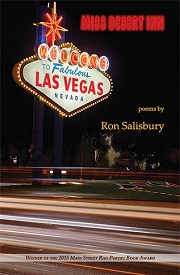
    Ron Salisbury is the author of the recently published Miss Desert Inn. He writes and studies in San Diego State University’s Master of Fine Arts program, Creative Writing.

  • Concept is simple, execution is difficult.

    Once again, I’m embarking on a new food plan. I’ve done this one before and lost a ton of weight. Then I slipped into old habits and all that weight I released came drifting back.

    This time, it feels like . . . scratch that. . . It is a lifetime change. I’m eating very simply: lean protein, most vegetables, some fruit and a little grain. Minimal processed food.

    It’s a very simple concept, yet hard to execute. It takes determination and keeping my eye on the goal: being healthy.

    It’s a lot like writing. Many of us want to write but either don’t have the time or don’t know how to start.

    Right now about 56,000 writers are participating in National Novel Writing Month (NaNoWriMo). When you come up for air, NaNoWriMo Campers . . . let us know how you managed to fit writing time into your busy lives.

    For the rest of us, here’s an idea: Take inventory.

    Make a list of all that you do in a day. Write down everything. Include daydreaming time, Facebook browsing, meals (planning, shopping, preparing, cleaning after), cleaning house, laundry, shopping, work, commute and so on. Everything. When you are done, set your list aside (but don’t forget about it. Okay, forget about it for a day or two).

    Next: Plan for a time to go over your list when you won’t be interrupted. Get out of the house if you need to. You really need some thought-full time for this next step.

    And be honest. You’ll only set yourself up for failure if you aren’t honest here.

    You can use highlighters, colored pencils, stickers or symbols to categorize your activities.

    Highlight/mark things that you have to do. No negotiating with these items. Maybe a red pencil will be good for this. Or check marks. Or star stickers. Or hand-drawn stars.

    Next: Use a colored pencil or marker to underline or highlight the things that bring you joy. Don’t give up activities. Joy in your life is very important.

    Now, perhaps the hardest one: Put a line through activities that you don’t have to be doing. Can you give up the areas that are stressful or cause unhappiness? Be as honest as you can. You probably can’t eliminate all these items, but perhaps you can modify. Brainstorm how these unpleasant things could be accomplished quickly or with a positive attitude. Perhaps when you cook a meal, prepare enough for two meals. And if you don’t like to cook, crank up music, or listen to an inspiring podcast.

    Continue with categorizing your list: Cross off anything that has no meaning for you. These are the “shoulds.” Things you think you should be doing. . . but really, do you have to keep doing them? If not, cross off.

    Now, go back through your list. What can you let go of to achieve your goal of writing? Maybe it would be more fulfilling to write than watch TV or scroll through Facebook or play a computer game. Maybe you could get up earlier, stay up later to write. Perhaps you could write during work breaks, or lunch time. This isn’t forever. . . just a break from these activities so you have time to write.

    Lolita.200If you want to write and don’t have a particular topic in mind, or if you need a warm-up (like stretching before exercising), take a look at this list of prompts or jump on the magic carpet and select one of these prompts. Settle on a prompt and write.

    Be determined and keep your eye on your goal.  Just Write!

  • Take note.

    It’s early Monday morning. The day is just getting started and it’s very quiet. The softly falling rain has hushed all ambient noises. No cars drive up our country lane. People are still sleeping on this soft-feeling day, not quite ready to begin the busyness of our lives. Even the birds are quiet this morning.

    And I’m wondering, do you want to write? Do you contemplate ideas to write about as you stay in bed just a little longer in the morning? Do you have brilliant, awesome thoughts for writing while you are driving? As you wait for sleep to settle in, do these brilliant ideas swirl in your head? And they are brilliant, I am sure.

    You tell yourself you will remember everything until you have time to write. Finally, you sit down to write and those creative ideas seem to have vanished. You stretch to grasp your dazzling insights, but now they are elusive.

    If only you had made a note to jog your memory.

    What to do?

    Lightbulb.Great Idea Keep a notebook and pen handy.

    Jordan Rosenfeld suggests keeping a notebook and pen in every room. Rayne Wolfe suggests keeping a notebook in your back pocket. Why not? Oh, you don’t wear jeans with back pockets? How about a shirt pocket? Or a pocketbook (isn’t that a funny word for purse?). Keep a notebook or recording device your car. Use only when it’s safe, of course.

    You can also use technology to track of your ideas: Tablets, a Notebook (the computer kind), recording devices, Evernote, your smartphone, digital slates. Probably before I can tap the “publish” button for this post, there will be more gadgets available.

    So next time, you sit down to write, dig out your note-leaving device and pick up where you left off. That is, if you can read your writing. Sorry, I can’t help you with that. I can barely decipher my scribblings.  Just write!

  • Main Street Rag Publications

    Main Street Rag PublicationsLiterary Magazines, Anthologies, Book Publishing, Contests.

    Main Street Rag Literary Magazine

    Fiction/Creative non-fiction:    Please EMAIL THE IDEA FIRST. Main Street Rag will tell you whether the subject appeals to them and if there is space for it. Prefer social or political themes over How to, process pieces or literary pieces about the life of a literarian.

    Images: Need high resolution to print, but require low resolution to submit.” If you don’t know the difference, you’re not ready to have your work published.” We like it all—no subject taboo—but if you are targeting cover art, we like people doing what they do, street scenes, a world in motion. Send us a picture we can hear and smell.

    Interviews: Prefer interviews with those in the arts—mostly literary—but visual and performing arts will also be considered.

    Poetry: Up to 6 pages of poetry. That can mean one long poem or as many as 6 one-page (or shorter) poems. No more than one poem per page. Any style, any subject, emphasis on edgier material, but we’re not interested in the graphic details of your love life and we do enjoy a good laugh now and then–so just send your best material and let the rest sort itself out. We prefer work that is alive with the poet’s own experiences.

    While we do not publish much in the way of formal poetry in our magazine, we will consider it. In that regard, we like to see formal poems that maintain the integrity of the form without becoming stiff, uninteresting or losing their vitality.

    Click on the subject to find out about: Anthologies, Book Publishing, Contests

    Main Street Rag

  • Suicide Doors . . . Prompt #200

    Today’s writing prompt is a poem by Ron Salisbury. You can write on the theme of the poem or the mood. You can use a line or a word for the writing prompt. Ready? Read and write. Just write, without  worrying how your writing will sound.

    Suicide Doors

    Don’t put that in a poem, she said.

    What? Don’t put what I said in a poem.

    We talk and a week later I find what I said

    in one of your poems. What’s the matter

    with that? He’ll find out. He doesn’t read

    poems. His friends will tell him. His friends

    don’t read poems. Just don’t put me in your poems.

    How about I make it in the 1960’s

    and it happens in my 1951 Merc with suicide

    doors, I got a D.A. haircut, smell of Bay Rum

    and your angora sweater comes off on my sport coat.

    Then what happens. Well, we could be in love.

    We already are. I mean the crazy 60’s love

    before birth control pills and we both smoke

    and sneak bourbon from your father’s liquor cabinet

    and try to figure out how to get some Trojans

    because they’re not in every grocery store

    and you have to ask the druggist for them

    because they’re kept behind the counter

    like cigarettes are now and because

    he knows everyone in town, it’ll get around

    so we drive all the way to Dexter on Saturday

    night and I’ll try to be cool and see if

    I can buy some and if I can’t we’ll take

    our chances anyways. Do we do it in the

    back seat? Yeah, the Merc had a giant

    back seat. And you won’t use any thing

    I said in the poem. Sure. Ok, but

    bring a blanket and you have to go slow

    and give me time to hang my sweater

    over the seat so it won’t get ruined.

    Ron SalisburyRon Salisbury, author of Miss Desert Inn, (Main Street Rag Publications) lives in San Diego, CA, where he continues to publish, write and study in San Diego State University’s Master of Fine Arts program, Creative writing. Publications and awards include: Eclipse, The Cape Reader, Serving House Journal, Alaska Quarterly Review, Spitball, Soundings East, The Briar Cliff Review, Hiram Poetry Review, A Year in Ink, etc; Semi Finalist for the Anthony Hecht Poetry Prize – 2012, Finalist for the ABZ First Book Contest – 2014, First Runner-up for the Brittingham and Pollak Prize in Poetry – 2014, Winner of Main Street Rag’s 2015 Poetry Prize.

  • So you’ve earned that MFA, now what?

    Guest Blogger Ron Salisbury talks about MFA – Master of Fine Arts writing programs.

    Everywhere I go, I’m asked if I think the universities stifle writers. My opinion is that they don’t stifle enough of them. There’s many a best seller that could have been prevented by a good teacher.”–Flannery O’Connor

    Flannery may be a little tough but not far wrong. What will you do with your MFA in poetry or fiction or non-fiction or children’s literature? Is it different from what you thought you would do before you started that MFA program?

    The proliferation of Master of Fine Arts Writing Programs in the United States (some 200 as of this writing) requires new crops of students every year; cannon fodder, inductees to charge over the lip of the trench into the guns of Admission Departments and Student Loans without much chance of becoming that famous author, a goal which is implied but never stated by these programs. (Is that what you thought you’d learn at that program?)

    When I started my MFA – Poetry program in 2013, I had few of those allusions given my age (70) and narrative style of poetry. I was not going to be offered that tenure track teaching position in some MFA program. At best, I would get some adjunct position. (the typical pay for a semester class as an adjunct is $2000 to $3000 with no guarantee of any future work) And would hope to worm my way into the hearts and pockets of the program directors and students. Last year the United States graduated approximately 2,000 poetry MFAs, 2,000 fiction and between 500 to 1,000 non-fiction and other. And there were less than forty tenure tract creative writing positions available in those universities and colleges. But, I did naively expect that in my program I would be among poets striving to become better poets. What I have mostly found is a cadre of wonderful people learning “how” to write poetry. My observations have been generally supported by other writers in other programs throughout the United States.

    To  satisfy the body count necessary for these 200+ programs, the threshold has been considerably lowered. If your goal is to teach in an MFA program, anecdotally, minimal requirements today are the MFA degree and two published books at least. If one or both books were contest winners, so much the better. Given the proliferation of book publishing options today such as high quality appearing print-on-demand and self-published, the vetting process for MFA instructors—ones skilled and with enough notoriety to attract students—has become more difficult for universities. It used to be just a book from a good publisher and you could be considered, then it became the book and the MFA. Now the field is murky. Which has led to an entirely new phenomenon, the PhD in Creative Writing which has begun to propagate much as the MFA programs did fifteen-twenty years ago (today, about 32 programs). It would not be a surprise to discover in less than ten years that the minimum requirement to be considered as an instructor in an MFA program is the book or two and the Creative Writing PhD. So, if you have a goal to obtain an MFA in Creative Writing and do more with it than hang it on your wall, continue to work at Starbucks or teach two classes of freshman composition at some Junior College, hurry.

    Your Turn: Should you or shouldn’t you join an MFA program? Have you done it? What do you think? Weigh in. Post your writing on The Write Spot Blog.

    Miss Desert Inn. Salisbury.180Ron Salisbury lives in  San Diego, CA where he continues to publish, write and study in San Diego State University’s Master of Fine Arts program, Creative Writing. Publications and awards include: Eclipse, The Cape Reader, Serving House Journal, Alaska Quarterly Review, Spitball, Soundings East, The Briar Cliff Review, Hiram Poetry Review, A Year in Ink, etc; Semi Finalist for the Anthony Hecht Poetry Prize – 2012, Finalist for the ABZ First Book Contest – 2014, First Runner-up for the Brittingham and Pollak Prize in Poetry – 2014, Winner of Main Street Rag’s 2015 Poetry Prize

    Miss Desert Inn published November 2015.