Sy and Editing

  • Sy and Editing

    Sy Safransky has this to say about editing:

    Readers sometimes ask how much I edit my own writing.

    I edit until each paragraph has lost the ten pounds it gained over the winter.

    I edit until each sentence can survive three days in the wilderness on its own.

    My father taught me to look at a sentence and, if it didn’t deserve to live, shoot it between the eyes. 

    Sy Safransky, The Sun Magazine, May 2011

  • Hold or carry. Prompt #511

    Like Prompt #510, this prompt is also inspired by Lin-Manuel Miranda, besides being an amazing lyricist, he is the author of Gmorning, Gnight!: Little Pep Talks for Me & You which came from his Tweets.

    Jonny Sun said Lin should make the tweet comments into a book.

    Lin asked Jonny, “Why would I write a book when you can get this free?”

    Jonny, the person who became the illustrator for the book, answered, “Because people like to hold things.”

    Prompt: What do you like to hold or carry?

  • Next Avenue Online Journal

    Next Avenue is a nonprofit journalism website.

    Next Avenue is extending an invitation to share your story (for those over the age of 50).

    We are seeking original essays with an insightful perspective on aging.

    Every day on Next Avenue, we tell the stories of what makes us different and where we share commonalities. It is our hope that readers will glimpse themselves in someone else’s story; find a nugget of information they need; or discover a fresh perspective on an issue relative to aging.

    We’re looking for insightful essays that illuminate a truth or teach us something new.

    As the pandemic persists, and life continues to swirl around all of us in unexpected ways, perspective has taken center stage. You may have discovered there has been more space for quiet, like the calm in the center of the storm. Perhaps the quiet is not always welcome, but it is there. In the quiet, opportunities for reflection, for finding perspective, can emerge.

    Stories are waiting to be told.

    From July 24 through August 31, 2020, readers age 50+ may submit a 500-word original essay focused on a topic or experience of your choosing. 

    Beginning on July 24, you may submit your work here. One submission per person, please.

    We’re looking for insightful essays that illuminate a truth or teach us something new.

    Share a personal perspective with fellow readers about what it means to “act your age.” Tell us how you have found resilience in difficult times. How has growing older surprised you?

    What is the story you want to tell?

    The Next Avenue editorial team will select 12 essays, representing a diverse collective of voices, for publication on the site this fall.

    The 500-word format should be strictly followed; longer essays will not be considered.

    Be sure to check spelling, grammar and punctuation before submitting your essay.

    Please give your piece a title.

    We are looking for engaging and well-crafted personal narratives.

    Next Avenue Editor’s note: The Joy of Writing by Elizabeth Berg, a New York Times bestselling author, is the first in a series of essays in conjunction with Next Avenue’s Telling Our Stories initiative, inviting readers to submit their own personal essays.

    Elizabeth wrote on Facebook:

    “Okay, all you would-be writers! This is your chance! Take a look at this invitation to submit essays. I would like to point out that this is exactly how I got my start as a published writer, by entering an essay contest. Good luck to all of you!”

    Note from Marlene: You can’t win if you don’t enter.

    Berg’s essay begins with:

    “There I was, a nine-year-old girl with a bad pixie cut, sitting at my card table desk, drinking pickle juice and writing a poem meant to inspire rapture and envy in every reader’s heart. It wasn’t much of a poem, though I thought it was terrific. I mailed it to American Girl magazine and waited for my acceptance check (of about a million dollars, I figured) to arrive. Then I was going to buy my father a Cadillac.

    The poem was swiftly (and rightly) rejected, and so wounded was I that it took another 25 years before I submitted anything. By then, I was a registered nurse wanting to find a job that would let me stay home with my daughters. So I entered an essay contest in Parents magazine, won it and went on to write essays for many magazines. I moved on to short stories, then books. I’ve now published over thirty books, I’m long past the usual retirement age, and still I keep on. Why?”  continue reading.

    Note from Marlene: Even if you don’t submit your writing, there are a lot of ideas for writing prompts at Next Avenue.

  • What do you need to hear? Prompt #510

    This prompt is inspired by an interview with Lin-Manuel Miranda, an American composer, lyricist, actor, singer, rapper, producer, and playwright. He composed music for Moana, and starred in Mary Poppins. He is possibly best known for creating and starring in the Broadway play, Hamilton.

    He is the author of Gmorning, Gnight!: Little Pep Talks for Me & You which came from his Tweets.

    Jonny Sun said to Lin, “You should make these tweet comments into a book.”

    Lin replied, “Why would I write a book when you can get this free?”

    Sun, the person who became the illustrator for the book, answered, “Because people like to hold things.”

    Lin’s tweets came from asking himself, “What do I need to hear right now?”

    Prompt: What do you need to hear right now?

  • Performance. Prompt #509

    Write about:

    ~ A performance you were in, or a performance your fictional character was in.

    Or:

    ~ A live performance you will always remember.

  • Storytelling: Family Secrets

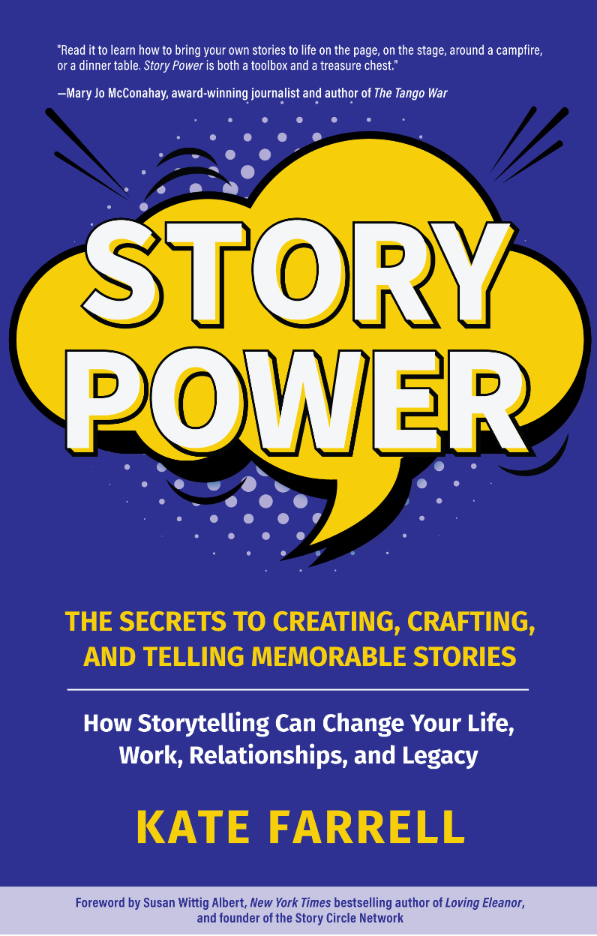
    Today’s Guest Blogger, Kate Farrell, author of Story Power, with her unique experience as a storyteller, shares methods to unlock family secrets,

    There’s nothing louder than a family secret—it pesters and pokes until someone speaks up. Secrets have a way of hiding in plain sight. There are always the whispered rumors, missing pieces of a puzzle, stories that keep changing. But just as shared family folklore can develop strength and identity, keeping family secrets can destroy trust. Secrets that persist, unspoken and misunderstood, can erode the very foundation of a family. Family members who are perceptive, who sense hidden truths, may become fearful or internalize guilt and shame. At the very least, family secrets isolate—family members from one another and the entire family from their community.

    Some family secrets are more harmful to keep than others. Those that were traumatic, that violated some taboo, or were life-changing are vital to expose. Some of these important secrets can only be shared privately, within the family, and only with members old enough to understand. Certainly, by the time most children reach adulthood, they ought to know most of the essential family secrets that were kept from them, yet influenced their lives in ways both known and unknown.

    When considering the sensitive nature of family secrets, a storyteller should proceed with care. There will be those in the family who will never accept the truth, once exposed. And there will be those members who will feel relieved or validated by newly discovered stories that make sense of a puzzle. It can be a powerful healing process for many. Of course, there will also be relatives who find family secrets fascinating and telling them juicy entertainment. As a family member and storyteller, it’s often a challenge to share family secrets in a responsible, but enduring way.

    As you ponder what secrets you’ve learned about your family, either from relatives or from research, choose the ones whose revealed truth meant the most to you. Which ones contributed most to your identity, and resolved issues that had once confused you. Select the ones with the most personal impact to shape into stories and tell, to store in notebooks or to record. As you share these, other family members might be encouraged to share theirs.

    Exercises & Prompts: Family Secrets & Shadows

    Prompts: Shadows

    1. Think of a family member in the past who was shunned or forgotten
    2. Remember someone who brought shame to the family
    3. Recall a family member in past generations who committed a wrong
    4. Remember someone who was wrongly accused
    5. Think of a family member who was judged by an outdated taboo
    6. Remember a relative who was flawed or found lacking
    7. Think of a time when you were judged or the family thought less of: what happened?

    Prompts: Secrets

    1. What are the worst family secrets?
    2. Which ones were committed three or four generations back?
    3. What secrets were kept by your grandparents’ generation?
    4. What secrets were kept by your parents’ generation?
    5. What secrets were yours or your siblings?
    6. Are there secrets still hidden by your family today?
    7. What secrets of yours do you want to share with your family?

    Let all these memories and stories play in your mind’s eye as you search for one story to tell. Select one that has a clear structure with a beginning, middle, and end. Choose one that has a conflict, a problem, suspense, tension, or an adventure.

    Freewrites

    Freewrites, or stream of consciousness writing, might reveal new thoughts and perhaps uncover information and present answers that haven’t been previously discovered.  With freewrites, personal experiences emerge for your writing. Writing prompts can be used to inspire writing. Prompts can be a word, a phrase, a picture, a sound, a smell, a line from a book or a poem. Set a timer for fifteen minutes to corral your writing time. Choose a prompt and start writing.

    Freewrite Example: Family Secrets

    Marlene Cullen employs the practice of free writing or “freewrites” with great success and has shared it with many writers over the years. It is also called timed writing and the results are unpredictable, creative, and at times, surprising. It’s one sure way to reach into the shadows to a family member whose status in the family was diminished, as Marlene does with her father. By letting her mind probe a theme without judgement, she reveals her own feelings, ones she’s kept under wraps for a lifetime. Start, as Marlene does, with a prompt about family secrets and see where your free writing takes you. Use a freewrite to explore the secrets and shadows within your own family.

    “Meeting My Father”

    Marlene Cullen

    I have always had a hard time describing how my father didn’t fit into our family. He was a merchant seaman, away from home for months. He brought home exotic toys, and clothes for me and my sisters, always too small.

    “I have the perfect family. A daddy, a mommy, and two little girls.” I knew I wasn’t telling the truth to my second grade playmates, but if I pretended hard enough, maybe it would come true.

    When my father was home, it meant he was out of work, and could be found at one neighborhood bar or another. I have a child’s handful of memories about my father—none of them are good. The best I could say was that he was a “Third Street Bum.” He died when he was thirty-seven of alcohol related diseases. I was sixteen.

    When I was fifty-four, through a series of serendipitous happenings, I met my father’s high school best friends. They painted a picture of him as a happy-go-lucky kid. They said Bill was a quiet guy, a gentleman, a prankster, and very sensitive. Seeing my father through the eyes of his teenage friends introduced me to the person I never knew.

    Sloshing my way through freewrites, I realized my father was more than a person with an alcohol problem. He was a husband and a father, a loving son, and a loyal friend, struggling to navigate the challenges of life.

    Several free writes about my father evolved into a story revealing my epiphany about him, published in The Write Spot: Memories. My insight concludes: “He is a part of me, imperfections as well as the good parts. He is part of my granddaughter who shares his hazel-colored eyes.” Without freewrites, my father would have remained a “lesser” person in my mind.

    Kate Farrell, storyteller, author, librarian, founded the Word Weaving Storytelling Project and published numerous educational materials on storytelling.

    She has contributed to and edited award-winning anthologies of personal narrative.

    Farrell recently completed a how-to guide on the art of storytelling for adults, Story Power: Secrets to Creating, Crafting, and Telling Memorial Stories, released by Mango Publishing.

    She is past president of Women’s National Book Association, San Francisco Chapter.

    Kate blogs at Storytelling For Everyone.

  • Today I trust. Prompt #508

    I usually like to include a photo or an image with the writing prompts. It usually takes me longer to find an image than to create the prompt.

    Today’s writing prompt is multiple choice:

    What image would you use to go with this writing prompt?

    Or: What song lyrics would you use for this prompt? You can create your own song lyrics, or use a song you know to write about.

    I’m thinking of “You Raise Me Up,” by Josh Groban.

    Writing Prompt: Today I trust.

    Just Write!

  • Guest Blogger Nancy Julien Kopp and The Writing Fairies

    Guest Blogger Nancy Julien Kopp writes about her struggles and success with Good Fairy/Bad Fairy.

    2012

    I’ve had a story swirling in the recesses of my mind for several weeks. One that I think would work for a Chicken Soup for the Soul book. Last night, I opened a blank page in Word and began to write the story.

    I wrote for well over an hour. The story seemed to be coming together nicely. I was aiming for 1200 words, and by the time I was ready to call it quits for the day, I had over 700 words and still a lot to be told. I didn’t take time to read over what I’d written, knew there would be time to do that in the morning.

    I got ready for bed, feeling satisfied that more than half the first draft was complete. I settled down in bed to watch the news but while the news anchor and weatherman jabbered on about the day’s events, something began to gnaw at me. My story!

    I knew that the story wasn’t right but what, I wondered, was wrong with it. I mentally replayed what I’d written, and the answer came. The first two paragraphs were fine, but the rest of it went into background that threatened to take over the original story. It would overshadow the original premise. Maybe I’d find a solution the next day.

    Then the Bad Writing Fairy whispered that it would be a shame to lose all those words that I’d so painstakingly written. “Leave it the way it is and keep going.” The Good Writing Fairy rapped her over the head with her Writer’s Wand. but smiled sweetly at me. Then she said, “Dump all except the first two paragraphs and keep going.” I knew which one I should heed. I pushed both fairies off my pillow and decided to sleep on their advice.

    The next day there was no doubt in my mind that I had to begin the story again. The first thing I decided to was to delete more than 500 words, no matter how much it hurt. There was no reason to sabotage my own story with words that didn’t belong.

    A good many stories that are published look nothing like the first draft. It’s a practice round to help a writer know what direction to go. We begin and often begin again. Writing isn’t easy. Well, maybe the Bad Writing Fairy might tell you it’s a piece of cake, but the Good Writing Fairy is going to remind you that it’s hard work but well worth the effort.

    2020
    If you listen to that Bad Writing Fairy too often, you’ll become a lazy writer. Sometimes she talks loud enough to make you pay attention. You’ll be a lot better off paying attention to the Good Writing Fairy. She will push you in the right direction because she wants you to be the best writer ever.

    I was in that Bad Fairy/Good Fairy situation once again. I had a YA story that was finished. Well, maybe it was. It could end in two different ways. I chose one, then finished the story. But the Good Fairy kept tapping me on the shoulder with her wand. I knew she wanted me to write the second possible ending, then decide which one would work best. The Bad Fairy must have been hiding somewhere. I didn’t hear her say to use what I had and forget about writing the best ending.

    I know it pays to listen to each of those little nymphs, then make an adult decision.

    The Good Fairy is way ahead in scoring points. 

    Nancy Julien Kopp lives in Manhattan, KS where she writes creative non-fiction, fiction for children, personal essays, articles on the craft of writing, and poetry. She has been published in 22 Chicken Soup for the Soul books, newspapers, magazines, and ezines, and several anthologies including The Write Spot: Possibilities (available in both print and as an ebook at Amazon).

    Nancy was Prose Writer of the Year in 2013 by the Kansas Authors Club.

    She blogs at Writer Granny’s World With Nancy Julien Kopp with tips and encouragement for writers.

  • Happiest moments . . . Prompt #507

    What were your happiest moments last week? or last month? or last year?’

    You can also write on the opposite:

    Most annoying, frustrating, angry moments of last week, or last month, or last year.

  • I want to tell you about . . . Prompt #506

    If you want someone to understand you, what would you tell them about your past?

    Imagine a room full of people, they are looking at a speaker behind a podium. They want to know more about the topic. In a way, they want to be entertained.

    They are talking about you.

    Who knows more about you than you?  Who best to celebrate the essence of you, than you? 

    Write about you . . . Provide enough information so the people in that room have a clear vision or impression of you and your life. 

    Prompt: I want to tell you about . . .